
About Charles Samba Sissoko
Lived 1932 – 2000 (aged 68). Charles Samba Sissoko was a Malian politician and minister.
Charles Samba Sissoko, also spelled Cissoko or Cissokho was a Malian soldier and politician who served as Minister of Defense after the 1968 Malian coup d'état and as Minister of Foreign Affairs from 1970 to 1978. Sissoko was known for being the "intellectual of the CMLN".
Biography Sissoko was born on January 5, 1932, in Kaolack, French Sudan (now part of Senegal).
At the time of the 1968 Malian coup d'état, Sissoko was commanding an army base in Tessalit. He was one of the few putschists not at in Kati at the time of the coup; Moussa Traoré had sent a plane to pick Sissoko up in Tessalit and bring him to Kati. His appointment to Minister of Defense came as a result of the deletion and instatement of new ministries in late 1968; the Ministry of National Defense led by Henry Corenthin became the Ministry of Defense, and the minister was ranked the third-most important figure in Mali. The putschists tried to arrest Moussa Traore and Yoro Diakité, while taking advantage of the fact that Sissoko was on a diplomatic visit to Moscow. He also spoke against the American-backed détente during the Cold War, saying that true détente required a relaxation of Cold War rivalries worldwide. Sissoko, during a visit to Nouakchott and Dakar in the wake of the Faramana conflict, organized an OAU meeting to end the conflict. This succeeded after Malian president Traore and Upper Voltan president Sangoulé Lamizana met in Lomé. Sissoko, throughout the brief border conflict, asserted Malian diplomatic dominance over Faramana.
During the Events of February 28, 1978, Bagayoko, Dembele, and Doukara were all arrested by Traore on allegations that they were plotting to overthrow him. Sissoko was not present for these events, but was arrested immediately after returning to Mali from a mission in Tripoli, Libya. Sissoko was alleged to have been the head of state had the coup plot succeeded. He was stripped of his rank of colonel and made a 2nd class private, and sentenced to hard work in the Taoudenni concentration camps. He was released in 1983.
Sissoko died on July 18, 2000, in Bamako.
Videography Sissoko speaks at the United Nations, 1974
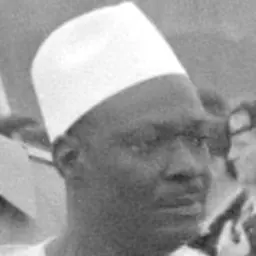
Photography Sissoko in 1968, location unknown Sissoko in Belgium, 1968
Don’t just read it —
keep it.
Full-length biographies made to live with: read them, listen on the way to work, watch them tonight.
- E-book
- Audio
- Video
Instant download · yours to keep · every purchase keeps this site free
Important facts
People in Charles Samba Sissoko's life
Named in this biography and alive at the same time


Related people
Same field, nearest in time






Contemporaries
People whose lives overlapped Charles Samba Sissoko's


Frequently asked questions
Who was Charles Samba Sissoko?
Malian politician
When was Charles Samba Sissoko born?
Charles Samba Sissoko was born on 5 January 1932.
When did Charles Samba Sissoko die?
Charles Samba Sissoko died on 18 July 2000.
What was Charles Samba Sissoko's occupation?
Charles Samba Sissoko was a politician and minister.
What nationality was Charles Samba Sissoko?
Charles Samba Sissoko was Malian.
Sources & further reading
· Wikipedia: Charles Samba Sissoko
· DBpedia: Charles Samba Sissoko
Cite this page
APA: Biography.guide. (2026). Charles Samba Sissoko. https://biography.guide/charles-samba-sissoko/
MLA: "Charles Samba Sissoko." Biography.guide, https://biography.guide/charles-samba-sissoko/.
Chicago: "Charles Samba Sissoko." Biography.guide. https://biography.guide/charles-samba-sissoko/.
Data last updated: 2026-09-20 · Spot an error? Report a correction.
Page generated 2026-09-27 05:14 UTC