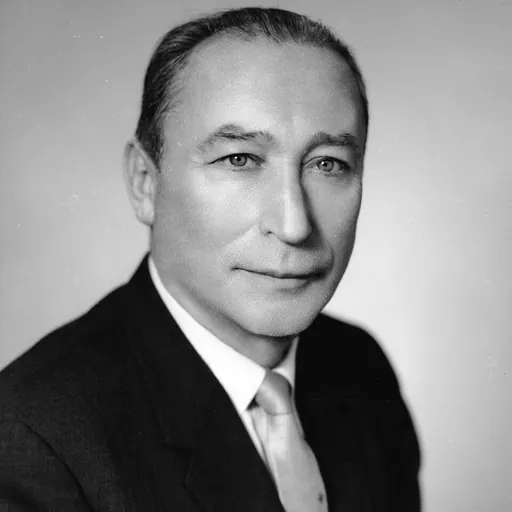
About Charles S. Zimmerman
Lived 1896 – 1983 (aged 86–87). Charles S. Zimmerman was an American trade unionist.
Charles S. "Sasha" Zimmerman (November 27, 1897 – June 3, 1983) was a Ukrainian-American socialist activist and trade union leader, who was an associate of Jay Lovestone. Zimmerman had a career spanning five decades as an official of the International Ladies Garment Workers Union. During the early 1970s, Zimmerman and Bayard Rustin were national Co-Chairmen the Socialist Party of America and the Social Democrats USA.
Biography Early years Charles S. Zimmerman was born of Jewish parents as Alexander Ubsushone in 1896. Alexander, known to family and friends as "Sasha," was born in the Ukrainian shtetl of Talne, then part of the Russian Empire. Sasha's father died when he was 7 and his widowed mother opened up a small grocery store and candy shop to support Sasha, his two siblings, and her mother. Sasha was raised in large measure by his grandmother, an Orthodox Jew.
Sasha emigrated to the United States in 1913 at the age of 16, where he joined a sister in living with an uncle in New York City. It has been alleged that Sasha had his name changed to Charles Sasha Zimmerman by an official at Ellis Island upon arrival and he was thereafter known by this new moniker Charles quit and took a job in the burgeoning New York garment industry making knee-pants, a position which allowed him to continue his studies in the evening. Pay for the immigrant workers was low and conditions poor in the New York sweatshops. Within a year, the young Zimmerman had helped to form a union local and had led a three-week strike of his fellows for better wages. After less than a year, Zimmerman again found himself unemployed, and he returned to work in the garment industry, working in a factory in New Jersey.
Political career Leaders of the Needle Trades Workers Industrial Union address striking workers 1929.Left to right: P. Goodman, Sascha Zimmerman, Ben Gold, and Louis Hyman. In 1916, Zimmerman joined the International Ladies' Garment Workers' Union (ILGWU), and was elected chairman of his shop within a few weeks. Zimmerman was stripped of his position due to his Communist political affiliation in 1925.
During the period in which he was excluded from the ILGWU, Zimmerman was influential in establishing the Needle Trades Workers Industrial Union, a dual union sponsored by the Communist Party's Trade Union Unity League (TUUL) and affiliated with the Red International of Labor Unions (RILU). Zimmerman's expulsion from the Communist Party in 1929 led to his expulsion from the NTWIU in 1930,
Zimmerman was in Moscow on party business in association with RILU in May 1929 at the time of the decisive showdown between Lovestone and his associates with the Communist International. The Comintern's was at the time attempting to solve the unceasing and bitter factional war in the American Communist Party by equalizing factional strength in the party leadership and reassigning factional leaders Lovestone and Alexander Bittelman to Comintern work abroad, decisions which the Lovestone majority group deeply resented. Zimmerman soon found himself expelled from the organization along with Lovestone and most of the others in his circle for their defiance of the Comintern's instructions.
Zimmerman joined with Lovestone in establishing the Communist Party (Majority Group), an organization which underwent a series of name changes before eventually emerging as the Independent Labor League of America in the late 1930s. He was among the initial members of the governing National Council of the CPMG.
In 1933, Zimmerman was asked by the retiring manager of Local 22 to run for his post. The election was held on April 6, 1933, with Zimmerman elected manager by a narrow margin, receiving 396 votes out of 825 cast in a three-way race. Zimmerman remained in this position heading Local 22 of the ILGWU for the next 40 years, retiring only in the early 1970s.
In the middle 1930s, with the ultra-radical "Third Period" at an end in favor of the coalition-building of the "Popular Front," the official Communists were persuaded to drop their dual union activities and to rejoin the ILGWU. Communist Party loyalists contested the "Lovestoneite" Zimmerman's leadership of Local 22 for a number of years, without success.
As a national leader of the ILGWU, Zimmerman proved a loyal supporter of union head David Dubinsky, supporting the affiliation of the union to the Congress of Industrial Organizations in 1935 and backing Dubinsky's decision to withdraw from the CIO in 1938 in order to return to the American Federation of Labor (AFL), a decision made in the face of particularly bitter opposition from official Communists in the union.
During the years of the Spanish Civil War, Zimmerman led a trade union campaign to aid the Spanish workers and civilian populations in Spain who suffered under shortages of food, clothing, and medicine. The initial impulse for this fund-raising work was an appeal that came to Dubinsky and the ILGWU from secretary general Walter Schevenels and president Walter M. Citrine of the International Federation of Trade Unions, which had established a Labor Solidarity Fund for the relief work. In response the ILGWU took the lead in founding the Trade Union Red Cross for Spain, with Zimmerman as chairman, Dubinsky as treasurer, and Alex Rose, of the Hat, Cap, and Millinery Workers Union, as secretary. Promoting the humanitarian effort as support to Spanish labor in the fight against fascism, the union leaders raised $125,000 by May 1937. The relief organization was later renamed Trade Union Relief for Spain, and remained in existence through early 1939.
By the end of the 1930s, Zimmerman had come over to lending the Roosevelt Administration and its New Deal policies his full sympathy and support. In January 1939 he sent a telegram to William Green, president of the American Federation of Labor, accusing "conservative forces in Congress" of "organizing to prevent enactment of new social legislation" and of acting "to worsen the unemployment situation by cutting down WPA appropriations." Zimmerman called for a national conference bringing together representatives of the AFL, the CIO, and the railway brotherhoods as a means of establishing "united labor action" to defend the Rooseveltian policies.
Along with his political allies David Dubinsky and Jay Lovestone, Zimmerman emerged as a prominent anti-communist "Cold War liberal" in the years after the conclusion of World War II. Early in 1946, Zimmerman was dispatched to Europe on behalf of the Jewish Labor Committee to make a survey of the political situation on the ground there. Zimmerman made his report on his trip in April 1946, detailing his perspective on Scandinavia, France, Poland, and Germany. Zimmerman was particularly concerned that in the zone of divided Germany controlled by the Soviet Union, Communist unionists were receiving five times the amount of newsprint allotted to the Socialists, thus making them far better able to advance their views. Zimmerman's son Paul was the famed football writer for the weekly magazine Sports Illustrated. Zimmerman's papers are housed at Cornell University in Ithaca, New York.
Footnotes
Publications American labor faces the future; the problems of trade unionism in the light of the San Francisco general strike. New York, Dressmakers union local 22, I.L.G.W.U. 1934 The labor movement and the NRA: the standpoint of progressive unionism. New York, Dressmakers union local 22, I.L.G.W.U. 1934 Our Union at work; Summary report of the executive board of Dressmakers Union, Local 22, I.L.G.W.U., for the year April 1933 to April 1934 New York, Dressmakers union local 22, I.L.G.W.U. 1934 Report on the medical administration of sick benefits to Dressmakers' Union Local 22 of the International Ladies' Garment Workers' Union for the year 1935. New York, Dressmakers union local 22, I.L.G.W.U. 1936 Probable effect of the war on the New York women's garment industry and some recommendations: report by a special committee of the International Ladies' Garment Workers' Union. New York: Jewish Labor Committee 1942 In freedom 's cause. Report Antidiscrimination department Jewish Labor Committee [of the] 1957 Biennial Convention, Atlantic City, N.J. New York: Jewish Labor Committee 1957
Don’t just read it —
keep it.
Full-length biographies made to live with: read them, listen on the way to work, watch them tonight.
- E-book
- Audio
- Video
Instant download · yours to keep · every purchase keeps this site free
Important facts
People in Charles S. Zimmerman's life
Named in this biography and alive at the same time



Related people
Same field, nearest in time




Contemporaries
People whose lives overlapped Charles S. Zimmerman's



Frequently asked questions
Who was Charles S. Zimmerman?
American activist
When was Charles S. Zimmerman born?
Charles S. Zimmerman was born in 1896 in New York City.
When did Charles S. Zimmerman die?
Charles S. Zimmerman died in 1983.
What was Charles S. Zimmerman's occupation?
Charles S. Zimmerman was a trade unionist.
What nationality was Charles S. Zimmerman?
Charles S. Zimmerman was American.
Sources & further reading
· Wikipedia: Charles S. Zimmerman
· DBpedia: Charles S. Zimmerman
Cite this page
APA: Biography.guide. (2026). Charles S. Zimmerman. https://biography.guide/charles-s-zimmerman/
MLA: "Charles S. Zimmerman." Biography.guide, https://biography.guide/charles-s-zimmerman/.
Chicago: "Charles S. Zimmerman." Biography.guide. https://biography.guide/charles-s-zimmerman/.
Data last updated: 2026-09-23 · Spot an error? Report a correction.
Portrait: Wikimedia Commons · author & licence
Page generated 2026-09-27 05:05 UTC