
About Charles Ranken
Lived 1828 – 1905 (aged 77). Charles Ranken was a British chess player.
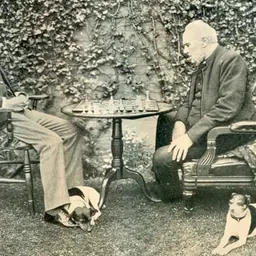
Charles Edward Ranken (5 January 1828 – 12 April 1905) was a Church of England clergyman and a minor British chess master. He co-founded and was the first president of the Oxford University Chess Club. He was also the editor of the Chess Player's Chronicle and a writer for the British Chess Magazine. Ranken is best known today as the co-author of Chess Openings Ancient and Modern, one of the first important opening treatises in the English language.
Education and religious career Ranken was born in Brislington, near Bristol, on 5 January 1828, son of Rev. Charles Ranken Sr.
In 1867, Ranken became vicar at Sandford-on-Thames and lived at Oxford. Census records reflect that she was born in Pendleton, Greater Manchester, was 14 years Ranken's junior, and that they married sometime between 1861 and 1871, and had at least three children: daughters Francis (born c. 1871) and Emily (born c. 1876), and son Herbert (born c. 1878). Ranken died at Malvern on 12 April 1905.
Chess tournament career
Ranken was a leading member of a group of clerics who played a prominent role in early Victorian Era English chess. In addition to Ranken, these included the Reverend George Alcock MacDonnell, John Owen, William Wayte, Edmund Thorold and Arthur Skipworth. Mike Fox and Richard James remark that, "The English parsons were a talented mob; presumably quiet country parishes in the nineteenth century gave one the leisure needed to become a star." However, Philip Sergeant in his book A Century of British Chess writes that, "In chess he was one of the writing rather than the fighting clergy, and his delight lay most in analysis".
Despite Sergeant's characterization, Ranken played in a number of tournaments in Britain between 1851 and 1895. After leaving Oxford, he played in the provincial section of the great London 1851 tournament, finished second behind Samuel Boden. By 1859, the Chess Player's Chronicle ranked him the best English player outside London. He played in many congresses organized by the Counties Chess Association. He had another excellent performance in 1881, when he won the 16th British Counties Chess Association Congress in Leamington, scoring 8 of 9 possible points, ahead of Revs. Owen (7.5 points) and Wayte (7 points). In 1877, he won the Counties Chess Association handicap tournament at Birmingham.
At the 1883 London Vizayanagaram minor tournament, Ranken "started well but his health gave way after the first week". Curt von Bardeleben won with 21.5 points; Isidor Gunsberg, who would narrowly lose an 1890–91 World Championship match to Wilhelm Steinitz, finished fourth with 19 points.
Ranken also participated in several correspondence chess matches and took first place in the British Chess Association's 1872 competition.
Chess writing
Ranken next became a member of the staff of the British Chess Magazine (BCM), which began publication in January 1881 under the editorship of John Watkinson. There, Ranken specialized in analysis of the opening, middlegame and endgame. For example, the March 1898 issue featured his analysis of the Rice Gambit. In 1897, the BCM published his article Chess Reminiscences in the Victorian Era, in which he wrote, "With great defects he had great virtues; there was nothing mean, cringing, or small in his nature, and, taking him all in all, England never had a more worthy chess representative than Howard Staunton."
Ranken is remembered today as the co-author, with Edward Freeborough, of the opening treatise Chess Openings Ancient and Modern, a precursor of Modern Chess Openings. It was one of the first opening books written in columnar form: columns of move-sequences thought to constitute best play, presented in chess notation and concluding with a symbol indicating the analyst's assessment of the final position (such as "equal", "White wins", or "advantage to Black"). The book also set forth a number of general principles, many of which are still valid today. Specifically referring to the analysis in Chess Openings Ancient and Modern, Grandmaster Robert Byrne wrote in a 1991 New York Times chess column, "Ingenious strategies and tactics were tried out in the old days, and if your opponent knows them and you don't, you are in for a pounding." Likewise Fischer, in his famous book My 60 Memorable Games, annotating an Evans Gambit that he had won against Reuben Fine, cited analysis from the 1893 edition of Chess Openings Ancient and Modern as an improvement on Fine's ninth move.
Notable games
For another game between these players, see William Wayte.
Don’t just read it —
keep it.
Full-length biographies made to live with: read them, listen on the way to work, watch them tonight.
- E-book
- Audio
- Video
Instant download · yours to keep · every purchase keeps this site free
Important facts
People in Charles Ranken's life
Named in this biography and alive at the same time







Related people
Same field, nearest in time


Contemporaries
People whose lives overlapped Charles Ranken's



Frequently asked questions
Who was Charles Ranken?
British chess player (1828-1905)
When was Charles Ranken born?
Charles Ranken was born on 5 January 1828 in Brislington.
When did Charles Ranken die?
Charles Ranken died on 12 April 1905 in Worcestershire.
What was Charles Ranken's occupation?
Charles Ranken was a chess player.
What nationality was Charles Ranken?
Charles Ranken was British.
Sources & further reading
Cite this page
APA: Biography.guide. (2026). Charles Ranken. https://biography.guide/charles-ranken/
MLA: "Charles Ranken." Biography.guide, https://biography.guide/charles-ranken/.
Chicago: "Charles Ranken." Biography.guide. https://biography.guide/charles-ranken/.
Data last updated: 2026-09-20 · Spot an error? Report a correction.
Page generated 2026-09-27 04:59 UTC