
About Charles R. Forbes
Lived 1878 – 1952 (aged 74). Charles R. Forbes was an American politician.
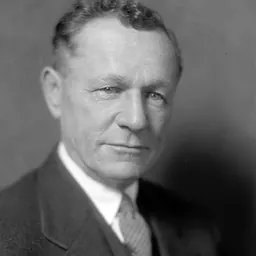
Charles Robert Forbes (February 14, 1877 – April 10, 1952) was a Scottish-American politician and military officer. After serving in the United States Armed Forces and having fought on the Western Front of World War I, Forbes participated in Warren G. Harding's successful bid to become president of the United States. Forbes was appointed the first director of the Veterans' Bureau by President Harding on August 9, 1921, and served until February 28, 1923. His tenure was characterized by corruption and scandal, including cases in which he embezzled money and took bribes. After being pressured into resignation by Harding, he was convicted of fraud and served jail time. He died in 1952.
Early life Forbes was born February 14, 1877, in Scotland. As a child, he and his parents emigrated to the United States and the family lived in New York and Boston. When Forbes was 16 years old, he joined the Marines as a musician, and was eventually stationed at the Washington Navy Yard. Trained as an engineer, Forbes attended Phillips Exeter Academy, the Cooper Institute in New York, Columbia University, and the Massachusetts Institute of Technology. Two months after enlisting in the U.S. Army in 1900, he was charged with desertion but restored to duty without a trial. Forbes served in the Philippines after completing his enlistment and was honorably discharged from the Army in the rank of sergeant first class in 1908.
Pacific Northwest and Hawaii
After leaving the Army, Forbes engaged in construction work in the Pacific Northwest, moving to Seattle, where he became active in state politics. He married and had a daughter. In 1912, Forbes and his family moved to Hawaii, at that time a United States territory, and worked at the Pearl Harbor naval station as an engineer for the next five years. While in Hawaii, he served in four federal government appointments: as Commissioner of Public Works, Chairman of the Public Service Commission, Chairman of the Harbor Commission and chairman of the Reclamation Commission, appointed by President Woodrow Wilson. While in Hawaii, Forbes became acquainted with vacationing senator Warren G. Harding, a meeting that would eventually change both of their lives. His charismatic personality and hospitality created a positive impression with Harding, and soon the two became close friends,
Forbes' final promotion was to the rank of colonel.
1920 Harding campaign When his close friend Warren G. Harding was running for president in 1920, Forbes helped to deliver the state of Washington's delegate vote at the Republican National Convention held in Chicago.
Forbes' wife Katherine had direct access to the White House, having been given special privileges under Mrs. Harding's authority.
Veterans' Bureau tenure
With a $500,000,000 annual budget at his disposal at the Veterans' Bureau,
Although 300,000 soldiers had been wounded in combat, Forbes had only allowed 47,000 claims for disability insurance, while many were denied compensation for reasons that Congress called "split hairs." Even fewer veterans received any vocational training under Forbes' direction of the bureau. While on the numerous trips (called "joy rides") that Forbes took to inspect hospital construction sites, he and his contractor friends allegedly indulged in parties and drinking. The men developed a secret code in order to communicate insider information and ensure government contracts. According to congressional testimony, on an inspection trip to Chicago, Forbes gambled and accepted a $5,000 bribe from contractor J. W. Thompson and middleman E. H. Mortimer at the Drake Hotel to secure $17,000,000 in veterans' hospital construction contracts. Forbes claimed that the $5,000 payment was a loan. Mortimer also accused Forbes of conducting an affair with Mortimer's wife while on the inspection tours. Forbes was suspected of receiving kickbacks from contractors. When President Harding ordered Forbes to stop, Forbes disobeyed and continued to sell supplies.
On January 24, 1923, Forbes awarded Hurley-Mason Construction, his former company, a contract of $1,300,000 to construct a new veterans' hospital at American Lake, near Tacoma. By January 1923, rumors had spread indicating that Forbes would resign from the Veterans' Bureau in June. Forbes pleaded with Harding to allow him to tender his resignation from outside the country, and Forbes resigned on February 15, 1923, while in Paris. Among Forbes' final acts as chairman were numerous personnel changes at the bureau. In a searing attack on Forbes on the floor of the House of Representatives, Georgia congressman William Washington Larsen accused Forbes of making the personnel changes to reward his "henchmen" and remove those who may have had knowledge of Forbes' malfeasance.
Congressional investigation On March 2, 1923, the U.S. Senate passed a resolution to investigate the conduct of the Veterans' Bureau under Forbes. A three-member committee led by Pennsylvania senator David A. Reed
In October 1923, Forbes divorced his wife Katherine, who had accused him of neglect and claimed that it had caused her to become ill.
Trial, conviction, and prison sentence Forbes spent prison time at the USP Leavenworth during the 1920s after his conviction.
Forbes was prosecuted and convicted of conspiracy to defraud the federal government, fined $10,000 and sentenced to a prison term of two years. He filed an appeal, but the United States Circuit Court of Appeals in Chicago upheld the conviction.
Forbes was incarcerated on March 20, 1926, at the Leavenworth federal penitentiary and served 20 months. His cellmate was Frederick Cook, an explorer convicted of fraud who claimed to be the first man to have reached the North Pole.
On December 16, 1927, Forbes testified before a grand jury in Kansas City regarding his statement in the article claiming that narcotics were easily obtained within Leavenworth. After Forbes' lengthy testimony before the grand jury, he said that he was sworn to secrecy and refused to offer a statement to the press.
Illness and death
In October 1949, Forbes underwent a major operation. He died at the Walter Reed Hospital in Washington, D.C., at the age of 74 on April 10, 1952, after a long illness. He was interred at Arlington National Cemetery. He was survived by his wife Katherine T. Forbes and a daughter, Marcia.
Don’t just read it —
keep it.
Full-length biographies made to live with: read them, listen on the way to work, watch them tonight.
- E-book
- Audio
- Video
Instant download · yours to keep · every purchase keeps this site free
Important facts
People in Charles R. Forbes's life
Named in this biography and alive at the same time



Related people
Same field, nearest in time





Contemporaries
People whose lives overlapped Charles R. Forbes's





Frequently asked questions
Who was Charles R. Forbes?
American soldier
When was Charles R. Forbes born?
Charles R. Forbes was born on 14 February 1878 in Scotland.
When did Charles R. Forbes die?
Charles R. Forbes died on 10 April 1952 in Washington, D.C..
What was Charles R. Forbes's occupation?
Charles R. Forbes was a politician.
What nationality was Charles R. Forbes?
Charles R. Forbes was American.
Sources & further reading
· Wikipedia: Charles R. Forbes
Cite this page
APA: Biography.guide. (2026). Charles R. Forbes. https://biography.guide/charles-r-forbes/
MLA: "Charles R. Forbes." Biography.guide, https://biography.guide/charles-r-forbes/.
Chicago: "Charles R. Forbes." Biography.guide. https://biography.guide/charles-r-forbes/.
Data last updated: 2026-09-20 · Spot an error? Report a correction.
Page generated 2026-09-27 05:28 UTC