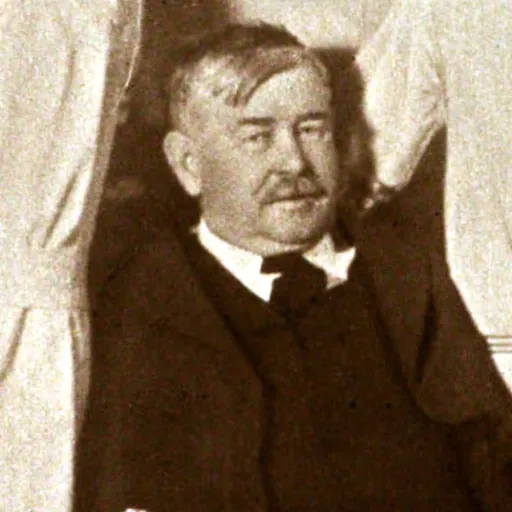
Charles Page
American philanthropist
About Charles Page
Lived 1860 – 1926 (aged 66). Charles Page was an American.
Charles Page (June 2, 1860 – December 27, 1926) was a businessman and philanthropist in the early history of Tulsa, Oklahoma. After his father died when Page was an 11-year-old boy in Wisconsin, he left school early to try to help support his mother and siblings. He had years of struggle before succeeding in business and striking oil in 1905 in Oklahoma.
Wanting to help other widows and children, in 1911 Page founded the Sand Springs Home. Concurrently, he founded the city of Sand Springs, Oklahoma as a model community to support the home, attracting industry and businesses. In 1987 he was posthumously inducted into the Tulsa Hall of Fame.
Early life and family Charles Page was born on June 2 in 1860 or 1861 in Arnott, Wisconsin, near Stevens Point, to James William and Mary (Gottrey) Page. His mother's family were German and immigrated from Alsace in the 1830s. His father was an American of Scottish and French descent. He was one of eight children and his oldest brother, William, died fighting in the American Civil War. After the war, the family moved to Stevens Point so the children could attend school.
He dropped out of school in 1870 and began working on a freight wagon after his father became too ill to work and his father died in 1871. Thereafter, he took care of his mother and four younger siblings.
In 1880, he moved to Tower, Minnesota, to become the chief of police for the company town run by Charlemagne Tower. His main duties involved repressing the local labor movement and he left the town by 1883. He later went to work for the Pinkerton National Detective Agency for most of the rest of the 1880s.
He married his first wife, Lucy, in Duluth, Minnesota in 1881. She already had a son named Willie, whom Page adopted. The children were not allowed to be adopted. Breeding served as superintendent of the Home until 1948.
Tommy Atkins allotment One of the more valuable oil leases in northeastern Oklahoma was for the Tommy Atkins allotment. Three different women claimed Tommy Atkins was deceased and they were his mother, one man claimed to be Atkins, and the Muscogee Nation argued there was never a Tommy Atkins, leading to litigation over the ownership of the allotment. Page paid Sadie James, a descendant of Cherokee Freedmen who claimed to know Tommy's real mother, $3,000 to find the allotment's owner. When James found Atkins mother, Minnie Atkins, she claimed she never had a son named Tommy. Page had his secretary forge documents showing Atkins was Tommy's mother and pressured her into supporting his claim to the allotment. Page eventually won the litigation and rights to the oil lease.
In 1917, James accused Page of bribery and paying her $50 for sex. The Tulsa World, which was generally critical of Page, called the allegations "not fit for print," while Page's publication called the allegations a malicious lie.
Shell Creek Page owned the Sand Springs Bottling Company, which was the dominant supplier of fresh water for domestic consumption. By 1920, he had built a dam on Shell Creek, which created Shell Lake, near Sand Springs. He proposed to sell fresh water to the city of Tulsa. His proposal competed with the alternative of building a dam on Spavinaw Creek. Heated competition ensued between the two major newspapers, Tulsa Democrat (owned by Page), which supported the Shell Creek proposal, and the Tulsa World (owned by Eugene Lorton), which supported the Spavinaw plan. Page's proposal was rejected when tests showed that the quantity of water he could produce at Shell Creek was inadequate to meet Tulsa's expected needs.
Tulsa Race Massacre Aftermath Many Black families spent the winter of 1921–1922 in tents as they worked to rebuild. Charles Page was commended for his philanthropic efforts in the wake of the riot in the assistance of 'destitute people of color. He donated land and lumber so that black families could build homes in Sand Springs, helping them rebuild their lives in the wake of the Tulsa Race Massacre that occurred May 31 - June 3, 1921. He also took in abandoned children into his orphanage whose parents were killed. He spent the last years of his life trying to help give African-Americans who relocated to Sand Springs, Oklahoma a place free from the Ku Klux Klan which was in every facet of Tulsa government at that time.
Death and legacy Page died of influenza on December 27, 1926. Charles (followed by his wife Lucile Page) was entombed at Woodland Cemetery in Sand Springs.
The main street of Sand Springs was named "Charles Page Boulevard" in his honor. This street connects Sand Springs to Tulsa, where it becomes West Third Street.
In the town's center, a statue of Page was installed. The Sand Springs Home continues to help families and children in the 21st century. The local high school is named Charles Page High School in his honor. There are also a park and a library named for him in Sand Springs.
In 1987, Page was posthumously inducted into Tulsa's Hall of Fame.
Don’t just read it —
keep it.
Full-length biographies made to live with: read them, listen on the way to work, watch them tonight.
- E-book
- Audio
- Video
Instant download · yours to keep · every purchase keeps this site free
Important facts
People in Charles Page's life
Named in this biography and alive at the same time

Contemporaries
People whose lives overlapped Charles Page's



Frequently asked questions
Who was Charles Page?
American philanthropist
When was Charles Page born?
Charles Page was born on 2 June 1860 in Arnott.
When did Charles Page die?
Charles Page died on 27 December 1926 in Sand Springs, Oklahoma.
What nationality was Charles Page?
Charles Page was American.
Sources & further reading
Cite this page
APA: Biography.guide. (2026). Charles Page. https://biography.guide/charles-page/
MLA: "Charles Page." Biography.guide, https://biography.guide/charles-page/.
Chicago: "Charles Page." Biography.guide. https://biography.guide/charles-page/.
Data last updated: 2026-09-22 · Spot an error? Report a correction.
Portrait: Wikimedia Commons · author & licence
Page generated 2026-09-27 04:57 UTC