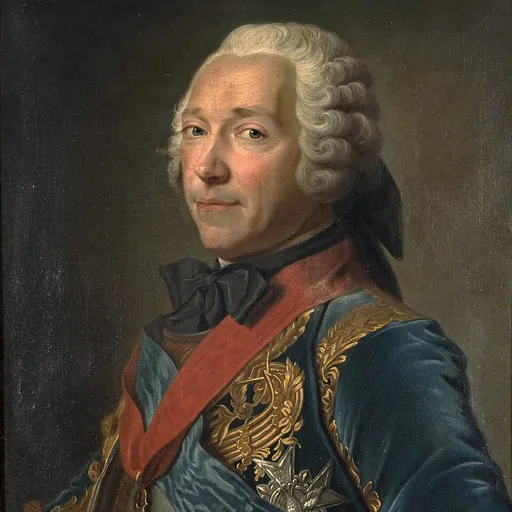
Charles Louis Auguste Fouquet, duc de Belle-Isle
Marshal of France
About Charles Louis Auguste Fouquet, duc de Belle-Isle
Lived 1684 – 1761 (aged 76). Charles Louis Auguste Fouquet, duc de Belle-Isle was a French military personnel, diplomat and military officer.
Charles Louis Auguste Fouquet, duc de Belle-Isle (22 September 168426 January 1761) was a French general and statesman.
Life and career He was born in Villefranche-de-Rouergue, Belle-Isle, Rouergue. He was the grandson of Nicolas Fouquet, who served as Superintendent of Finances under Louis XIV. His family was in disgrace because of Fouquet's brash ambition in the eyes of Louis XIV. Determined to blot out his family's prior disgrace, he entered the army at an early age and was made proprietary colonel of a dragoon regiment in 1708. He rose during the War of the Spanish Succession to the rank of brigadier, and in March 1718 to that of Maréchal de Camp. He was present at the capture of Fuenterrabía in 1718 and of San Sebastián in 1719 during the War of the Quadruple Alliance (1718–1720).
Aided by the rise of Cardinal Fleury, Belle-Isle was made lieutenant-général, and grew in influence over French military policy. In the War of the Polish Succession he commanded a corps under the orders of Marshal Berwick, capturing Trier and Traben-Trarbach and taking part in the Siege of Philippsburg in 1734. When peace was made in 1736, Louis XV gave Belle-Isle the governments of three important fortresses, Metz, Toul and Verdun, offices that he would hold until his death. This was in recognition of both his military services and of his taking part in the negotiations for the cession of Lorraine. In the eventful year of 1741, he was at the masthead of French interventionist policy in Germany—characterised by scholar Richard Lodge as a "scheme for the humiliation of the House of Austria" —and of the beginnings of the War of the Austrian Succession. French aggression was in large part made possible by the precedent set by the Frederick II of Prussia and his conquest of Silesia. France's initial victories—including the election of Charles Albert to Holy Roman Emperor—were short lived, and by 1743 the war was proving to be very disappointing for France, as Belle-Isle's military command in Germany was full of setbacks and losses. His aggressive strategy towards Austria was predicated on the swift defeat of an impotent and disorganised Austria, along with the lynchpin that was Franco-Prussian alliance.
Belle-Isle was named Maréchal de France in 1741 and received control of a large army, with which it is said that he promised to make peace in three months under the walls of Vienna. The truth of this story is open to question, for no one knew better than Belle-Isle the limitations imposed upon commanders by the military and political circumstances of the times. He was, according to one scholar, "the most important single influence on French policy in the crucial year of 1741."
However, the circumstances in which he found himself severely limited his efforts both as a general and as a statesman. —into and across the Upper Palatine Forest whilst being harassed by the enemy's light cavalry and suffering great hardships. But by never allowing himself to be cut off, he was able to reach the relative safety of Eger, after losing 1500 men.
The campaign, however, had discredited Belle-Isle; he was ridiculed in Paris and Fleury is said to have turned against him, and to complete his misfortunes, he was taken prisoner by British forces while going from Cassel to Berlin through Hanover. King Louis XV would make him Secretary of State for War in 1758, a position Belle-Isle would hold until his death in 1761.
During his three years as Secretary of War, Belle-Isle undertook many reforms. Most important was the development of a French military school for officers, seeing as the officer corps had been shown to be inadequate during the wars of the past few decades. These included the suppression of the proprietary colonelcies of nobles who were too young to command; and he instituted an Order of Merit. These reforms of the officer corps were similar to the structure of the Prussian army in that they attempted to place merit and honour above the blind appointments of nobility. The success of his reforms is debated, because by this time the Seven Years' War was in progress. According to one scholar, Walter L. Dorn, Belle-Isle's efforts came "too late to make a difference" in the war and the continuing decline of French military power.
Belle-Isle held an interest in literature throughout his life, and was elected a member of the French National Academy in 1740; so he founded the National Academy of Metz in 1760. Also, Belle-Isle is regarded today as a builder-ruler. As benefactor of the city, he initiated during his dukedom the modernisation of the centre of Metz in a context of Enlightenment. Belle-Isle awarded royal architect Jacques-François Blondel for the embellishment of the town square and the construction of the city hall, the parliament, and the guardhouse lodging. He also decided the edification of the royal Governor and Intendant palaces and the opera house of Metz, describing it as "one of the most beautiful of France's opera-theatres" at his time. Just before his death, he stated: "The city of Metz is my mistress." However, his dukedom over Metz would end with his death because his only son, the Comte de Gisors, had been killed on 23 June 1758 in the Battle of Krefeld. A commemorative plate honours him today on the forecourt of the opera house of Metz.
Don’t just read it —
keep it.
Full-length biographies made to live with: read them, listen on the way to work, watch them tonight.
- E-book
- Audio
- Video
Instant download · yours to keep · every purchase keeps this site free
Important facts
Related people
Same field, nearest in time
Contemporaries
People whose lives overlapped Charles Louis Auguste Fouquet, duc de Belle-Isle's

Frequently asked questions
Who was Charles Louis Auguste Fouquet, duc de Belle-Isle?
Marshal of France (1684-1761)
When was Charles Louis Auguste Fouquet, duc de Belle-Isle born?
Charles Louis Auguste Fouquet, duc de Belle-Isle was born on 22 September 1684 in Villefranche-de-Rouergue.
When did Charles Louis Auguste Fouquet, duc de Belle-Isle die?
Charles Louis Auguste Fouquet, duc de Belle-Isle died on 26 January 1761 in Versailles.
What was Charles Louis Auguste Fouquet, duc de Belle-Isle's occupation?
Charles Louis Auguste Fouquet, duc de Belle-Isle was a military personnel, diplomat and military officer.
What nationality was Charles Louis Auguste Fouquet, duc de Belle-Isle?
Charles Louis Auguste Fouquet, duc de Belle-Isle was French.
Sources & further reading
· Wikipedia: Charles Louis Auguste Fouquet, duc de Belle-Isle
· DBpedia: Charles Louis Auguste Fouquet, duc de Belle-Isle
Cite this page
APA: Biography.guide. (2026). Charles Louis Auguste Fouquet, duc de Belle-Isle. https://biography.guide/charles-louis-auguste-fouquet-duc-de-belle-isle/
MLA: "Charles Louis Auguste Fouquet, duc de Belle-Isle." Biography.guide, https://biography.guide/charles-louis-auguste-fouquet-duc-de-belle-isle/.
Chicago: "Charles Louis Auguste Fouquet, duc de Belle-Isle." Biography.guide. https://biography.guide/charles-louis-auguste-fouquet-duc-de-belle-isle/.
Data last updated: 2026-09-25 · Spot an error? Report a correction.
Portrait: Wikimedia Commons · author & licence
Page generated 2026-10-04 09:35 UTC