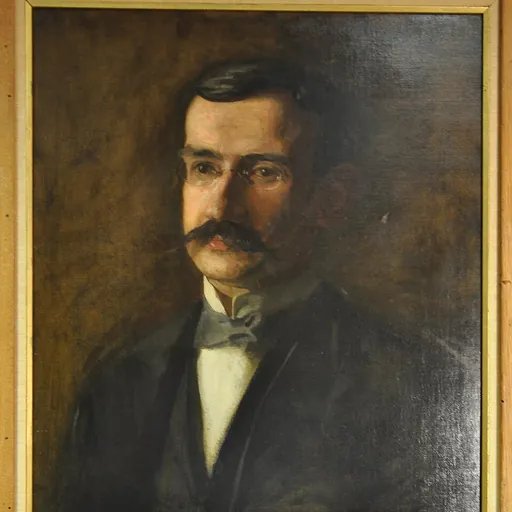
About Charles Lester Leonard
Lived 1861 – 1913 (aged 51). Charles Lester Leonard was an American physician.
Charles Lester Leonard (1861–1913) was an American physician and X-ray pioneer. Leonard was the first radiologist at the Hospital of the University of Pennsylvania, founded the Philadelphia Roentgen Ray Society, and served as president of the American Roentgen Ray Society in 1904–1905. He was known as one of the foremost experts in urological X-ray diagnosis, and he was the first American physician to demonstrate kidney stone disease with X-rays.
A native of Massachusetts, Leonard completed bachelor's degrees at the University of Pennsylvania and Harvard University, then returned to Penn for medical school. As a student, he was interested in photography, and after going to Europe to work in science laboratories, he developed an interest in photomicrography. Leonard captured microscopic images that furthered the understanding of the life cycles of microorganisms.
Leonard was associated with University Hospital from the mid-1890s to 1902. He was first named an assistant instructor in clinical surgery under J. William White, and then he ran the hospital's X-ray service, which seemed to combine his interests in photography and surgical problems. While he was at Penn, Leonard opened a private office for taking X-rays. After he left the medical school, he devoted his time to this private practice as well as to writing about radiology and representing the specialty nationally and internationally at medical conferences.
Like many of the pioneers in radiography, Leonard suffered from adverse effects of radiation exposure before the causes of these problems were fully understood. During his first several years of X-ray work, he believed that X-ray burns resulted from ungrounded electrical current, so he did not take precautions to shield his body from radiation. Before he died of radiation-induced cancer, Leonard had multiple operations, including the amputation of his entire right arm.
Early life
Leonard was born on December 29, 1861, in Easthampton, Massachusetts, to Moses and Harriet Leonard. He had two siblings; his brother, Frederick M. Leonard, became a prominent Philadelphia attorney. The family could trace its ancestry back to John Leonard, who left England in 1632 to settle in Springfield, Massachusetts, and to William Brewster, who came to the U.S. on the Mayflower. Another of their forebears, Elijah Leonard, fought in the American Revolutionary War.
Leonard grew up in Philadelphia, and he attended Rittenhouse Academy. He then earned bachelor's degrees at the University of Pennsylvania (1885) and Harvard University (1886). He received a medical degree from Penn in 1889, then went to Europe to observe some laboratory techniques. During his studies, Leonard was interested in photography and served as a model for Eadweard Muybridge's photographic study of human motion called Man Running.
Leonard used an X-ray system consisting of accumulators and a Ruhmkorff coil with a low-voltage primary winding that excited a self-regulating X-ray tube. In 1936, radiologist Percy Brown wrote that Leonard's intricate setup "was a source of great interest and some surprise to his contemporaries, but will amaze radiologists of a later generation who now read of them for the first time." He may have been the first American radiologist to define a dosage unit for radiation, though it was not possible to measure dosage at that point. Commenting on the possibility of employing radiation therapy, he said that physicians needed to be able to deliver a controlled dose, and the unit should be defined as "the unit quantity of electricity passing across a unit gap in unit time under the influences of radiation at unit distance under standard conditions of barometer and temperature."
X-ray injuries In the earliest days of X-rays, a radiographer had to take an image of his own hands to test the X-ray tube before each patient image was taken. The fragile X-ray equipment had to be positioned precisely, and this required that the radiographer's face, hands and arms were in close proximity to the X-ray beam during these lengthy examinations.
Leonard mentioned X-ray burns in a presentation before the AMA in 1897. At that time, he shared the belief of many physicians that X-ray burns were caused by a lack of grounding of the electrical current from the apparatus. He laid an aluminum sheet between the patient and the X-ray tube and had a grounding wire that ran from the aluminum down to the floor.
Leonard was so convinced of his electrical current explanation that for several years he did not take any precautions to shield his hands from radiation.
Death and legacy During the final months of his life, Leonard spent much of his time collaborating with Austrian radiologist Guido Holzknecht on a review of radiography in gastrointestinal conditions that was to be read at the August 1913 meeting of the Section of Radiology of the International Congress of Medicine. In spite of significant pain and suffering, Leonard read through literature in English, French and German in preparing the work. A memorial issue of the American Journal of Roentgenology said that Leonard was known for bearing his illness in secret. He had undergone amputation of his hand several years earlier, and his entire arm was amputated a few months before he died.
The American Roentgen Ray Society established the Charles Lester Leonard Prize to recognize outstanding contributions to X-ray technology. Leonard is buried in an unmarked grave near the conservatory at West Laurel Hill Cemetery in Bala Cynwyd, Pennsylvania.
Don’t just read it —
keep it.
Full-length biographies made to live with: read them, listen on the way to work, watch them tonight.
- E-book
- Audio
- Video
Instant download · yours to keep · every purchase keeps this site free
Important facts
People in Charles Lester Leonard's life
Named in this biography and alive at the same time





Related people
Same field, nearest in time



Contemporaries
People whose lives overlapped Charles Lester Leonard's


Frequently asked questions
Who was Charles Lester Leonard?
1861-1913 , physician
When was Charles Lester Leonard born?
Charles Lester Leonard was born on 29 December 1861 in Easthampton.
When did Charles Lester Leonard die?
Charles Lester Leonard died on 22 September 1913 in Atlantic City, New Jersey.
What was Charles Lester Leonard's occupation?
Charles Lester Leonard was a physician.
What nationality was Charles Lester Leonard?
Charles Lester Leonard was American.
Sources & further reading
· Wikipedia: Charles Lester Leonard
· DBpedia: Charles Lester Leonard
Cite this page
APA: Biography.guide. (2026). Charles Lester Leonard. https://biography.guide/charles-lester-leonard/
MLA: "Charles Lester Leonard." Biography.guide, https://biography.guide/charles-lester-leonard/.
Chicago: "Charles Lester Leonard." Biography.guide. https://biography.guide/charles-lester-leonard/.
Data last updated: 2026-09-23 · Spot an error? Report a correction.
Portrait: Wikimedia Commons · author & licence
Page generated 2026-09-27 05:05 UTC