
Charles Joseph La Trobe
English-born Australian colonial administrator
About Charles Joseph La Trobe
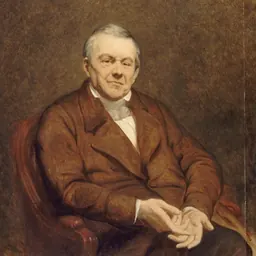
Lived 1801 – 1875 (aged 74). Charles Joseph La Trobe was a British politician, scientific explorer, diplomat and botanical collector.
Charles Joseph La Trobe (20 March 18014 December 1875), commonly Latrobe, was appointed in 1839 superintendent of the Port Phillip District of New South Wales and, after the establishment in 1851 of the colony of Victoria (now a state of Australia), he became its first lieutenant-governor.
In the 1830s, La Trobe headed a Grand Tour trip for Albert Pourtales, encompassing North America. On the trip, the two sometimes traveled with Washington Irving and Henry Leavitt Ellsworth. They witnessed Indian Removal, indigenous customs, and visited natural attractions like Niagara Falls and Minnehaha Falls.
La Trobe was a strong supporter of religious, cultural and educational institutions. During his time as superintendent and lieutenant-governor he oversaw the establishment of the Botanic Gardens, and provided leadership and support to the formation of entities such as the Mechanic's Institute, the Royal Melbourne Hospital, the Royal Philharmonic, the Melbourne Cricket Ground and the University of Melbourne.
Early life Charles La Trobe was born in London, the son of Christian Ignatius Latrobe, a leader of the Moravian Church, from a family of French Huguenot descent, whose mother was a member of the Moravian Church born in the United States. He was educated in England and later spent time in Switzerland and was active in mountaineering; he made a number of ascents in the Alps 1824–26. La Trobe wrote several travel books describing his experiences: The Alpenstock: Or Sketches of Swiss Scenery and Manners (1829) and The Pedestrian: A Summer's Ramble in the Tyrol (1832). Charles's uncle (Christian's brother) was the British-American "father of American architecture" Benjamin Henry Latrobe who designed the White House porticos.
In 1832, La Trobe visited the United States, chaperoning Count Albert Pourtales on a Grand Tour. Author Edgar Allen Poe called The Rambler in North America "the best book in America yet published", and John Stuart Mill said that the work contained "some of the most attractive descriptions we ever read". The London Quarterly Review called it "the book of the season as far as America is concerned". he was appointed superintendent of the Port Phillip District of New South Wales, even though he had little managerial and administrative experience. Having tried, with varying degrees of success, to cope with the enormous population and economic expansion of the new colony, La Trobe, who suffered criticism due to his inexperience, submitted his resignation in December 1852, but had to wait until a replacement, Charles Hotham, could take his place.
After Victoria Towards the end of his governorship, La Trobe's wife, Sophie, became ill and returned to Europe with their four children. She died on 30 January 1854. On his return to Europe after his term, La Trobe married Sophie's sister, Rose Isabelle de Meuron (1821–1883) in 1855, a marriage which was illegal in English law, being considered incestuous at the time. (See Deceased Wife's Sister's Marriage Act 1907.) The couple had two daughters (born 1856 and 1859) in Switzerland and moved to England in 1861. La Trobe did not receive any further British government appointments. His eyesight was increasingly deteriorating, and he was completely blind for the last years of his life. He died in 1875.
Geelong keys La Trobe is also linked to the discovery of a minor piece of evidence suggesting early European exploration of Australia. In 1847, at Limeburners' Point near Geelong, Victoria, Charles La Trobe, a keen amateur geologist, was examining the shells from a lime kiln when a worker showed him a set of five keys that he claimed to have found, subsequently named the Geelong Keys. La Trobe concluded that, based on their appearance, the keys were dropped onto the beach around 100 to 150 years beforehand (i.e. between 1700 and 1750). In 1977, Kenneth McIntyre hypothesized they were dropped by Portuguese sailors under the command of Cristóvão de Mendonça. Since the keys have long been lost, their exact origin cannot be verified. However, research by geologist Edmund Gill and historian P.F.B. Alsop showed the deposit they were supposedly found in was 2330–2800 years old, making La Trobe's dating impossible.
Views
Native Americans Charles La Trobe espoused racist views about Native Americans in The Rambler in North America, 1832–1835, describing them as a "degenerate race", "both savage and sensual", and a slave "to vices introduced by the whites". He argued that Native American extermination was brought on by the "superior power and intellect of whites", although it was to be lamented. Despite his views, La Trobe called the Black Hawk War a "chronicle of shame", and was saddened by the lack of diplomacy during the conflict.
The La Trobe Journal (founded 1968) is published by the State Library of Victoria. It is devoted to Australasia, especially in connection with Victoria.
The family motto of La Trobe is used at La Trobe University for their own motto. The motto in English is "whoever seeks shall find".
The flowering plant genus Latrobea was named after him.
He was a character in the 1949 film Eureka Stockade.
Involvement in Native Police Corps
The Native Police Corps as the Aboriginal force was known, was limited initially to one division in the Port Phillip District of the colony, around Melbourne.
In 1842, the formation of the Native Police Corps was halted due to funding problems. These issues delayed reformation of the corps until Superintendent Charles La Trobe indicated he was willing to underwrite the costs in 1842.
Native Police Corps were primarily a force of armed and mounted Aboriginal police under the command of white officers. They were used to patrol the often vast geographical areas along the colonial frontier in order to conduct indiscriminate raids and punitive expeditions against Aboriginal people.
Works
The Alpenstock: Or Sketches of Swiss Scenery and Manners (1829) The Pedestrian: A Summer's Ramble in the Tyrol (1832) The Rambler in North America, 1832–1835 (1835) The Rambler in Mexico (1836)
Don’t just read it —
keep it.
Full-length biographies made to live with: read them, listen on the way to work, watch them tonight.
- E-book
- Audio
- Video
Instant download · yours to keep · every purchase keeps this site free
Important facts
People in Charles Joseph La Trobe's life
Named in this biography and alive at the same time




Related people
Same field, nearest in time



Contemporaries
People whose lives overlapped Charles Joseph La Trobe's






Frequently asked questions
Who was Charles Joseph La Trobe?
English-born Australian colonial administrator (1801-1875)
When was Charles Joseph La Trobe born?
Charles Joseph La Trobe was born on 20 March 1801 in London.
When did Charles Joseph La Trobe die?
Charles Joseph La Trobe died on 4 December 1875 in Alfriston.
What was Charles Joseph La Trobe's occupation?
Charles Joseph La Trobe was a politician, scientific explorer, diplomat and botanical collector.
What nationality was Charles Joseph La Trobe?
Charles Joseph La Trobe was British.
Sources & further reading
· Wikipedia: Charles Joseph La Trobe
Cite this page
APA: Biography.guide. (2026). Charles Joseph La Trobe. https://biography.guide/charles-joseph-la-trobe/
MLA: "Charles Joseph La Trobe." Biography.guide, https://biography.guide/charles-joseph-la-trobe/.
Chicago: "Charles Joseph La Trobe." Biography.guide. https://biography.guide/charles-joseph-la-trobe/.
Data last updated: 2026-09-20 · Spot an error? Report a correction.
Page generated 2026-09-27 05:31 UTC