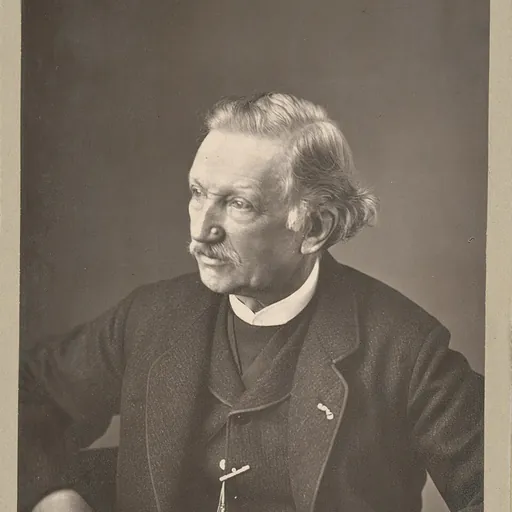
About Charles Jacque
Lived 1813 – 1894 (aged 80). Charles Jacque was a French animal painter, illustrator, etcher, painter, printmaker and photographer.
Charles-Émile Jacque (23 May 1813 – 7 May 1894) was a French painter of Pastoralism and engraver who was, with Jean-François Millet, part of the Barbizon School. He first learned to engrave maps when he spent seven years in the French Army.
Biography
Fleeing the Cholera epidemics that besieged Paris in the mid-nineteenth century, Charles Jacque relocated to Barbizon in 1849 with Millet. There, he painted rustic or pastoral subject matter: shepherds, flocks of sheep, pigs, and scenes of farm life. In addition to painting, Jacque was also famous for his etchings and engravings. He, along with Félix Bracquemond and Felix Buhot, is credited with the nineteenth-century revival of seventeenth-century techniques. He began his career as an engraver around 1841 by publishing a series of etchings with Louis Marvy. He followed this work with a series of engravings based on the works of Adriaen van Ostade, after which he began to create original engravings and artworks. Charles Baudelaire said of him, "Mr. Jacque’s new reputation will continue to grow always, we hope. His etchings are very bold and his subject matter is well conceived. All that Mr. Jacque does on copper is filled with a freedom and a frankness which reminds one of the Old Masters."
Henri Béraldi distinguished two periods in Jacque's career. The first saw his creation of more spontaneous, Dutch inspired vignettes. In the second, for which he is more famous, he produced larger plates which, according to Fanica, were "marked by the Dutch character of his work".
Jacque also provided the illustrations for numerous books, in particular the Vicar of Wakefield by Oliver Goldsmith; The Indian Cottage, a novella published with Paul et Virginie; Picturesque Greece by Christopher Wordsworth; the Works of Shakespeare; and Ancient and Modern Versailles by Alexandre de Laborde.
Family
His sons Émile Jacque (1848–1912) and Frédéric Jacque (1859–1931) were both painters and engravers especially of rural subjects. Another son, Lucien, was executed as a Communard during the French State's bloody repression of the Paris Commune.
Gallery
Landscape with Sheep, c. 1855–94, Clark Art Institute, Williamstown
Don’t just read it —
keep it.
Full-length biographies made to live with: read them, listen on the way to work, watch them tonight.
- E-book
- Audio
- Video
Instant download · yours to keep · every purchase keeps this site free
Important facts
more
jacques chas., chas. jacque, Jacque Ch., e. jacque, jaques, jacque charles-emile, chs. jacque, chas jacque, charles jaque, emil jacque, C. Jacque, jacque c., jacque e., a. jacque, cha.s jacque, ch. e. jacque, Ch. Jacque, charles emile jaque, Jacques, Ch. Jacques, jacque charles emile, C. Jacques, emile jacque, c.e. jacque, ch.s Jacque, ch.s jPeople in Charles Jacque's life
Named in this biography and alive at the same time



Related people
Same field, nearest in time





Contemporaries
People whose lives overlapped Charles Jacque's





Frequently asked questions
Who was Charles Jacque?
French painter (1813–1894)
When was Charles Jacque born?
Charles Jacque was born on 23 May 1813 in former 10th arrondissement of Paris.
When did Charles Jacque die?
Charles Jacque died on 7 May 1894 in boulevard de Clichy.
What was Charles Jacque's occupation?
Charles Jacque was an animal painter, illustrator, etcher, painter, printmaker and photographer.
What nationality was Charles Jacque?
Charles Jacque was French.
Sources & further reading
Cite this page
APA: Biography.guide. (2026). Charles Jacque. https://biography.guide/charles-jacque/
MLA: "Charles Jacque." Biography.guide, https://biography.guide/charles-jacque/.
Chicago: "Charles Jacque." Biography.guide. https://biography.guide/charles-jacque/.
Data last updated: 2026-09-21 · Spot an error? Report a correction.
Portrait: Wikimedia Commons · author & licence
Page generated 2026-09-27 04:59 UTC