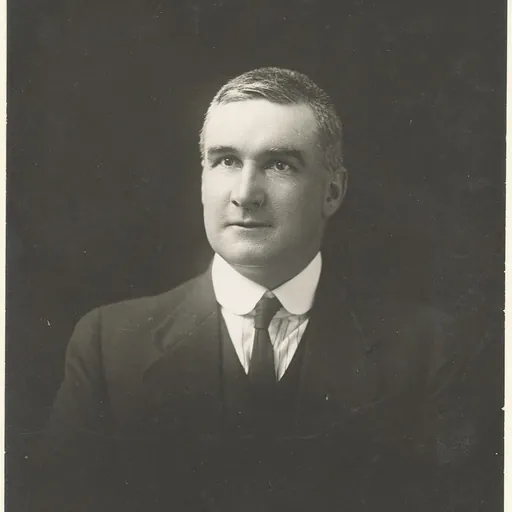
About Charles Grant
Lived 1878 – 1943 (aged 65). Charles Grant was an Australian politician.
Charles William Grant (25 April 1878 – 14 December 1943) was an Australian businessman and politician. He was a Senator for Tasmania from 1932 to 1941, representing the United Australia Party (UAP), and also briefly filled a casual vacancy in 1925 for the Nationalist Party.
Early life Grant was born on 25 April 1878 in Hobart, Tasmania. He was one of four children born to Jane and Charles Henry Grant. His English-born father was a railway engineer and company director who was elected to the Tasmanian Legislative Council in 1892.
Grant was educated at The Hutchins School in Hobart. After leaving school he worked on sheep stations on the Australian mainland for several years before returning to Tasmania in 1901. In 1923 he crossed the floor to vote against Nationalist premier Walter Lee on a no-confidence motion, resulting in Australian Labor Party leader Joseph Lyons becoming premier. This contributed to his defeat at the 1925 state election. He defeated Walter Lee in the ballot for the vacancy. Grant's first stint in the Senate was short, as he was defeated for re-election on the Nationalist ticket at the 1925 federal election. In accordance with the constitutional provisions at the time, his term ended immediately on the date of the election.
Grant was re-elected to the Senate on 3 March 1932, filling another casual vacancy caused by the death of James Ogden. He again defeated Lee in the ballot. He joined the United Australia Party, which had replaced the Nationalist Party, and was elected to a full six-year term at the 1934 federal election. He did not seek re-election in 1940 with his term expiring on 30 June 1941.
In the Senate, Grant was a strong advocate for Tasmania. He was the only Tasmanian senator to vote against the Lyons government's Financial Agreements Enforcement Bill, which had been designed to target the New South Wales state government but was opposed by the Tasmanian state government. He was also critical of the impact of the Navigation Act on shipping across the Bass Strait and believed the Commonwealth Grants Commission could be replaced by direct grants to Tasmania. Grant also spoke regularly on financial and economic matters. He argued for reduced government spending and a decrease in the powers of the Commonwealth government.
Personal life In 1903, Grant married Charlotte Bell, with whom he had four children. He was widowed in 1938 and died on 14 December 1943 in the same house on Davey Street, Hobart, that he had been born in.
Don’t just read it —
keep it.
Full-length biographies made to live with: read them, listen on the way to work, watch them tonight.
- E-book
- Audio
- Video
Instant download · yours to keep · every purchase keeps this site free
Important facts
People in Charles Grant's life
Named in this biography and alive at the same time



Related people
Same field, nearest in time





Contemporaries
People whose lives overlapped Charles Grant's




Frequently asked questions
Who was Charles Grant?
Australian politician
When was Charles Grant born?
Charles Grant was born on 25 April 1878 in Hobart city center.
When did Charles Grant die?
Charles Grant died on 14 December 1943 in Hobart city center.
What was Charles Grant's occupation?
Charles Grant was a politician.
What nationality was Charles Grant?
Charles Grant was Australian.
Sources & further reading
· DBpedia: Charles Grant (Australian politician)
Cite this page
APA: Biography.guide. (2026). Charles Grant. https://biography.guide/charles-grant-politician/
MLA: "Charles Grant." Biography.guide, https://biography.guide/charles-grant-politician/.
Chicago: "Charles Grant." Biography.guide. https://biography.guide/charles-grant-politician/.
Data last updated: 2026-09-22 · Spot an error? Report a correction.
Portrait: Wikimedia Commons · author & licence
Page generated 2026-09-27 05:02 UTC