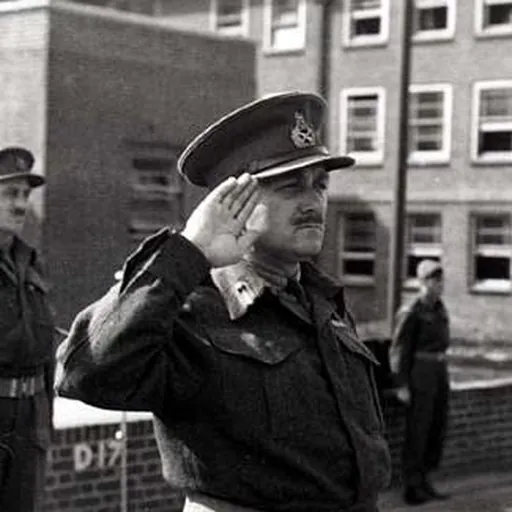
About Charles Foulkes
Lived 1903 – 1969 (aged 66). Charles Foulkes was a British military personnel.
General Charles Foulkes, (3 January 1903 – 12 September 1969) was a Canadian soldier, and an officer of The Royal Canadian Regiment.
Military career One of eight children, Foulkes was born in Stockton-on-Tees, England, on 3 January 1903. His family moved to Canada, eventually settling at 230 Hill Street in London, Ontario. He completed his secondary school education at the London Collegiate Institute (now Central Secondary School) before going to the University of Western Ontario.
He joined the Canadian Militia in 1926. In 1937 he attended the Staff College in Camberley, England.
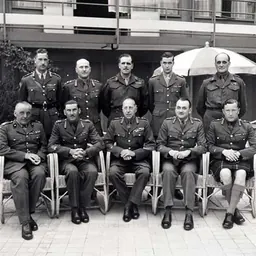
Senior commanders of the First Canadian Army, May 1945. Seated from the left: Stanisław Maczek (Polish Army), Guy Simonds, Harry Crerar, Charles Foulkes, Bert Hoffmeister. Standing from the left: Ralph Keefler, Bruce Matthews, Harry Foster, Robert Moncel (standing in for Chris Vokes, Stuart Rawlins (British Army).
On 4 May 1945, south of Hamburg, Field Marshal Sir Bernard Law Montgomery accepted the unconditional surrender of the German forces in the Netherlands, northwest Germany including all islands, in Denmark and all naval ships in those areas. The surrender preceded the end of World War II in Europe and was signed in a carpeted tent at Montgomery's headquarters on the Timeloberg hill at Wendisch Evern.
Lieutenant-General Charles Foulkes (left centre), GOC I Canadian Corps, accepts the surrender of German forces in the Netherlands from General Johannes Blaskowitz (right centre).
On 5 May 1945, Foulkes summoned German General Blaskowitz to the Hotel de Wereld in Wageningen to discuss the surrender of German forces in the Netherlands. His Royal Highness Prince Bernhard, acting as commander in chief of the Dutch Interior Forces, attended the meeting as well. Blaskowitz agreed with all of the proposals made by Foulkes. However, nowhere in the building – some sources claim: nowhere in the whole town – could a typewriter be found. Thus the surrender document could not be typed. The next day, 6 May, both parties returned, and in the presence of both General Foulkes and Prince Bernhard, Blaskowitz signed the surrender document which in the meantime had been typed.
After the war, Foulkes was appointed Chief of the General Staff (CGS) and, in 1951, the year he was promoted to full general,
Foulkes retired in 1960. He died in Ottawa in 1969.
His medals and other personal artifacts are on display at the Royal Canadian Regiment Museum in London, Ontario. He was awarded the Honorary degree of Doctor of Laws (LL.D) from the University of Western Ontario on 11 June 1947.
Don’t just read it —
keep it.
Full-length biographies made to live with: read them, listen on the way to work, watch them tonight.
- E-book
- Audio
- Video
Instant download · yours to keep · every purchase keeps this site free
Important facts
People in Charles Foulkes's life
Named in this biography and alive at the same time





Related people
Same field, nearest in time


Contemporaries
People whose lives overlapped Charles Foulkes's
Frequently asked questions
Who was Charles Foulkes?
British-Canadian general (1903–1969)
When was Charles Foulkes born?
Charles Foulkes was born on 3 January 1903 in Stockton-on-Tees.
When did Charles Foulkes die?
Charles Foulkes died on 12 September 1969 in Ottawa.
What was Charles Foulkes's occupation?
Charles Foulkes was a military personnel.
What nationality was Charles Foulkes?
Charles Foulkes was British.
Sources & further reading
· DBpedia: Charles Foulkes (Canadian Army officer)
Cite this page
APA: Biography.guide. (2026). Charles Foulkes. https://biography.guide/charles-foulkes/
MLA: "Charles Foulkes." Biography.guide, https://biography.guide/charles-foulkes/.
Chicago: "Charles Foulkes." Biography.guide. https://biography.guide/charles-foulkes/.
Data last updated: 2026-09-20 · Spot an error? Report a correction.
Portrait: Wikimedia Commons · author & licence
Page generated 2026-09-27 04:58 UTC