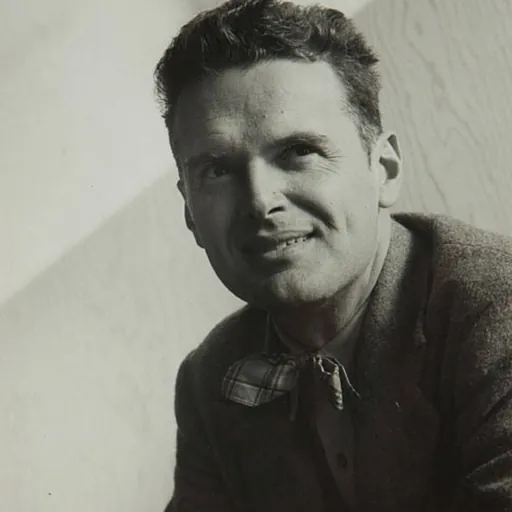
About Charles Eames
Lived 1907 – 1978 (aged 71). Charles Eames was an American designer, architect, filmmaker, film director, director and graphic artist, known for Ray Eames.
Charles Ormond Eames Jr. (June 17, 1907 – August 21, 1978) was an American designer, architect and filmmaker. In professional partnership with his wife Ray-Bernice Kaiser Eames, he made groundbreaking contributions in the fields of architecture, furniture design, industrial design, manufacturing and the photographic arts.
Biography Childhood Charles was born in St. Louis, Missouri, Other sources, less frequently cited, note that while a student, Charles Eames was also employed as an architect at the firm of Trueblood and Graf. The demands on his time from this employment and his classes may have led to sleep-deprivation and diminished performance at the university.
First marriage While at Washington University, Eames met his first wife, Catherine Woermann, whom he married in 1929. A year later, they had a daughter, Lucia Dewey Eames. Charles and Catherine were divorced in early 1941.
Early architectural practice In 1930, Eames began an architectural practice in St. Louis with partner Charles Gray. They were later joined by a third partner, Walter Pauley. Their buildings included:
Sweetzer House, St. Louis, Missouri, 1931 St. Mary's Church, Helena, Arkansas, 1934 St. Mary's Catholic Church, Paragould, Arkansas, 1935 Meyer House, Huntleigh, Missouri, 1936–1938 Dinsmoor House, St. Louis, Missouri, 1936 Dean House, St. Louis, Missouri, 1936
Eames was influenced by the Finnish architect Eliel Saarinen (whose son Eero, also an architect, would become a partner and friend).
Cranbrook and the beginning of furniture design
At the elder Saarinen's invitation, Charles moved in 1938 with his wife Catherine and daughter Lucia to Michigan to further study architecture at the Cranbrook Academy of Art. Charles quickly became an instructor and the head of the industrial design department. In order to apply for the Architecture and Urban Planning Program, Eames defined an area of focus—the St. Louis waterfront. Together with Eero Saarinen he designed prize-winning furniture for New York's Museum of Modern Art "Organic Design in Home Furnishings" competition. He met Ray Kaiser during this project; she was a student at Cranbrook and helped with graphic design. Eames and Saarinen's work displayed the new technique of wood molding (originally developed by Alvar Aalto) that Charles would further develop with Ray in many molded plywood products, including chairs and other furniture, and splints and stretchers for the US Navy during World War II.
The long-running BBC television program Mastermind features an iconic black chair that was designed by Eames.
Ray Kaiser In 1941, Charles and Catherine divorced, and soon afterwards, Eames married his Cranbrook Educational Community colleague Ray Kaiser. During their honeymoon, he relocated with her to Los Angeles, California, where they worked and lived together until their deaths. Together, Charles and Ray Eames internationally became two of the most recognized and celebrated designers of the 20th century. The Eames House (also known as Case Study House No. 8), constructed in 1949 in Pacific Palisades, California by Charles and Ray Eames
The Eames House
Three years after arriving in Los Angeles, Charles and Ray were asked to participate in the Case Study House Program, a housing program sponsored by Arts & Architecture magazine in the hopes of showcasing examples of economically priced modern homes that used wartime and industrial materials. John Entenza, the owner and editor of Arts & Architecture, recognized the importance of Charles and Ray's thinking and design practices—alongside becoming a close friend of the couple. Charles and Eero Saarinen were hired to design Case Study House number 8, which would be the residence of Charles and Ray, and Case Study House number 9, which would house John Entenza, in 1945. The two homes (alongside other Case Study houses) would share a five-acre parcel of land in the Pacific Palisades neighborhood north of Santa Monica, which overlooked the Pacific Ocean. Because of post-war material rationing, the materials ordered for the first draft of the Eames House (called "the Bridge House") were backordered. Charles and Ray spent many days and nights on-site in the meadow picnicking, shooting arrows, and socializing with family, friends, and coworkers. They grew to love the eucalyptus grove, the expanse of land, and the unobstructed view of the ocean.
They chose not to build the Bridge House and instead reconfigured the materials to create two separate structures nestled into the property's hillside. Eero Saarinen had no part in this second draft of the Eames House; it was a collaboration between Charles and Ray. The materials were finally delivered, and the house was erected from February through December 1949. The Eameses moved in on Christmas Eve, and it became their only residence for the remainder of their lives. It remains a milestone of modern architecture operated by the Eames Foundation, a non-profit organization instituted by Lucia Eames.
The Eames Office designed a few more pieces of architecture, many of which were never built. The Herman Miller Showroom on Beverly Boulevard in Los Angeles was built in 1950 and the De Pree House was constructed in Zeeland, Michigan for the founder of Herman Miller's son, Max De Pree, and his growing family. Unbuilt projects include the Billy Wilder House, the prefabricated kit home known as the Kwikset House, and a national aquarium.
The Eames Office
From 1943 until his death in 1978, Charles and Ray worked together with a team of staff and produced an unparalleled breadth of creative design work across many disciplines.
IBM and The 1964 World's Fair With their interest in communicating ideas visually, the Eameses also turned their attention to exhibition design, beginning in 1950, for the Chicago Merchandise Mart and the New York Museum of Modern Art, and continuing into the mid-1970s, for IBM. thumb leftAs ongoing consultants to IBM, Charles and Ray developed a special relationship with the company that involved not only the creation of films, presentations, and educational products, but also Charles and Ray's insights for the future of the company.
During the 1960s and early 1970s, the Eameses designed a series of exhibitions for IBM, centered on scientific and mathematical themes, as well as famous individuals within those fields. If Ray was less passionate about computers than her husband, she shared his belief in their importance and used her talents to make them understandable and acceptable to ordinary people.
Philosophy In 1970 and 1971, Charles Eames gave the Charles Eliot Norton Lectures at Harvard University. At the lectures, the Eames viewpoint and philosophy are related through Charles' telling of what he called "the banana leaf parable", a banana leaf being the most basic eating utensil in southern India. He related the progression of design and its process where the banana leaf is transformed into something fantastically ornate. He explains the next step and ties it to the design process by finishing the parable with:
Don’t just read it —
keep it.
Full-length biographies made to live with: read them, listen on the way to work, watch them tonight.
- E-book
- Audio
- Video
Instant download · yours to keep · every purchase keeps this site free
Important facts
People in Charles Eames's life
Named in this biography and alive at the same time





Related people
Same field, nearest in time



Contemporaries
People whose lives overlapped Charles Eames's


Frequently asked questions
Who was Charles Eames?
American designer (1907-1978)
When was Charles Eames born?
Charles Eames was born on 17 June 1907 in St. Louis.
When did Charles Eames die?
Charles Eames died on 21 August 1978 in St. Louis.
What was Charles Eames's occupation?
Charles Eames was a designer, architect, filmmaker, film director, director and graphic artist.
What was Charles Eames known for?
Charles Eames was known for Ray Eames.
What nationality was Charles Eames?
Charles Eames was American.
Sources & further reading
Cite this page
APA: Biography.guide. (2026). Charles Eames. https://biography.guide/charles-eames/
MLA: "Charles Eames." Biography.guide, https://biography.guide/charles-eames/.
Chicago: "Charles Eames." Biography.guide. https://biography.guide/charles-eames/.
Data last updated: 2026-09-23 · Spot an error? Report a correction.
Portrait: Wikimedia Commons · author & licence
Page generated 2026-09-27 05:06 UTC