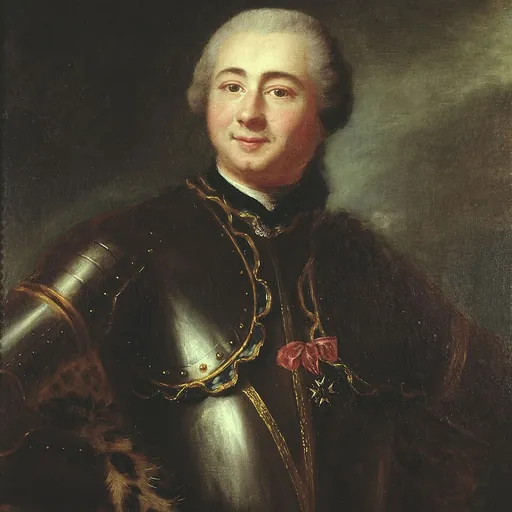
About Charles Deschamps de Boishébert et de Raffetot
Lived 1727 – 1797 (aged 69). Charles Deschamps de Boishébert et de Raffetot was a Canadian military personnel.
Charles Deschamps de Boishébert (also known as Courrier du Bois, Bois Hebert) was a member of the Compagnies Franches de la Marine and was a significant leader of the Acadian militia's resistance to the Expulsion of the Acadians. He settled and tried to protect Acadians refugees along the rivers of New Brunswick. At Beaubears National Park on Beaubears Island, New Brunswick he settled refugee Acadians during the Expulsion of the Acadians.
King George's War
Siege of Annapolis Royal
From October until 3 November 1746, Boishebert took part in the unsuccessful Siege of Annapolis Royal, Nova Scotia (N.S.), the British administrative and military headquarters in Acadia. The British force consisted of two Royal Navy ships and 200 New England soldiers stationed at Port-La-Joie. Jean-Baptiste Nicolas Roch de Ramezay was sent from Quebec to the region in 1746 to support the Duc d'Anville Expedition in its effort to regain Acadia. Upon arriving at Fort Beauséjour on the Isthmus of Chignecto, he sent Boishébert to Île Saint-Jean on a reconnaissance to assess the size of the British force. After Boishébert returned, Ramezay sent Joseph-Michel Legardeur de Croisille et de Montesson along with over 500 men, 200 of whom were Mi'kmaq, to Port-la-Joye. The battle took place in July 1746 near Port-la-Joye on the bank of the Northeast River (present day Hillsborough River). Montesson and his troops killed forty New Englanders and captured the rest. Montesson was commended for having distinguished himself in his first independent command.
Siege of Annapolis Royal (1746)
He also participated in the Siege of Annapolis Royal under Ramezay.
Battle of Grande Pré
Boishébert fought in the Battle of Grand Pré. In the winter of 1747, Ramezay who had marched from Quebec the previous year to support the d'Anville Expedition, ordered his subordinate Nicolas Antoine II Coulon de Villiers with two hundred and fifty Canadians and fifty Mi'Kmaq to fight against Arthur Noble who was stationed at Grand Pré. Boishébert was wounded in the battle fought there on 11 February 1747. Following this French victory he returned to Quebec with the rest of the troops. the British fled. Boishébert, who had lost only one man, returned to the Saint John River with 30 of the most destitute families.
After Louisbourg fell on 26 July 1758, Boishébert withdrew, with the enemy in pursuit. He brought back a large number of Acadians from the region around Port-Toulouse (St. Peter's, Nova Scotia) to the security of his post on the Miramichi.
The Acadian Refugee Camps
For the Acadians fleeing the deportation, Boishebert created refugee camps at Shediac, Miramichi, and on the Restitgouche River. He spent part of the winter of 1755–56 at (Shediac, New Brunswick) with the 600 Acadians stationed there. The following year, Boishebert left Shediac and went to Miramichi and established Le Camp d'Esperance (Cape Hope) at Beaubears Island. This camp was reported to have between 1000 and 3500 Acadians. By January 1757, the conditions at Campe d'Esperance were horrendous and riots began to break out over provisions. In January 1757 he went to Beaubears Island on the Miramichi River and there set up his headquarters and a refuge for the Acadians. With Father Charles Germain's help he tried to sustain the Acadians' resistance to the British. After Wolfe had left the area, the 1760 Battle of Restigouche led to the capture of several hundred Acadians at Boishébert's refugee camp at Petit-Rochelle.
Boishébert's was constantly vigilant over these settlements. The settlers had already been deported from the region of Beaubassin, despite Boishébert's attempts to evacuate the most destitute families. His efforts were limited by a scarcity of supplies, which coincided from 1756 to 1758 with a period of extreme poverty for most Acadians.
They then went on to raid Friendship, Maine, where people were killed and others taken prisoner.
Battle of Quebec With a corps of Acadian volunteers Boishébert took part in the defence of Quebec in the summer of 1759, and also in the decisive battle on the Plains of Abraham. In the winter he returned for the last time to Acadia, to gather reinforcements for the defence of Canada and to restore the morale of the discouraged Acadians.
In 1763 Boishébert was involved in plans for settling Acadians at Cayenne (now French Guiana) and vainly tried to obtain a military appointment there. In 1774 his request for an appointment as inspector of colonial troops was turned down. He sold his Canadian seigneury of La Bouteillerie, also known as Rivière-Ouelle, that year. Until his death, on 9 January 1797, he lived in France at Raffetot, a property he had acquired through his marriage. He was mayor of Raffetot in 1790-1791.
Don’t just read it —
keep it.
Full-length biographies made to live with: read them, listen on the way to work, watch them tonight.
- E-book
- Audio
- Video
Instant download · yours to keep · every purchase keeps this site free
Important facts
People in Charles Deschamps de Boishébert et de Raffetot's life
Named in this biography and alive at the same time

Related people
Same field, nearest in time




Contemporaries
People whose lives overlapped Charles Deschamps de Boishébert et de Raffetot's






Frequently asked questions
Who was Charles Deschamps de Boishébert et de Raffetot?
French army officer
When was Charles Deschamps de Boishébert et de Raffetot born?
Charles Deschamps de Boishébert et de Raffetot was born on 7 February 1727 in Quebec City.
When did Charles Deschamps de Boishébert et de Raffetot die?
Charles Deschamps de Boishébert et de Raffetot died on 9 January 1797 in Raffetot.
What was Charles Deschamps de Boishébert et de Raffetot's occupation?
Charles Deschamps de Boishébert et de Raffetot was a military personnel.
What nationality was Charles Deschamps de Boishébert et de Raffetot?
Charles Deschamps de Boishébert et de Raffetot was Canadian.
Sources & further reading
· Wikipedia: Charles Deschamps de Boishébert et de Raffetot
· DBpedia: Charles Deschamps de Boishébert et de Raffetot
Cite this page
APA: Biography.guide. (2026). Charles Deschamps de Boishébert et de Raffetot. https://biography.guide/charles-deschamps-de-boishebert-et-de-raffetot/
MLA: "Charles Deschamps de Boishébert et de Raffetot." Biography.guide, https://biography.guide/charles-deschamps-de-boishebert-et-de-raffetot/.
Chicago: "Charles Deschamps de Boishébert et de Raffetot." Biography.guide. https://biography.guide/charles-deschamps-de-boishebert-et-de-raffetot/.
Data last updated: 2026-09-23 · Spot an error? Report a correction.
Portrait: Wikimedia Commons · author & licence
Page generated 2026-09-27 05:08 UTC