
About Charles de Watteville
Lived 1605 – 1670 (aged 64–65). Charles de Watteville was a Spanish diplomat.
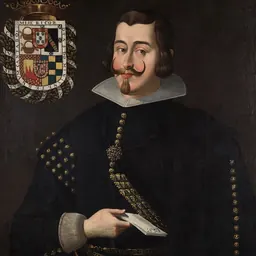
Portrait of Charles de Watteville, painted in Italy ca. 1637–40. Charles Watteville de Joux (Franche-Comté, Spanish Empire, 1605 – Lisbon, Portugal, 1670), 1st Baron of Watteville, was a Burgundian noble, soldier and diplomat in the service of King Philip IV of Spain. His surname is supposed to be an adaptation into French of the origin of his grandfather, a native of Wattenwil (Switzerland), and has also been translated as Batteville, Vatteville and Vatevile. He also had the titles of Count of La Corbière and Knight of the Golden Fleece.
Biography He was the son of Pierre de Watteville de Joux (1575–1631) and his wife Catalina Bobbio, Countess of Bussolino. His younger brother was Jean de Watteville, Abbot of Baume-les-Messieurs, famous for his eventful life.
He participated in the Thirty Years' War, fighting against the French in Valtellina, enrolled in the Burgundian Tercio. In 1638 he took command of that Tercio, when it fought in Milan and participated in the defense of Trino, besieged by Marshal Turenne in 1643. He also participated in the defense of fortresses in Tuscany in 1646, and as Mariscal de campo in the recovery of Naples in 1648. He negotiated on behalf of the King of Spain the assistance of the rebel fleet that supported the Fronde uprising against King Louis XIV of France in the Battle of Bordeaux (1653) in the Bordeaux estuary. The event was widely commented on by the chroniclers of the time, such as Samuel Pepys, who due to his animosity towards the French celebrated the 'victory' of the Spanish in his famous diary. The event angered King Louis XIV, who expelled the Spanish ambassador in Paris and threatened to declare war on Spain if the guilty were not punished, which led to the return of Watteville to Madrid.
After his return from London, he was held prisoner in the castle of Santorcaz, not recovering his role at Court until the death of Philip IV, in 1665. Already under the regency of Mariana of Austria, in 1666 he was assigned as extraordinary ambassador to Rome. He participated in the negotiations for the defense of Franche-Comté, claimed by the French and in 1668, after the Portuguese Restoration War, he was entrusted with the new embassy in Portugal, where he died in 1670.
Shortly before dying, Queen Mariana had named him a knight of the Order of the Golden Fleece.
He never married and had no children.
Don’t just read it —
keep it.
Full-length biographies made to live with: read them, listen on the way to work, watch them tonight.
- E-book
- Audio
- Video
Instant download · yours to keep · every purchase keeps this site free
Important facts
People in Charles de Watteville's life
Named in this biography and alive at the same time


Related people
Same field, nearest in time



Contemporaries
People whose lives overlapped Charles de Watteville's





Frequently asked questions
Who was Charles de Watteville?
Spanish diplomat (1605-1670)
When was Charles de Watteville born?
Charles de Watteville was born in 1605 in Nozeroy.
When did Charles de Watteville die?
Charles de Watteville died in 1670 in Lisbon.
What was Charles de Watteville's occupation?
Charles de Watteville was a diplomat.
What nationality was Charles de Watteville?
Charles de Watteville was Spanish.
Sources & further reading
· Wikipedia: Charles de Watteville
· DBpedia: Charles de Watteville
Cite this page
APA: Biography.guide. (2026). Charles de Watteville. https://biography.guide/charles-de-watteville/
MLA: "Charles de Watteville." Biography.guide, https://biography.guide/charles-de-watteville/.
Chicago: "Charles de Watteville." Biography.guide. https://biography.guide/charles-de-watteville/.
Data last updated: 2026-09-20 · Spot an error? Report a correction.
Page generated 2026-09-27 05:19 UTC