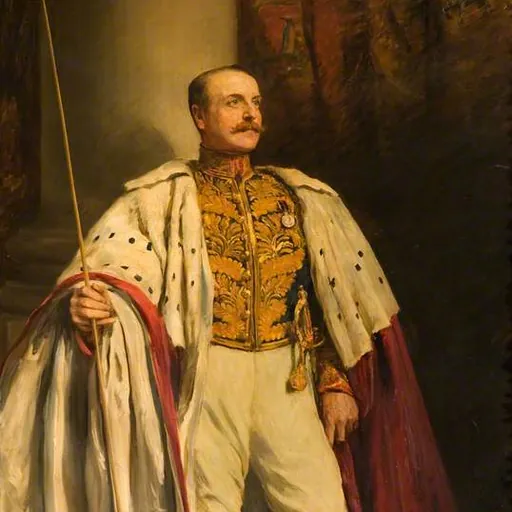
About Charles Chetwynd-Talbot, 20th Earl of Shrewsbury
Lived 1860 – 1921 (aged 60). Charles Chetwynd-Talbot, 20th Earl of Shrewsbury was a British polo player and businessperson.
Major Charles Henry John Chetwynd-Talbot, 20th Earl of Shrewsbury, 20th Earl of Waterford, 5th Earl Talbot , KCVO (13 November 1860 – 7 May 1921), styled Viscount Ingestre from 1868 to 1877, was a British peer. Unlike other wealthy noblemen of the period, he went into business, opening several ventures connected to road transport, with mixed success.
Family background Shrewsbury, who was born at Eaton Place, Belgravia, London, was the only son and heir of Charles Chetwynd-Talbot, 19th Earl of Shrewsbury and 4th Earl Talbot. His grandfather, The 18th Earl of Shrewsbury, had inherited the earldoms from a very distant cousin, and had to prove his claim to the premier earldoms of Great Britain and Ireland on the Roll in the House of Lords by demonstrating his descent from the 2nd Earl of Shrewsbury and 2nd Earl of Waterford. Shrewsbury was the nephew of: Constance, who married The 8th Marquess of Lothian; Gertrude, who married The 13th Earl of Pembroke; and Adelaide, who married The 3rd Earl Brownlow, the brother of Theresa, a notable hostess, who married The 6th Marquess of Londonderry.
Inheritance Shrewsbury's very rich father died when Shrewsbury, then styled as Viscount Ingestre, was a schoolboy of 16. All his father's property and personal wealth were left to the young Lord Shrewsbury's mother, the former Anna Theresa Cockerell. She lived until 1912, when he was aged 51.
Education and marriage Lord Shrewsbury was educated at Eton College but the relationship was superseded by his elopement with his future Countess.
Public offices and honours In right of his peerage, Lord Shrewsbury became Hereditary Lord High Steward of Ireland, in which capacity he took part in the coronations of Kings Edward VII and George V, and accompanied the former on his state visit to Dublin in July 1903. He was made KCVO in 1907. In 1895, Lord Shrewsbury founded the Staffordshire Polo Club at his house, Ingestre Hall.
Then, aged only 23, he began in Westminster, London, in the summer of 1884 with 35 Forder Royal Hansom cabs made by Forder of Wolverhampton, who held Royal Warrants for their carriages and made luxury hansoms for private use. Lord Shrewsbury's were built to Forder's special patented design and they were of Forder's special lightweight construction. Each was fitted with rubber tyres for passenger comfort which also had a side effect of lengthening the carriage's life. All his horses were hog-maned and on the side of each cab was a coronet and the initials S and T at either side of it. The telephone was laid on to the stables so a cab might be called at a moment's notice. To begin with, drivers paid £1 a day for the use of the horse and cab, keeping the remainder of their takings. In slack periods the drivers would strike, asking Lord Shrewsbury for a price reduction. In the summer of 1888, he floated a public listed company, The Shrewsbury and Talbot Cab and Noiseless Tyre Company Limited, to buy two businesses. Firstly, the business of cab proprietor and job master worked by the earl himself, and secondly the business of The Noiseless Tyre Company Limited, manufacturers of steel and rubber tyres in Manchester and London.
In the spring of 1891, following almost annual strikes by his cab drivers, Lord Shrewsbury put his company's 300 horses up for sale, under police protection, in the company's Battersea premises. At that time they operated from a number of yards in different parts of London. The press reported the terms offered to drivers in detail, then the prices of the horses, and advised that every animal put up for sale had been sold. Strong competition from other rubber tyred cabs seems to have become a serious problem. The business was restarted in October 1891 with cabmen friendly to the company.
Motoring In November 1900, Lord Shrewsbury formed another public listed company, Shrewsbury S T and Challiner Tyre Company Limited, to manufacture and deal in cabs, carriages, motor cars, cycles, vehicles, tyres, tubes, wire, India rubber and gutta percha goods, etc. In December 1903, he was described in a court action brought by Dunlop over the importation of Michelin tyres as "proprietor of the business known as Maison Talbot in London's Long Acre managed by Mr Weigel."
In March 1901 he formed British Automobile Commercial Syndicate Limited "with objects sufficiently indicated by the title". The shareholders were not people of note but provided addresses in the then almost semi-rural Ladbroke Grove, Notting Hill, Shepherd's Bush areas and Hatton Garden EC. One of the shareholders was a Mr R. Weigel of 25 Maxilla Gardens, North Kensington. Lord Shrewsbury was the first chairman. The other first directors were M. Chabert, president of the Société Commerciale d'Automobiles, Paris, and Mr D.M. Weigel, managing director. The new premises, (formerly occupied by carriage builders) at 97-98 Long Acre (adjoining 1 Endell Street), covered "four large floors". Twelve months later, Lord Shrewsbury was made chairman of Messrs J. Rothschild and Son Limited, incorporated to carry on the business of making motor car bodies by expanding the London activities of the well-known French businesses of Clément-Rothschild and Messrs J. Rothschild and Son. The second floor of the same building was to be Maison Talbot, suppliers of Talbot tyres (as fitted by The Hon. C.S. Rolls), the third floor to be automobile clothing. In March 1909, Shrewsbury made a formal announcement that he would close the business which could be seen to be competing with his Talbot agents.
In 1909, he floated Homoil Trust Limited, leading a board of the late engineer-in-chief of the Navy, another colliery owner and a well-known consulting engineer. The company was formed to purchase and develop various patents for the production of a cheaper home-produced and more efficient substitute for petrol made from coal-tar. It was voluntarily wound up at the end of 1910.
Talbot motorcars
Lord Shrewsbury founded Clément-Talbot Limited in 1902. He built for it the United Kingdom's first purpose-built automotive-manufacturing plant in London's North Kensington with his own personal crest set high above the entrance to the administration building. He involved Adolphe Clément-Bayard as his "engineer" and began by importing his popular French Clément-Bayard cars into Britain.
At Brooklands in November 1912, Lord Shrewsbury's Talbot car of only 25.6 horsepower rating, driven by Percy Lambert, attained a speed of 113.28 miles per hour and broke many other class records. The only faster car on the Brooklands track was a Mercedes-Benz of 84.8 horsepower rating.
Military service The Earl served entirely on home service in Britain during the First World War. He was a Major in the Army Remount Service of the Army Service Corps from 1914 to 1915, In January 1915, his only son, Viscount Ingestre, a reservist in the Royal Horse Guards at Regent's Park Barracks, died in London of influenza followed by pneumonia.
Later life Lord Shrewsbury died in May 1921, aged 60, and was buried at the parish church of Ingestre. There then ensued an inheritance battle for his estate between his wife and his grandson. His grandson, John, 21st Earl of Shrewsbury, claimed the late 20th Earl had not been of sound mind when his last will was written and won a court settlement. Ellen left the house the late Earl had built for her, 'Cariad' in Goring-on-Thames, moving to 'Cariad Cottage' in an equally tranquil setting. Prior to Lord Shrewsbury's death, he had already bequeathed her the sum of £2,000 per month until she died.
Ancestry
Don’t just read it —
keep it.
Full-length biographies made to live with: read them, listen on the way to work, watch them tonight.
- E-book
- Audio
- Video
Instant download · yours to keep · every purchase keeps this site free
Important facts
People in Charles Chetwynd-Talbot, 20th Earl of Shrewsbury's life
Named in this biography and alive at the same time



Related people
Same field, nearest in time
Contemporaries
People whose lives overlapped Charles Chetwynd-Talbot, 20th Earl of Shrewsbury's

Frequently asked questions
Who was Charles Chetwynd-Talbot, 20th Earl of Shrewsbury?
British Earl
When was Charles Chetwynd-Talbot, 20th Earl of Shrewsbury born?
Charles Chetwynd-Talbot, 20th Earl of Shrewsbury was born on 13 November 1860.
When did Charles Chetwynd-Talbot, 20th Earl of Shrewsbury die?
Charles Chetwynd-Talbot, 20th Earl of Shrewsbury died on 7 May 1921.
What was Charles Chetwynd-Talbot, 20th Earl of Shrewsbury's occupation?
Charles Chetwynd-Talbot, 20th Earl of Shrewsbury was a polo player and businessperson.
What nationality was Charles Chetwynd-Talbot, 20th Earl of Shrewsbury?
Charles Chetwynd-Talbot, 20th Earl of Shrewsbury was British.
Sources & further reading
· Wikipedia: Charles Chetwynd-Talbot, 20th Earl of Shrewsbury
· DBpedia: Charles Chetwynd-Talbot, 20th Earl of Shrewsbury
Cite this page
APA: Biography.guide. (2026). Charles Chetwynd-Talbot, 20th Earl of Shrewsbury. https://biography.guide/charles-chetwynd-talbot-20th-earl-of-shrewsbury/
MLA: "Charles Chetwynd-Talbot, 20th Earl of Shrewsbury." Biography.guide, https://biography.guide/charles-chetwynd-talbot-20th-earl-of-shrewsbury/.
Chicago: "Charles Chetwynd-Talbot, 20th Earl of Shrewsbury." Biography.guide. https://biography.guide/charles-chetwynd-talbot-20th-earl-of-shrewsbury/.
Data last updated: 2026-09-24 · Spot an error? Report a correction.
Portrait: Wikimedia Commons · author & licence
Page generated 2026-10-04 09:10 UTC