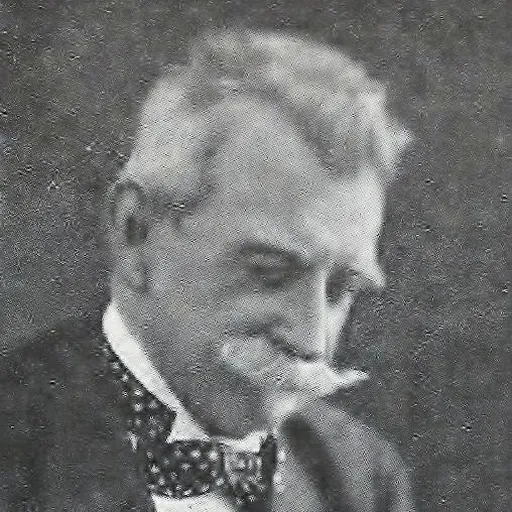
About Charles Cazalet
Lived 1858 – 1933 (aged 74). Charles Cazalet was a French politician.
Charles Cazalet (June 22, 1858 – January 18, 1933) was president of the Union of Gymnastics Societies of France from 1896 to 1931 and of the International Gymnastics Federation from 1924 to 1933.
Son of a Protestant family of Bordeaux wine merchants, Cazalet worked in the family business after completing his studies at the Lycée de Bordeaux. A philanthropic businessman, he initiated several social measures and created the first neighborhood gymnastics association. Elected to the Bordeaux city council, he took advantage of this mandate to innovate by creating popular shower baths, low-cost housing, and allotments. Then, without neglecting his professional commitments, he devoted himself more specifically to the development of gymnastics. President of the Union des sociétés de gymnastique de France in 1897, he held this position for 34 years, adding in 1924 the presidency of the new International Gymnastics Federation, which he held until he died in 1933.
Biography Charles Cazalet, a major figure in Bordeaux, is intimately linked to the city's life at the beginning of the 20th century. He was born in Cenon on June 22, 1858, into a Protestant family of wine merchants. Married in 1885 to Alice Hauchecorne, he had three children, including a son killed in the First World War on September 3, 1916.
Professional and civic commitments
After studying at the Lycée de Bordeaux, he began assisting his father in 1878, introducing a profit-sharing scheme for employees.
Married in 1889, he also became involved in social issues, helping his young wife to found the La Bastide crèche in 1891, the same year he organized a public heating system for the underprivileged during a particularly harsh winter. he made a considerable contribution to improving the situation of his fellow citizens. On April 13, 1892, he was responsible for setting up the Œuvre bordelaise des bains-douches à bon marché (Bordeaux low-cost shower-baths charity), chaired by the mayor of Bordeaux and of which he was general secretary. This was the starting point for the public shower-bath establishments invented sometime earlier for prisons. From 1899 onwards, he imported them to the capital, from where they spread to other cities. View of the Bastide district in 1907, from the Saint-Michel tower. On the following December 28, he founded the Société bordelaise des habitations à bon marché, which expanded rapidly from 1902 onwards. Although he gave up his municipal duties in 1896, The same year, he joined the Board of Governors of the Ligue de l'enseignement. In 1918, he created the Banque Populaire de la Gironde, and in 1927 opened the Clinique de La Bastide. However, Cazalet's fame extended beyond the city and its major achievements, for from 1896 to 1931, he acquired a national dimension by becoming president of the Union des sociétés de gymnastique de France (USGF), which he transformed from a patriotic educational organization into a sports organization.
In 1929, Maison Cazalet et fils was hit hard by the economic crisis, and Charles Cazalet, affected by the death of his wife, relinquished the main responsibilities he had held until then.
Republic gymnastics Indeed, gymnastics was to be the best means of expressing his commitment. In 1873, his parents enrolled him in the Bordeaux Gymnastics Society, where he was a student instructor in 1878 and a member of the board of directors in 1881. In 1884, he founded and chaired La Bastidienne, Bordeaux's first popular gymnastics society. The following year, he helped organize the XIth Fête Fédérale in Bordeaux: to this end, his Bordeaux friend Daniel Merillon had been elected President of the USGF at the Fête Fédérale in Amiens the previous year. Cazalet also set up the first instructors' course in Bordeaux. In 1890, he was rapporteur for the finance committee of the USGF,
In 1894, La Bastidienne inaugurated its new gymnasium in the presence of Joseph Sansboeuf, and the following year, Cazalet again became rapporteur for the USGF During the 1900 Olympic Games, the USGF federal festival inaugurates the new Vincennes velodrome. In 1900, at the Paris Olympics, gymnastics, along with cycling, was the most popular sport in France. It was also at the heart of the Third Republic's physical and moral education and, according to Jules Ferry, the true “peaceful avant-garde of the fatherland in arms”. On June 3 and 4, the USGF inaugurated the brand-new Vincennes velodrome with its federal festival, attended by 8,050 gymnasts from all over France. The ensuing international competition, held on July 29 and 30 as part of the Universal Exhibition, was won by Gustave Sandras and was a great success for the French gymnasts, who relegated the first foreigner, a Swiss, to 18th place. On September 2, the competition organized by the Association des Sociétés de Gymnastique de la Seine brought the gymnastics festivities to a close. Cazalet, already convinced of the value of competition, capitalized on the craze and lobbied the European office for the regular organization of gymnastics competitions.
At the same time, he was determined to make the opportunity a permanent one in France, and invited the painter Octave Denis Victor Guillonnet to the next federal festival in Nice on April 7 and 8, 1901. 3,000 French gymnasts marched past Gambetta's tomb in a solemn national tribute. He arranged for the work immortalizing the moment to be etched and reproduced on a large scale. In a letter to Étienne Dujardin-Beaumetz, Under-Secretary of State at the Ministry of Fine Arts, dated October 2, 1909, he stated his objective: “propaganda engravings which, I believe, would serve admirably the patriotic cause to which we are attached; the memory of this great event, the ideas it evokes, the memory of Gambetta and the defense of the nation are all radiating forces to further increase the patriotic and republican feelings of all our youth”. In 1905, he organized the Fête Fédérale in Bordeaux, in the presence of Émile Loubet, President of the Republic, and again to mark the inauguration of a monument to Gambetta.
Sports development at USGF On April 12, 1903, the USGF was recognized as a public utility and the first international tournament was held in Antwerp under the aegis of the European office. France took first place in the team event. The USGF had entered the sporting era, and President Charles Cazalet took charge of the next tournament, held in Bordeaux in 1905 on the occasion of the Fête Fédérale: France did it again and Marcel Lalue, from Limoges, won the individual ranking. In 1908, Charles Cazalet headed 100 French gymnasts to the London Games. Like Martinez, Torres hails from Algeria, which quickly proved to be a region of gymnastic excellence. The USGF organized its French championship there in 1930 to celebrate the centenary of the Sidi-Ferruch landing.
Cazalet attached great importance to the training of managers, most of whom were military personnel or former military personnel from the École de Joinville. To provide them with a higher level of training, in 1903 he financed the Cours Supérieur d'Education Physique created at the Sorbonne by Georges Demenÿ, Étienne-Jules Marey's assistant at the Parc des Princes physiological station.
Under his presidency, the USGF also invested in the colonial Empire: in his book, Jean Latte cites Algéria-Sports and the Tricolore de Dakar among the USGF's major associations. Although the USGF had already organized its federal festival in Algiers in 1896, it returned there in 1930 to celebrate the 100th anniversary of the conquest of Algeria. However, international results declined: France fell back to third place at the international tournaments in Ljubljana in 1922 and Lyon in 1926, before moving up to second place in 1930 in Luxembourg. From the following year onwards, international tournaments gave way to world championships, and France fell back again in the overall rankings.
During this period, the USGF remained a strong showcase for the defense of the republican ideal, and Cazalet mobilized his federal party whenever necessary: in 1929 in Orleans to mark the secular state's claim to Joan of Arc as a national heroine, and in 1931 in Paris for the Paris International Colonial Exhibition.
Despite his services, his never-ending duel with Tissié and his medical colleagues finally turned to his disadvantage in 1923: the higher education course fell out of the hands of the USGF, which had to give up the right to govern the training of physical education teachers. Cazalet refocused on training the gymnastics managers of his associations, and from 1927 onwards the USGF organized an annual course for civilian instructors in Dinard. The course was moved to Saint-Maur during the Occupation. In 1931, Cazalet, suffering from his professional setbacks, stepped down as president and died two years later.
Notoriety
International dimensions His relations with the Czech sokols led to his appointment as Czechoslovak consul in Bordeaux, and his professional connections enabled him to expatriate the federal festival to North Africa on three occasions (Algiers in 1896 and 1930, Tunis in 1912). In 1924, at the Paris Congress, Charles Cazalet, vice-president of the Bureau des fédérations européennes de gymnastique (BFEG) since 1910 succeeded the Belgian Cupérus at the head of the Fédération internationale de gymnastique (FIG), which had replaced the BFEG founded in 1881 two years earlier. He became its second president and remained in office until he died in 1933. It was during his term of office that the biennial international tournament was transformed into the Gymnastics World Championships in 1931. He received the medal of honor from the Société nationale d'encouragement au bien in 1895 and the gold medal from Assistance publique in 1908.
The recipient of numerous foreign awards, his promotion to the Legion of Honor was meteoric: knight in 1896, officer in 1900, and commander in 1912. This last promotion was confirmed in 1919 to Lieutenant-Colonel Charles Cazalet for his exemplary behavior at Verdun and on the Somme.
In 1931, he was awarded a Grand Prix at the Paris International Colonial Exhibition.
Don’t just read it —
keep it.
Full-length biographies made to live with: read them, listen on the way to work, watch them tonight.
- E-book
- Audio
- Video
Instant download · yours to keep · every purchase keeps this site free
Important facts
People in Charles Cazalet's life
Named in this biography and alive at the same time



Related people
Same field, nearest in time





Contemporaries
People whose lives overlapped Charles Cazalet's


Frequently asked questions
Who was Charles Cazalet?
French politician
When was Charles Cazalet born?
Charles Cazalet was born on 22 June 1858 in Cenon.
When did Charles Cazalet die?
Charles Cazalet died on 18 January 1933 in Bordeaux.
What was Charles Cazalet's occupation?
Charles Cazalet was a politician.
What nationality was Charles Cazalet?
Charles Cazalet was French.
Sources & further reading
Cite this page
APA: Biography.guide. (2026). Charles Cazalet. https://biography.guide/charles-cazalet/
MLA: "Charles Cazalet." Biography.guide, https://biography.guide/charles-cazalet/.
Chicago: "Charles Cazalet." Biography.guide. https://biography.guide/charles-cazalet/.
Data last updated: 2026-09-21 · Spot an error? Report a correction.
Portrait: Wikimedia Commons · author & licence
Page generated 2026-09-27 04:58 UTC