
About Charles Byrne
Lived 1761 – 1783 (aged 21–22). Charles Byrne was an Irish circus performer.
Charles Byrne (probable real name: Charles O'Brien; 1761 – 1 June 1783), or "The Irish Giant", was a man regarded as a curiosity or freak in London in the 1780s for his large stature. Byrne's exact height is of some conjecture. Some accounts refer to him as being to tall, but skeletal evidence places him at just over .
His skeleton was on display at the Hunterian Museum in London from 1799 until it was removed from public display in 2023.
Early life Byrne's family lived near the hamlet of Littlebridge in the south of County Londonderry in Ulster. It is said that Byrne had been conceived on top of a haystack, and that this was the cause of his great height. Some sources say that Byrne's father worked as a weaver, while his mother may have been Scottish.
Fame His celebrity spread as he made his way down northern England, arriving in London in early 1782, aged 21. There he entertained paying audiences at rooms in Spring Garden-gate, then Piccadilly, and lastly Charing Cross. He was the toast of the town; a 6 May 1782 newspaper report stated: "However striking a curiosity may be, there is generally some difficulty in engaging the attention of the public; but even this was not the case with the modern living Colossus, or wonderful Irish Giant."
His gentle, likeable nature inspired an immense public fondness, and his celebrity life was constantly splashed across the newspapers of the day. By mid-1782, he had inspired a hit London stage show called Harlequin Teague, or the Giant's Causeway. The coffin was made and measured 9 feet 4 inches in length, but Hunter nevertheless acquired the body.
Hunter then reduced Byrne's corpse to its skeleton and four years later put Byrne's skeleton on display in his Hunterian Museum. His skeleton was purchased in 1799 by the Hunterian Museum at the Royal College of Surgeons in London and it was then displayed for nearly two centuries.
A public poll conducted on the BMJ website over December 2011—January 2012 in response to the article "Should the Skeleton of 'the Irish Giant' Be Buried at Sea?" by Doyal and Muinzer offered people the chance to vote on what they thought should happen to Byrne's remains. Doyal and Muinzer reported: "On the last count that we saw before voting ceased, 55.6% (310) voted for burial at sea; 13.17% (74) for removal from display and being kept for research; and 31.55% (176) for the status quo."
The BMJ article was widely reported and the resulting swell of public support for the campaign forced The Royal College of Surgeons to formally consider whether it should release Byrne's skeleton, the showpiece of their Hunterian Museum, in February 2012. They decided to continue the exhibit.
A further academic article was published in the International Journal of Cultural Property On 6 June 2018, speaking on behalf of the campaign, Muinzer published an article in The Conversation entitled "Why a London museum should return the stolen bones of an Irish giant" as a result of recent developments with the case.
Following renewed pressure from campaigners, The Guardian reported in a 2018 article entitled "'Irish giant' may finally get respectful burial after 200 years on display" that the Trustees of the Hunterian Museum have confirmed that they will consider whether to release the skeleton of Charles Byrne for burial. A spokesperson for the Royal College of Surgeons said "The Hunterian Museum will be closed [from late 2016] until 2021 and Charles Byrne's skeleton is not currently on display. The board of trustees of the Hunterian collection will be discussing the matter during the period of closure of the museum".
Carla Valentine, technical curator of the Pathology Museum at Queen Mary University, London, said: "Now that it's out there that they're considering this, I think it will be difficult to go back from that". The article set out a proposed legal case for Byrne's burial, based on common law principles mainly drawn from corpse disposal law. It suggested that, were a person seeking to arrange Byrne's sea burial to challenge the Hunterian Museum in an English court for lawful possession of his remains, the court would grant them this possession. She further argued in 2022 that English law has always prioritised the dignity of the human corpse, treating it as if it is still to some degree a person owed human dignity, and that it would do so for Byrne if the current situation were challenged - noting that the law can only intervene in such a matter if asked.
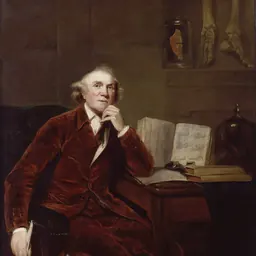
On 11 January 2023, the Hunterian Museum announced official retirement of Byrne's skeleton from public display. The museum instead will display an oil portrait of John Hunter by painter Sir Joshua Reynolds, completed in 1789. This portrait features the feet of Byrne's skeleton hanging above Hunter in the upper righthand corner.
Medical condition The American surgeon Harvey Cushing studied Byrne's bones in 1909 and found that Byrne had had a pituitary tumour based on an enlarged pituitary fossa. In 2011, British and German researchers determined the cause of Byrne's gigantism. They extracted DNA from Byrne's teeth and found that he had a rare mutation in his AIP gene that is involved in pituitary tumours. The researchers found that four contemporary families living in Northern Ireland which have a history of related pituitary disorders also carried this mutation. The researchers inferred that Byrne and these families had a common ancestor about 57 to 66 generations ago (1,425 to 1,650 years ago).
Legacy Author Dame Hilary Mantel wrote a fictionalised novel of his life in The Giant, O'Brien, published in 1998. The plot of the novel focused on the battle between the revolution of science and the ways of poem and song. O'Brien (Byrne) was portrayed as a man whose faith was in tales of kings and the little people, while his polar opposite John Hunter was portrayed as at the dawn of the scientific age, destroying all that is old and cherished. It mentions that O'Brien (Byrne) was related to another Irish giant in Patrick Cotter O'Brien of County Cork, who exhibited himself shortly after the death of Byrne, stating that he was 8'7" in height.
An exhumation of Patrick O'Brien's bones in 1972 showed that his true height was 8'1". The book mentions a sort of kinship with two other Irish giants known simply as 'The Brothers Knipe' who both stood 7'2" each. They were recognised by the Guinness Book of World Records as the tallest identical twins in history. In 2010, poet Moyra Donaldson from Northern Ireland published the anthology Miracle Fruit which featured a poem inspired by Charles Byrne called 'The Skeleton of the Great Irish Giant'.
Author Tessa Harris made him one of the main characters in her novel The Dead Shall Not Rest, which examines the beginnings of forensic science, anatomy and surgery. The book emphasises the difficulties that anatomists of the time had in gaining access to bodies to dissect, and the resulting illegal trade in dead bodies.
He is mentioned in chapter 32 of Charles Dickens' novel David Copperfield, to illustrate the enormousness of an umbrella: "But her face, as she turned it up to mine, was so earnest; and when I relieved her of the umbrella (which would have been an inconvenient one for the Irish Giant), she wrung her little hands in such an afflicted manner; that I rather inclined towards her."
Pat Murphy's 1990 novella Bones is a fictionalized account of Byrne's life, with elements of magic realism. It won the World Fantasy Award for best novella and was nominated for the Nebula Award and the Hugo Award.
On 2017, Irish songwriter Seamus Fogarty released a song about Byrne - "A Short Ballad for a Long Man", with a video by Kieran Evans.
In June 2023, an opera about Byrne by composer Sarah Angliss called Giant premiered at Snape Maltings in the UK.
Don’t just read it —
keep it.
Full-length biographies made to live with: read them, listen on the way to work, watch them tonight.
- E-book
- Audio
- Video
Instant download · yours to keep · every purchase keeps this site free
Important facts
People in Charles Byrne's life
Named in this biography and alive at the same time

Related people
Same field, nearest in time


Contemporaries
People whose lives overlapped Charles Byrne's




Frequently asked questions
Who was Charles Byrne?
Irish entertainer
When was Charles Byrne born?
Charles Byrne was born in 1761 in Derry.
When did Charles Byrne die?
Charles Byrne died in 1783 in London.
What was Charles Byrne's occupation?
Charles Byrne was a circus performer.
What nationality was Charles Byrne?
Charles Byrne was Irish.
Sources & further reading
· DBpedia: Charles Byrne (giant)
Cite this page
APA: Biography.guide. (2026). Charles Byrne. https://biography.guide/charles-byrne-circus-performer/
MLA: "Charles Byrne." Biography.guide, https://biography.guide/charles-byrne-circus-performer/.
Chicago: "Charles Byrne." Biography.guide. https://biography.guide/charles-byrne-circus-performer/.
Data last updated: 2026-09-26 · Spot an error? Report a correction.
Page generated 2026-09-27 05:14 UTC