
About Charles Audé de Sion
Lived 1758 – 1837 (aged 78). Charles Audé de Sion was a Russian and Italian military officer, teacher and monk.
Charles Osipovich Ode-de-Sion (; born Charles-Marie-Joseph-Joachim Audé, or shortly Charles Audé; 23 August 1758, Faverges, Duchy of Savoy, Kingdom of Sardinia5 January 1837, Saint Petersburg, Russian Empire) was a Savoyard Benedictine monk and military serviceman; in Russian service — major general, military pedagogue, a prominent freemason of the highest degrees of initiation. Landowner and founder of the Russian noble family Ode-de-Sion.
During his early years, he exchanged monastic vows for military service, swearing oaths to several European sovereigns — including the French, Prussian, and Polish crowns — through which he attained a Doctor of Theology degree in the ecclesiastical sphere and the rank of captain in the military. Upon entering Russian service, he was posted to Warsaw as an officer on special assignments under the Commander-in-Chief of Russian forces in Lithuania and Poland, General of Infantry Count Osip Igelström. He distinguished himself in engagements against Polish insurgents during the Kościuszko Uprising.
He was the tutor of Arkadi, the son of the great commander Count Alexander Suvorov. Enjoying the latter's trust, he participated in the financial machinations of his son-in-law Count Nikolai Zubov. From a private tutor, he advanced under Alexander I to the position of inspector of classes at the Page Corps, to which he devoted 25 years.
After the initiation into the free masons brotherhood in Poland and Savoy at the end of the 18th century, he reached the highest degrees and became a prominent figure in the "golden age" of Freemasonry in Russia (1802–1822). Co-founder and Worshipful Master of the lodge "United Friends" in Saint Petersburg, member of a number of other lodges and higher Masonic organizations.
Names He was baptized as Charles-Marie-Joseph-Joachim Audé , or briefly — Charles Audé. In monastic life, he bore the name Dom Joachim , but upon entering Russian service, he adopted the name Charles Osipovich Ode-de-Sion. According to his biographer, the French historian Dr. Michel Francou, in order to give the merchant surname Audé a more aristocratic ring, he "borrowed" the prefix from his distant Savoyard relatives, the barons de Sion , who from 1276 owned the eponymous château and a small parish in the vicinity of Annecy (now part of the commune Val-de-Fier). It is also possible that such a surname was a kind of allusion to Charles Osipovich's Masonic nickname — Chevalier du Fort de Sion (French: Chevalier du Fort de Sion). In private correspondence and some official documents, his Russian surname appears in abbreviated form — Sion.
Origin Charles Audé came from the "Annecy-Faverges" branch of the ancient Savoyard family Audé. Although some Russian sources erroneously describe him as Swiss or French, his official biography confirms his Savoyard origin.
His ancestors settled in Annecy from 1628, initially trading in spices before switching to iron goods — mainly weapons — and acquiring several forges and mines in the vicinity. In 1715 the family purchased the notarial patent of nearby Faverges and relocated there, retaining their Annecy home and part of their forge operations. The position passed from father to eldest son until 1786.
Despite their low origin, the family's wealth and influence secured them a prominent place in Savoyard society, and impoverished noble houses willingly intermarried with them. Charles's second cousin once removed, Philibert de La Diat, married the nobleman Prosper-Antoine ; his paternal grandmother, Claudine Cochet, was a second cousin of mathematician and Sorbonne rector Jean Cochet (1698–1771); and his mother, demoiselle Marie-Thérèse, née Favre (1710–?), was the full sister of François Favre, marquis de Thônes. Thus, while not noble by estate, Charles Audé was of noble blood.
Biography
Birth and early years According to Savoyard sources, Charles Audé was born on August 23, 1758, in his parents' house in Faverges. Russian sources do not report the place of birth, and the dates vary: according to the Russian Biographical Dictionary, he was born in 1753 (in the Petersburg Necropolis — August 1, 1753), while his 1817 service record states his age at the time of compilation as 56 years old. Nassau-Siegen took a liking to the Russian-serving francophone officer familiar with Polish and Prussian military orders and willingly performing delicate tasks for the prince's mission.
Little before death, Charles Osipovich corresponded brother Joseph Audé (1773–1838) —Annecy military pensioner— allocating part last inheritance own son Charles. But Savoy kin opposed ensured uncle estate entirely another nephew Baron Benoit-Jacques Audé. Charles Charlesovich Ode-de-Sion inherited father's large debts and family estate 75 serfs Pskov Governorate.
Class inspector at the Page Corps (1802–1827)
In February 1798, while still tutoring Arkady Suvorov, Ode-de-Sion was engaged as a private tutor by General of Infantry Count Ivan Ferzen, then Director of the Land Cadet Corps, to prepare noble children for cadet life under his patronage. Among his pupils during this period was the future writer Faddei Bulgarin, enrolled in the corps on November 13, 1798. On August 25, 1799, Ode-de-Sion was formally enrolled in the corps staff as a teacher of fortification. While being pregnant with their second child, Karolina Ivanovna was separated from her husband by the events of the Warsaw Uprising (also known as the Warsaw Matins). Having safely survived the looting of their Warsaw estate by marauders, she gave birth a few days later, on 26 April 1794, to their only son Charles, who would later become a participant in the Patriotic War of 1812, a State Councillor, and Vice-Governor of Saratov Governorate. It was only after Russian troops occupied Warsaw in November of that year that Captain Ode-de-Sion was able to locate his family and see his newborn son for the first time. Thanks to her efforts, the Ode-de-Sion family line did not die out. Its descendants continue to live in the post-Soviet space, while some, having emigrated after the October Revolution, reside in France.
Awards
On 28 February 1795, he was awarded the highest Prussian military order For Merit (Pour le Mérite). On 8 November 1808, for diligent service, he was awarded the Order of Saint Vladimir 4th class. On 26 November 1826, for length of service, he was awarded the Order of Saint George 4th class.
Language knowledge Charles Osipovich Ode-de-Sion was proficient to varying degrees in at least four languages. French was his native tongue, and thanks to his theological education, he was able to express himself fluently in writing and speech in "refined Latin". In addition, his 1817 service record indicates that he could read and write in German and Russian. However, as late as 1802, upon his appointment to the Page Corps after eleven years of service in Russia, he "assumed his duties completely unfamiliar with the Russian language, and even wrote reports to his superiors in French".
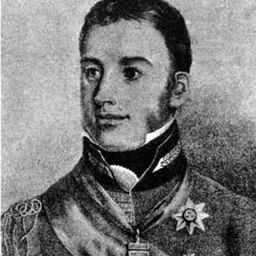
Verbal portrait No images of Major-General Ode-de-Sion are known to exist in Russian sources. However, it is documented that he sent at least one portrait miniature of himself, painted in 1827 at the age of 69 by Jean-Henri Benner, to relatives in Savoy. In the second half of the 20th century, the French historian Dr. Francou had the opportunity to see it and provided the following verbal description of Charles Osipovich's appearance in his book:His portrait <...> reveals a man of action whose features are like Winston Churchill's: a broad forehead with receding hairline, short nose, penetrating eyes, the faint outline of a benevolent smile; the gold of the epaulettes and the red of the collar stand out against the dark green of the tunic.
Assessments Following his participation in the Polish campaign of 1794, Ode-de-Sion received highly favourable recommendations from both of his superiors to the Military Collegium: Baron Igelström (3 December 1795) and Prince Nassau-Siegen (10 September 1794) praised his exemplary conduct, diligence and precision in performing his duties, 'as befits a good and conscientious officer".
However, Lieutenant-General Pyotr Mikhailovich Daragan spoke of Charles Osipovich rather disparagingly in his memoirs about his years of study in the Page Corps, believing that he preferred 'good wine, a good dinner, and his Masonic lodge' to concern for the pages' education. However, in his memoirs, Philipp Philippovich Vigel described Charles Osipovich as a kind, cheerful and intelligent man who inspired love and respect from the pages and Masons alike, and who 'lacked the insolence and turbulence of the nation to which he belonged'.
Don’t just read it —
keep it.
Full-length biographies made to live with: read them, listen on the way to work, watch them tonight.
- E-book
- Audio
- Video
Instant download · yours to keep · every purchase keeps this site free
Important facts
People in Charles Audé de Sion's life
Named in this biography and alive at the same time
Related people
Same field, nearest in time

Contemporaries
People whose lives overlapped Charles Audé de Sion's






Frequently asked questions
Who was Charles Audé de Sion?
savoyard monk and soldier (1758-1837)
When was Charles Audé de Sion born?
Charles Audé de Sion was born on 23 August 1758 in Faverges.
When did Charles Audé de Sion die?
Charles Audé de Sion died on 5 January 1837 in Saint Petersburg.
What was Charles Audé de Sion's occupation?
Charles Audé de Sion was a military officer, teacher and monk.
What nationality was Charles Audé de Sion?
Charles Audé de Sion was Russian and Italian.
Sources & further reading
· Wikipedia: Charles Audé de Sion
· DBpedia: Charles Audé-de-Sion
Cite this page
APA: Biography.guide. (2026). Charles Audé de Sion. https://biography.guide/charles-aude-de-sion/
MLA: "Charles Audé de Sion." Biography.guide, https://biography.guide/charles-aude-de-sion/.
Chicago: "Charles Audé de Sion." Biography.guide. https://biography.guide/charles-aude-de-sion/.
Data last updated: 2026-09-20 · Spot an error? Report a correction.
Page generated 2026-09-27 04:57 UTC