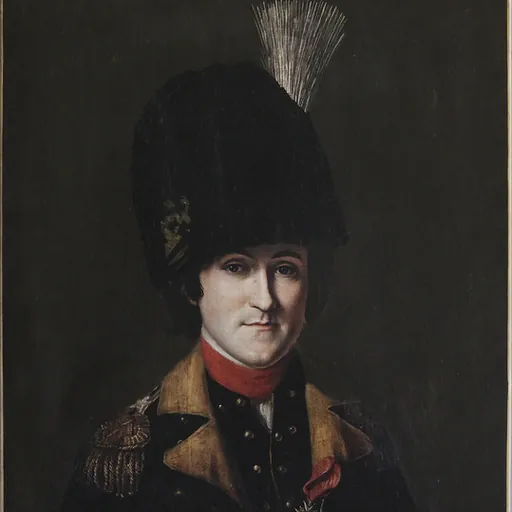
Charles Armand Tuffin, marquis de la Rouerie
French cavalry officer
About Charles Armand Tuffin, marquis de la Rouerie
Lived 1751 – 1793 (aged 41). Charles Armand Tuffin, marquis de la Rouerie was a French military personnel, military officer and chouannerie.
Charles Armand Tuffin, marquis de la Rouërie (13 April 1751 – 30 January 1793) was a French army officer who served in the American Revolutionary War. He was promoted to brigadier general after the siege of Yorktown and led Chouan rebels during the Chouannerie. La Rouërie is less-remembered than Gilbert du Motier, Marquis de Lafayette and other Frenchmen in writings on France in the American Revolutionary War.
Early life Destined for a military career from his earliest years, La Rouërie had an impetuous temperament that soon brought him to the public eye. He spent a rebellious youth in and around the French royal court, serving as an officer in the Gardes Françaises. After wounding the count in the duel, he fell into disgrace with the king and was ejected from the Gardes. La Rouërie took poison and went to la Trappe to die. It sank in Chesapeake Bay, but La Rouërie succeeded in getting to shore with only three surviving servants.
Under George Washington's orders, he became Colonel Armand and recruited volunteers which he paid from his own pocket. Pulaski's Legion, initially named after its commander, was renamed the First Partisan Corps (or Armand's Partisan Corps or Armand's Legion) after Pulaski's death at the end of 1779. Made up of infantry and cavalry, this corps of foreign volunteers fluctuated between three and five companies strong.
Promoted to a General on 25 June 1778, La Rouërie took part in the battles of New York, Monmouth, Short Hills, Brandywine, Whitemarsh, the Campaign in Virginia, and the Siege of Yorktown. In 1781, Colonel Armand returned to France to re-equip his troops, and was there made a Knight of the Order of Saint-Louis. He returned to France in the summer of 1784. He retained his friendship with Washington after leaving America and the two continued to correspond. La Rouërie was also made a member of the Society of the Cincinnati French chapter.
Early French Revolution In 1785 La Rouërie married Louise-Caroline Guérin, Marquise de Saint-Brice, a wealthy aristocrat. Shortly afterwards she developed mental illness and was treated by doctor Valentin Chevetel. Chevetel's help was not enough and La Rouërie’s wife died months later. He was freed a month later but would give up his former ideals. At first, he welcomed the Revolution which soon followed, but at the Estates General of 1789 he was indignant at seeing the Breton nobility succumb to the demands of the Third Estate. Excited to resistance, he provoked a refusal to send representatives to the Estates General, saying that he did not want those of the ancient nobility to bend over themselves to become a double representation of the people. This helped lead to the creation of the Breton Association. and, somewhat later, by the Count of Provence. The Association raised troops and measures were taken to build support garrisons of the National Guard. La Rouërie was then scheduled to address the ranks of men.
The Marquis de la RouërieLa Rouërie found support among the population of Brittany, who were very disappointed with the results of the Revolution, after having first been in favor, and then strongly opposed to the Civil Constitution of the Clergy, which sought to destroy the independence of the Catholic Church in France from control by the State. La Rouërie, a non-practicing Catholic criticized the Civil Constitution of the Clergy, and prepared the manifesto of the Breton Association. He also argued that since the abolition of the Provincial Estates General of Brittany, poverty had increased, and taxes were now three times higher.
On 20 April 1792, the French declared war on the Austrian Monarchy and the Holy Roman Empire. That same day, opponents of the Revolutionaries received the support of the Kingdom of Prussia, and the Army of Émigrés, leading to the formation of the first coalition against Revolutionary France. The Breton Association was ready with 10,000 men equipped for battle.
After a raid by French Revolutionary Army dragoons upon the Marquis's castle, La Rouërie moved to Launay-Villiers, which was located close to the hideout of Jean Chouan and his men. There is no evidence that La Rouërie and Jean Chouan ever met face to face, or that he had been recruited by the Association, but La Rouërie remained in hiding for three months at Launay-Villiers until early September.
Death Throughout late 1792-early 1793, La Rouërie wandered the countryside of Brittany. He adopted the false name of Gasselin and was accompanied by only Loaisel Fricandeau, his secretary, and Saint-Pierre, one of his servants. On 12 January 1793, after traveling around the forest of La Hunaudaye, La Rouërie and his two companions sought refuge near Castle Guyomarch, which belonged to the family of the same name from the parish of Saint-Denoual. It had snowed that day, and Saint-Pierre was suffering from a fever. La Guyomarch, a member of the Association, had already hosted la Rouërie three times in the previous month. They were housed in the castle for a couple days but Saint-Pierre's state was not improving. The next day, Loaisel Morel fetched a surgeon at Plancoët. On January 18 Saint-Pierre recovered, but then La Rouërie in turn fell ill on January 19. Guyomar recalled Dr. Morel, then as a precautionary measure, sent for Dr. Taburet of Lamballe. La Rouërie was believed to be suffering from a fever and was suffering from chills and severe coughing but it is now known that La Rouërie had pneumonia.
On January 24, the National Guard of Lamballe made a raid on Castle Guyomarch. Alerted by a neighbor, La Guyomar hid the marquis in a farm, located a hundred meters from the castle. The Guard discovered nothing. The next day, Schaffner and Fontevieux came to Guyomarch, bringing with them a newspaper which told of the execution of Louis XVI on January 21.
In a crisis of delirium, La Rouërie jumped out of bed, dressed, with the intent to leave the castle, but collapsed in a fit of weakness. For two to three days, he lay dying, alternating between prostration, delirium, and unconsciousness. A third doctor, Lemasson, was dispatched but could do nothing. La Rouërie died on 30 January 1793, at four-thirty in the morning.
Don’t just read it —
keep it.
Full-length biographies made to live with: read them, listen on the way to work, watch them tonight.
- E-book
- Audio
- Video
Instant download · yours to keep · every purchase keeps this site free
Important facts
People in Charles Armand Tuffin, marquis de la Rouerie's life
Named in this biography and alive at the same time


Related people
Same field, nearest in time



Contemporaries
People whose lives overlapped Charles Armand Tuffin, marquis de la Rouerie's




Frequently asked questions
Who was Charles Armand Tuffin, marquis de la Rouerie?
French cavalry officer
When was Charles Armand Tuffin, marquis de la Rouerie born?
Charles Armand Tuffin, marquis de la Rouerie was born on 13 April 1751 in Fougères.
When did Charles Armand Tuffin, marquis de la Rouerie die?
Charles Armand Tuffin, marquis de la Rouerie died on 30 January 1793 in Château de La Guyomarais.
What was Charles Armand Tuffin, marquis de la Rouerie's occupation?
Charles Armand Tuffin, marquis de la Rouerie was a military personnel, military officer and chouannerie.
What nationality was Charles Armand Tuffin, marquis de la Rouerie?
Charles Armand Tuffin, marquis de la Rouerie was French.
Sources & further reading
· Wikipedia: Charles Armand Tuffin, marquis de la Rouerie
· DBpedia: Charles Armand Tuffin, marquis de la Rouërie
Cite this page
APA: Biography.guide. (2026). Charles Armand Tuffin, marquis de la Rouerie. https://biography.guide/charles-armand-tuffin-marquis-de-la-rouerie/
MLA: "Charles Armand Tuffin, marquis de la Rouerie." Biography.guide, https://biography.guide/charles-armand-tuffin-marquis-de-la-rouerie/.
Chicago: "Charles Armand Tuffin, marquis de la Rouerie." Biography.guide. https://biography.guide/charles-armand-tuffin-marquis-de-la-rouerie/.
Data last updated: 2026-09-21 · Spot an error? Report a correction.
Portrait: Wikimedia Commons · author & licence
Page generated 2026-09-27 04:59 UTC