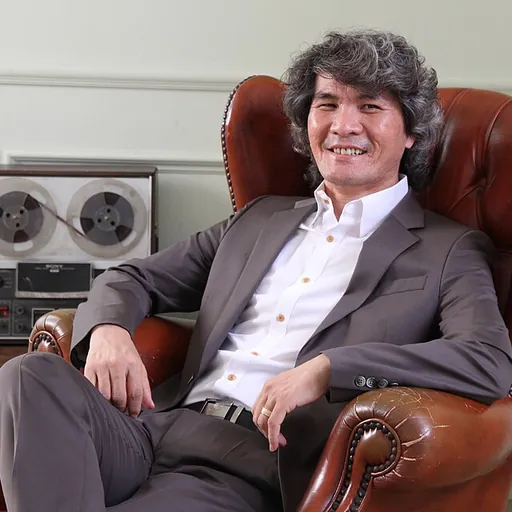
About Changjoon Justin Lee
Born 1966. Changjoon Justin Lee is a South Korean neuroscientist and researcher, known for Gamma-Aminobutyric acid and Glia.
Changjoon Justin Lee is an American neuroscientist specializing in the field of glioscience. He served as the Director of Center for Neuroscience at the Korea Institute of Science and Technology and later founded the WCI Center for Functional Connectomics as part of the World Class Institute Program. In 2015, he established the Center for Glia-Neuron Interaction before becoming co-director of the IBS Center for Cognition and Sociality and head of the Cognitive Glioscience Group in 2018. He has been on the editorial boards of the journals Molecular Brain and Molecular Pain and is a chief editor of Experimental Neurobiology.
Early life and education Born in a rural area of Gimpo, Lee interacted with the natural world and raised livestock at home which inspired an interest in biology. After completion of middle school, he left South Korea and moved to the US at age 15 and started high school at Rich Central High School, Olympia Fields, Illinois. While under an Illinois State Scholarship and working as a junior research assistant in the lab of Professor Louis Seiden, Lee majored in chemistry and obtained his B.A. from the University of Chicago in 1990. He then moved to New York where he enrolled in the Graduate School of Arts and Sciences of Columbia University where he earned his M.S. and Ph.D. in neurophysiology under the Department of Physiology and Cellular Biophysics. His doctoral thesis adviser was Professor Amy B. MacDermott, whose lab he worked in as a research technician and later as a graduate research assistant upon recipient of his M.S.
Before the first year of his joint M.S. and Ph.D. study, he worked as a research assistant in Emily Foster's lab at Michael Reese Hospital. Within Columbia University, he was also a research technician in Professor Martin Low's lab.
Career He then completed a three-year postdoc position in the lab of Professor Traynelis at Emory University in the Department of Pharmacology. His sponsor was Dr. Stephen Traynelis and his research scope was the modulation of NMDA receptors by protease-activated receptors. During the postdoc position, he visited the Korea Institute of Science and Technology (KIST) and was influenced by Shin Hee-sup to join KIST, and served as the organizing deputy director of the center.
In November 2018, Lee joined the IBS Center for Cognition and Sociality as a co-director with Shin Hee-sup, who he had previously met and worked with at KIST. Shin led the Social Neuroscience Group until his retirement in 2020 while Lee leads the Cognitive Glioscience Group which focuses on four research areas: molecular glioscience, glia-neuron interaction, glial plasticity and cognition, and gliopathy.
GABA synthesis and release from glia Lee's research group has contributed to the field of gliotransmission by creating several seminal publications on the channel-mediated gamma-Aminobutyric acid (GABA) and glutamate release from astrocytes. They later identified the biosynthetic pathway for astrocyte GABA and found monoamine oxidase B to be the key enzyme for GABA production which raised the possibility that astrocytes can directly participate in cognitive processes via astrocytic GABA.
His team also found a connection with GABA from reactive astrocytes and impaired memory in mouse models of Alzheimer's disease, leading them to propose astrocytic GABA might be a diagnostic tool, biomarker, and therapeutic target for both neurological diseases Alzheimer's and Parkinson's. The research is notable as it revealed that astrocytes, like neurons, play a significant role in cognitive processes. The findings also resulted in a technology transfer to MegaBioWood which will be prepared for a phase I clinical trial in 2019. In response to his Alzheimer's research related to causes of memory loss, Lee received the Science Day 2017 Presidential Medal of Honor. His team went on to discover two models of glutamate release; a fast mode through TREK-1 in the K2P channel and a slow mode through the Best1 channel in hippocampal astrocytes. These papers also show that the key modulator for excitation-inhibition balance in the brain is mainly dependent on the levels of glutamate and GABA. In addition to glutamate, Best1 can also release d-serine, which can act as a co-agonist of NMDA receptors to participate in synaptic plasticity.
Astrocytic volume transient and brain plasticity Some of his glioscience-related research has been with identifying and characterizing several astrocytic ion channels. His teams learned that the astrocytic two-pore potassium channel K2P has a passive conductance with a subunit composition of a heterodimer of TWIK-1 and TREK-1. The team found that the astrocytic volume-regulated anion channel (VRAC) is tweety-homolog (Ttyh), which is notable as VRAC was proposed to be leucine-rich repeat-containing protein 8 (LRRC8). Lee's research also showed that the astrocytic volume change through aquaporin-4 water channel is critical for synaptic plasticity. They demonstrated that a change in the volume can directly affect spatial memory in mice, meanwhile it affects memory and language-association learning in humans. but their in vivo functions have not been fully tested due to the lack of an appropriate experimental model. When Lee's team developed an astrocyte-specific toxin receptor model, they found that the astrocytes selectively became reactive, which identifies severe reactive astrocytes as a key factor in Alzheimer's disease neurodegeneration.
Software development Lee has been involved in the development of several research-related software projects, including Mini Analysis and Easy Articles, both distributed by Synaptosoft. His nervous system research software was the reason Lee was scouted by Shin Hee-sup to conduct research in Korea.
Honors and awards Changjoon Justin Lee at the 2024 Asan Award in Medicine ceremony with researchers and family. 2025: Asian Scientist 100, Asian Scientist 2025: Order of Science and Technology Merit 3rd level, Korean government 2024: Asan Award in Medicine 2023: Korea Science Award 2020: Korea's Top 5 Bio-Field Research Results and News, POSTECH Biological Research Information Center 2017: Science Day 2017, Korea Science & Technology Development Presidential Medal of Honor 2016: Kyung-Ahm Prize, Kyung-Ahm Education & Cultural Foundation 2014: FILA Basic Science Award , Korean Academy of Science and Technology 2014: Jang Jin Award , Korean Society for Brain and Neuroscience 2013: Dec. Star Professor Award, University of Science & Technology 2013: Aug. Outstanding Mentor Award , University of Science & Technology 2012: Dec. Best Mentor Award, University of Science & Technology 2011: Jun. Best Mentor Award, University of Science & Technology 2011: Jun. Outstanding Mentor Award, University of Science & Technology 2011: Outstanding Research Team Award, KIST 2011: Scientist of the Month, Korean Ministry of Science & Technology 2010: Outstanding Researcher Award, Prime Minister of Korea 2010: Dec. Scientist of the Month Award, KIST 2009: Outstanding Project Award, KIST 2009: Jun. Outstanding Teacher Award, University of Science & Technology 2009: May Outstanding Mentor Award, University of Science & Technology 2009: Feb. Outstanding Researcher Award, KIST 2003: Outstanding Researcher Award, Association of Korean Neuroscientists 2000: Outstanding Researcher Award, Association of Korean Neuroscientists
Scientific society 2023: Member of Korean Academy of Science and Technology 2016: President of Korean Neuroglia Society 2016: General Secretary of Korean Society for Brain and Neural Sciences 2015: Secretariat of Korean Society for Brain and Neural Sciences 1996: Member of Society for Neuroscience 1985: National Honors Society
Journal editing 2017–Present: Editor-in-chief, Experimental Neurobiology 2004–Present: Editorial board, Molecular Pain
Don’t just read it —
keep it.
Full-length biographies made to live with: read them, listen on the way to work, watch them tonight.
- E-book
- Audio
- Video
Instant download · yours to keep · every purchase keeps this site free
Important facts
People in Changjoon Justin Lee's life
Named in this biography and alive at the same time

Related people
Same field, nearest in time




Contemporaries
People whose lives overlapped Changjoon Justin Lee's


Frequently asked questions
Who is Changjoon Justin Lee?
American neuroscientist
When was Changjoon Justin Lee born?
Changjoon Justin Lee was born on 21 March 1966 in Gimpo.
What is Changjoon Justin Lee's occupation?
Changjoon Justin Lee is a neuroscientist and researcher.
What is Changjoon Justin Lee known for?
Changjoon Justin Lee is known for Gamma-Aminobutyric acid and Glia.
What nationality is Changjoon Justin Lee?
Changjoon Justin Lee is South Korean.
Sources & further reading
· Wikipedia: Changjoon Justin Lee
· DBpedia: Changjoon Justin Lee
Cite this page
APA: Biography.guide. (2026). Changjoon Justin Lee. https://biography.guide/changjoon-justin-lee/
MLA: "Changjoon Justin Lee." Biography.guide, https://biography.guide/changjoon-justin-lee/.
Chicago: "Changjoon Justin Lee." Biography.guide. https://biography.guide/changjoon-justin-lee/.
Data last updated: 2026-09-23 · Spot an error? Report a correction.
Portrait: Wikimedia Commons · author & licence
Page generated 2026-09-27 05:06 UTC