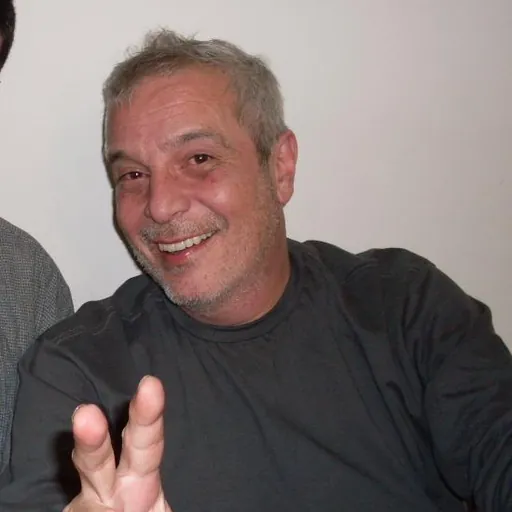
About Celso Blues Boy
Lived 1956 – 2012 (aged 56). Celso Blues Boy was a Brazilian singer, composer, guitarist and songwriter.
Celso Ricardo Furtado de Carvalho (January 5, 1956 – August 6, 2012), better known by his stage name Celso Blues Boy, was a Brazilian singer-songwriter and guitarist.
Biography Carvalho was born in Rio de Janeiro in 1956. His stage name, "Blues Boy", is a homage to American singer B.B. King, one of his idols and major influences. (Celso would play alongside King in 1986, at a gig in Rio.) He began his musical career in 1970, when only 17 years old, accompanying bands and singers such as Raul Seixas, Sá & Guarabyra and Luiz Melodia. In 1976 he formed the band Legião Estrangeira, and started to perform in some bars and clubhouses of Rio.
In 1980 he formed the band Aero Blues, considered to be one of the first Brazilian blues rock bands to sing in the Portuguese language; however, he decided to follow with a solo career later on, and released his debut album, Som na Guitarra, in 1984. It is notable for containing his most well-known song, "Aumenta que Isso Aí É Rock 'n' Roll". More albums would come afterwards, as well as performances at the prestigious Montreux Jazz Festival in Switzerland and at the Circo Voador in Rio.
2011 saw the release of his ninth (and ultimately last) studio album, Por um Monte de Cerveja, which counted with the special participation of the members of Detonautas Roque Clube.
Blues Boy was living in Joinville, Santa Catarina, towards the end of his life; an inveterate smoker, he died on August 6, 2012, due to laryngeal cancer. He was cremated and his ashes were buried in Blumenau.
Blues Boy was a die-hard fan of the soccer club Vasco da Gama. In a show promoting the club's 113th anniversary in 2011, he played the club's anthem on his guitar.
Discography (Singles) 1983: E Eu Disse Adeus & Caminhando 1984: Fugindo de Mim & Sinto Tanta Vontade
(Albums) 1984: Som na Guitarra 1986: Marginal Blues 1987: Celso Blues Boy 3 1988: Blues Forever 1989: Quando a Noite Cai 1991: Ao Vivo (live album) 1996: Indiana Blues 1998: Nuvens Negras Choram 1999: Vagabundo Errante 2008: Quem Foi que Falou que Acabou o Rock n' Roll? (live DVD) 2011: Por um Monte de Cerveja 2015: Acústico 2020: Quando um Bluseiro se Vai
Don’t just read it —
keep it.
Full-length biographies made to live with: read them, listen on the way to work, watch them tonight.
- E-book
- Audio
- Video
Instant download · yours to keep · every purchase keeps this site free
Important facts
People in Celso Blues Boy's life
Named in this biography and alive at the same time



Related people
Same field, nearest in time





Contemporaries
People whose lives overlapped Celso Blues Boy's


Frequently asked questions
Who was Celso Blues Boy?
Brazilian musician (1956-2012)
When was Celso Blues Boy born?
Celso Blues Boy was born on 5 January 1956 in Rio de Janeiro.
When did Celso Blues Boy die?
Celso Blues Boy died on 6 August 2012 in Joinville.
What was Celso Blues Boy's occupation?
Celso Blues Boy was a singer, composer, guitarist and songwriter.
What nationality was Celso Blues Boy?
Celso Blues Boy was Brazilian.
Sources & further reading
Cite this page
APA: Biography.guide. (2026). Celso Blues Boy. https://biography.guide/celso-blues-boy/
MLA: "Celso Blues Boy." Biography.guide, https://biography.guide/celso-blues-boy/.
Chicago: "Celso Blues Boy." Biography.guide. https://biography.guide/celso-blues-boy/.
Data last updated: 2026-09-21 · Spot an error? Report a correction.
Portrait: Wikimedia Commons · author & licence
Page generated 2026-09-27 04:59 UTC