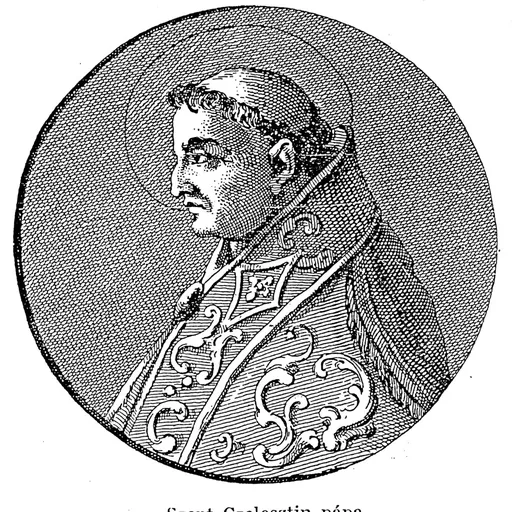
About Celestine I
Lived 400 – 432. Celestine I was a Roman catholic priest and writer.
Pope Celestine I (c. 359 – 27 July 432) was the bishop of Rome from 10 September 422 to his death on 27 July 432. Celestine's pontificate was largely spent combatting various teachings deemed heretical. He was instrumental in the condemnation of Nestorius in the Council of Ephesus when Cyril of Alexandria appealed him to make a decision; in response, Celestine delegated to Cyril the job of condemning Nestorius if he did not recant his teachings. He supported the mission of the Gallic bishops that sent Germanus of Auxerre in 429, to Britain to address Pelagianism, and later commissioned Palladius as bishop to the Scots of Ireland and northern Britain.
Early life and family Celestine I was a Roman from the region of Campania. He is said to have lived for a time at Milan with St. Ambrose. The first known record of him is in a document of Pope Innocent I from the year 416, where he is spoken of as "Celestine the Deacon".
Pontificate According to the Liber Pontificalis, the start of his papacy was 3 November. However, Tillemont places the date at 10 September. The Vatican also gives his pontificate as starting on 10 September 422.
Various portions of the liturgy are attributed to Celestine I, but without any certainty on the subject. In 430, he held a synod in Rome, at which the teachings of Nestorius were condemned. The following year, he sent delegates to the First Council of Ephesus, which addressed the same issue. The Novationists refused absolution to the lapsi, but Celestine argued that reconciliation should never be refused to any dying sinner who sincerely asked for it.
In a letter to certain bishops of Gaul, dated 428, Celestine rebukes the adoption of special clerical garb by the clergy. He wrote: "We [the bishops and clergy] should be distinguished from the common people [plebe] by our learning, not by our clothes; by our conduct, not by our dress; by cleanness of mind, not by the care we spend upon our person".
Death and legacy Saint Patrick sent to Ireland by Pope Celestine I; wall mosaic in St Mary's Cathedral, Kilkenny.
There are several interpretations for the date of Celestine's death. Different sources for the Liber Pontificalis provide a date of death as April 6 or 8, 432.
Louis Duchesne, when compiling the first complete critical edition of the Liber Pontificalis in 1886, similarly calculated a date of July 27, 432, which is now largely accepted in the Western tradition (and is marked as Celestine's feast day by the Roman church).
Celestine was buried in the cemetery of St. Priscilla on the Via Salaria, but his body, subsequently moved, now lies in the Basilica di Santa Prassede. In art, Celestine is portrayed as a pope with a dove, dragon, and flame, and is recognized by the Oriental Orthodox, Eastern Orthodox, and Catholic Churches as a saint.
Don’t just read it —
keep it.
Full-length biographies made to live with: read them, listen on the way to work, watch them tonight.
- E-book
- Audio
- Video
Instant download · yours to keep · every purchase keeps this site free
Important facts
People in Celestine I's life
Named in this biography and alive at the same time



Related people
Same field, nearest in time


Contemporaries
People whose lives overlapped Celestine I's


Frequently asked questions
Who was Celestine I?
pope
When was Celestine I born?
Celestine I was born in 400 in Rome.
When did Celestine I die?
Celestine I died on 27 July 432 in Rome.
What was Celestine I's occupation?
Celestine I was a catholic priest and writer.
What nationality was Celestine I?
Celestine I was Roman.
Sources & further reading
Cite this page
APA: Biography.guide. (2026). Celestine I. https://biography.guide/celestine-i/
MLA: "Celestine I." Biography.guide, https://biography.guide/celestine-i/.
Chicago: "Celestine I." Biography.guide. https://biography.guide/celestine-i/.
Data last updated: 2026-09-23 · Spot an error? Report a correction.
Portrait: Wikimedia Commons · author & licence
Page generated 2026-09-27 05:05 UTC