
About Alban of Mainz
Lived 400 – 406. Alban of Mainz was a German catholic priest.
Alban of Mainz (Latin: Albanus or Albinus; supposedly died in or near Mainz
Confusion with Alban of Verulamium There is evidence that, at various points in the Middle Ages, he was confused with the British Saint Alban, who died at Verulamium (now St Albans, Hertfordshire, England) around the year 300; later sources claim that both Albans had been killed by beheading, and both are always depicted with their head in their hands, and their feast days are 21 June and 22 June, respectively. |group="note" — Rabanus Maurus — Martyrologium. Iunius (c. 845)
Passio sancti Albani of Gozwin The second substantial source is the Passio sancti Albani, an incomplete hagiography written in the 1060s or 1070s by schoolmaster Gozwin, who lamented that very little evidence about Alban had survived to his day. Gozwin's account is much longer and adds many elements not found in Rabanus' Martyrologium, including a prologue about the First Council of Nicaea (325) which condemned Arianism, that nevertheless persisted until Honorius and Arcadius succeeded Theodosius (395). At that time, Alban is mentioned as one of four disciples of Theonestus, the others being Ursus, Tabraha and Tabratha. These five Catholic clerics are forced to flee from North Africa to Italy after being persecuted by Huneric, the fiercely Arian king of the Vandals (who historically ruled 80 years later in 477–484, however), travelling to Ambrose, bishop of Milan (r. 374–397; died 80 years before Huneric became king). The most wise Ambrose teaches Theonestus and his disciples refined theology and sends them out to convert the 'Arian beasts' in Gaul and Germany. They pass a city called Augusta primae Retiae, where Ursus is killed by Arians, and Alban is eventually beheaded in Mainz by local Arians to whom he was preaching the Catholic doctrine of the Trinity. The legend finishes by narrating that Alban carried his head on his hands to the place where he wanted to be buried.
Heinz Thomas (1970) demonstrated how the Passio was written with a political goal: in the service of his lord Siegfried I, archbishop of Mainz, Gozwin presented the archbishop of Mainz as the primate of all Christians in Germany and Gaul, and framed the lives of Alban, Theonastus, Boniface and other Mainzer clerics in ways to prove this point.
Attempts at reconstruction The accounts of Alban's life widely contradict each other in dating, geography, characters and acts, while other elements remain unclear; this has led scholars to create significantly divergent reconstructions of Alban.
Dating It is sometimes assumed that he died in or near Mainz around the year 400 (Watkins 2015), but others claim he died much later, around 483 (Hirschel 1855). Still others base themselves on a 10th-century vita of his teacher Theonistus, which claims that Alban was martyred in Mainz before Theonistus was martyred near Altinum on 30 October 380. As the death of Ambrose (397) and the reign of Huneric (r. 477–483) are well-known from other sources, this means Gozwin's claim that Theonistus and his disciples visited Ambrose in Milan after they were expelled from Africa by Huneric cannot be historically correct. The Vandal Kingdom in Africa was not established until 435 by Gaiseric, who died in 477, and Gozwin specifies it was ruled by Huneric Wandalorum Rex post Gezericum patrem ('Huneric, King of the Vandals after his father Gaiseric'). while others state that they are not sure about this identification, or that they have no idea where to locate it because it doesn't seem to have existed. Neither is it clear whether this Namsia was the birthplace of Alban, or (part of) the diocese of Theonistus, while others identify the latter as bishop of Philippi,
According to Schaab (1844), Alban came to Mainz around 404 to convert Arians to Catholicism, but they decapitated him at Gartenfeld.
Hirschel (1855) alleged that both Alban and bishop Theonistus were expelled from Africa by the Arian Vandalic king Huneric, and that Mainz had no bishop when they arrived to proselytise the local Arians, who proceeded to expel Theonistus and behead Alban in Gartenfeld around 483.
Smith & Wace (1877) wrote: "Albanus of Mentz, martyred at Mentz no one knows when, according to Baeda under Diocletian also, according to Sigebert (in Chron.), who says he had been driven from Philippi with Theonistus its bishop, in 425, and respecting whom Rabanus Maurus goes so far abroad as to call [Alban] an African bishop flying from Hunneric..."
Häuptli (2003) argued that Alban's cult became associated with that of Theonistus, who may have been a bishop of Philippi but who was confused with Thaumastus, a 5th-century bishop of Mainz.
Pelizaeus (2012) claimed that Mainz was conquered by the Vandals, Suebi and Burgundians in 406, during which Alban was killed.
In Watkins' reconstruction (2015), Alban was a Greek priest from the isle of Naxos, who was exiled by the Arians to Mainz, where he became a missionary; the local Arians killed him around 400. The monastery was devastated in 1557 and never renewed.
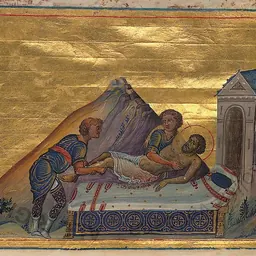
Both Alban of Mainz and Alban of Verulamium are represented in art as carrying their head between their hands, having been beheaded.
Don’t just read it —
keep it.
Full-length biographies made to live with: read them, listen on the way to work, watch them tonight.
- E-book
- Audio
- Video
Instant download · yours to keep · every purchase keeps this site free
Important facts
People in Alban of Mainz's life
Named in this biography and alive at the same time


Related people
Same field, nearest in time


Frequently asked questions
Who was Alban of Mainz?
Missionary and martyr
When was Alban of Mainz born?
Alban of Mainz was born in 400 in Geographical region of Italy.
When did Alban of Mainz die?
Alban of Mainz died in 406 in Mainz.
What was Alban of Mainz's occupation?
Alban of Mainz was a catholic priest.
What nationality was Alban of Mainz?
Alban of Mainz was German.
Sources & further reading
Cite this page
APA: Biography.guide. (2026). Alban of Mainz. https://biography.guide/alban-of-mainz/
MLA: "Alban of Mainz." Biography.guide, https://biography.guide/alban-of-mainz/.
Chicago: "Alban of Mainz." Biography.guide. https://biography.guide/alban-of-mainz/.
Data last updated: 2026-09-25 · Spot an error? Report a correction.
Page generated 2026-09-27 05:12 UTC