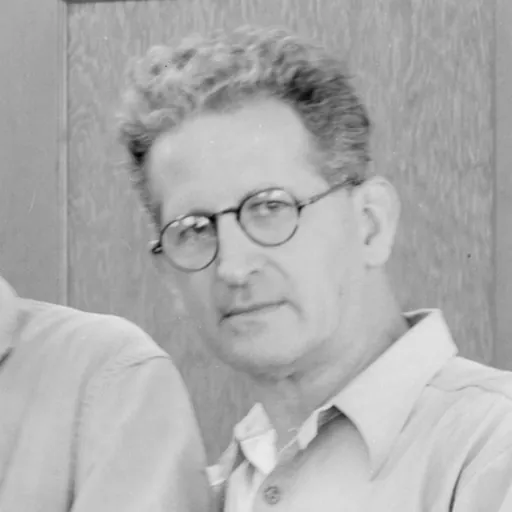
About Cedric Wright
Lived 1889 – 1959 (aged 69–70). Cedric Wright was an American photographer.
George Cedric Wright (April 13, 18891959) was an American violinist and a wilderness photographer of the High Sierra. He was Ansel Adams's mentor and best friend for decades, and accompanied Adams when three of his most famous photographs were taken. He was a longtime participant in the annual wilderness High Trips sponsored by the Sierra Club.
Family
Cedric Wright was born and raised in Alameda, California. His father was a successful attorney, and one of his father's clients was astronomer Charles Hitchcock Adams, Ansel Adams's father. Cedric's uncle, William Hammond Wright, was also an astronomer who became head of Lick Observatory. As a result of his father's success, Wright was financially comfortable throughout his life.
Violinist
Wright was motivated to become a violinist when he heard a performance by Fritz Kreisler. After study in the United States, he spent seven years studying with Otakar Ševčík in Prague and Vienna.
Wright was known as a "distinguished violinist", and was a violin teacher at the University of California Extension and Mills College for many years. Renowned violin teacher and conductor Louis Persinger called him "one of the foremost performers and instructors in the West". In 1934, arthritis brought an early end to his professional career as a violinist, and he then decided to pursue his hobby of photography as a career.
Friendship and collaboration with Ansel Adams
Wright first met Ansel Adams at a family gathering at the Wright family vacation home in the Santa Cruz Mountains when Cedric was about 21 and Ansel was about 8 years old.
Their friendship, which continued until Wright's death in 1959, was described by Mary Street Alinder as an "intense comradeship". The men shared a deep interest in both classical music and photography, since Adams was an accomplished classical pianist. Wright introduced Adams to the writings of the British philosopher Edward Carpenter, whose thoughts helped shape both men's world views. Together, they discussed the works of other writers, including Elbert Hubbard and Walt Whitman.
Back in the Bay Area after their initial 1923 wilderness journey together had ended, Adams became a part of Wright's social circle of musicians and Sierra Club activists who gathered at his Berkeley home. Adams "idolized" Wright, and he followed in Wright's footsteps by taking long trips into the wilderness of the Sierra Nevada each summer, photographing the remote mountain peaks.
In 1926, Wright introduced Adams to Albert Bender, a patron of the arts who was to play an instrumental role in Adams's enormous success as a photographer. Art historian H. W. Janson called this photo "a perfect marriage of straight and pure photography".
Wright's Berkeley home
In 1921, Wright purchased an old dairy barn at 2515 Etna Street in Berkeley, California, and hired architect Bernard Maybeck to remodel it into a home. Nicknamed "the barn", Wright's home featured "a soaring ceiling with room for a rope swing hung from the rafters and space enough for two grand pianos. Maybeck's daughter-in-law Jacomena Maybeck "remembered evenings at Cedric Wright's studio, when the women wore evening dresses and the men wore tuxedos, and there was much music around the big stone fireplace."
The home was known as "party central" among Sierra Club members of the era. Among that social circle were Richard M. Leonard and his wife Doris, Francis P. Farquhar and his wife Marjorie, David Brower and his wife Anne, Edgar Wayburn and his wife Peggy, and Wright's best friends, Ansel Adams and his wife Virginia. Tom Turner wrote that "Wright was a tireless and talented photographer of the mountain scene, who entertained campers with his fiddle and loved to greet weary hikers at day's end with an unexpected cup of tea or soup." During the High Trips, Wright and his student Dorothy Minty would often entertain groups of 200 participants with performances of Bach's Double Violin Concerto.
Photographer, inventor and writer
Arthritis forced Wright to give up his career as a violinist in 1934, and he resolved to pursue his hobby of photography as a new career. In 1939 the Museum of Modern Art accepted six of Wright's photographs, donated by Albert Bender, into its photography collection. These were followed by another ten prints the following year. Several of his photos were displayed at the Golden Gate International Exposition in San Francisco in 1939 and 1940. Wright's work was also featured in a 1943 exhibition at The Museum of Modern Art called "Action Photography", along with work by Erich Salomon, Peter Stackpole, Alfred Stieglitz, Paul Strand and Weegee.
He was issued a United States patent for a portable photo-printing device in 1935. He also made various devices, including "collapsible and portable latrines" for the High Trips, and "astonishingly solid camera and violin cases of varnished plywood with leather thongs, which would tolerate the rigors of being packed for a month on muleback." He dedicated these words to Sierra Club leader William Edward Colby, and they became part of the introduction to Wright's posthumous book, Words of the Earth.
Final years
Ansel Adams described Wright's final years as "complex and difficult". He suffered a stroke, which caused a personality change, and he became "rigid and dictatorial", which was a "painful experience for all his friends."
In 1961, a 12,362-foot (3768 meter) High Sierra peak was officially named Mount Cedric Wright , in memory of Wright, who was described as an "internationally known photographer whose photography has made a significant contribution to the appreciation of the natural scene." The mountain is located in Kings Canyon National Park, 1.9 km (1.2 mi) southwest of Colosseum Mountain and 5.3 km (3.3 mi) south-southeast of Mount Pinchot. Virginia Best Adams later arranged for park ranger Randy Morgenson to scatter Wright's ashes on the slopes of Mount Cedric Wright. In 1976, Ansel Adams and the Sierra Club arranged for Wright's personal papers to be donated to the Bancroft Library at the University of California, Berkeley.
Don’t just read it —
keep it.
Full-length biographies made to live with: read them, listen on the way to work, watch them tonight.
- E-book
- Audio
- Video
Instant download · yours to keep · every purchase keeps this site free
Important facts
People in Cedric Wright's life
Named in this biography and alive at the same time

Related people
Same field, nearest in time



Contemporaries
People whose lives overlapped Cedric Wright's

Frequently asked questions
Who was Cedric Wright?
American photographer and musician (1889-1959)
When was Cedric Wright born?
Cedric Wright was born on 13 April 1889.
When did Cedric Wright die?
Cedric Wright died in 1959.
What was Cedric Wright's occupation?
Cedric Wright was a photographer.
What nationality was Cedric Wright?
Cedric Wright was American.
Sources & further reading
Cite this page
APA: Biography.guide. (2026). Cedric Wright. https://biography.guide/cedric-wright/
MLA: "Cedric Wright." Biography.guide, https://biography.guide/cedric-wright/.
Chicago: "Cedric Wright." Biography.guide. https://biography.guide/cedric-wright/.
Data last updated: 2026-09-22 · Spot an error? Report a correction.
Portrait: Wikimedia Commons · author & licence
Page generated 2026-09-27 05:02 UTC