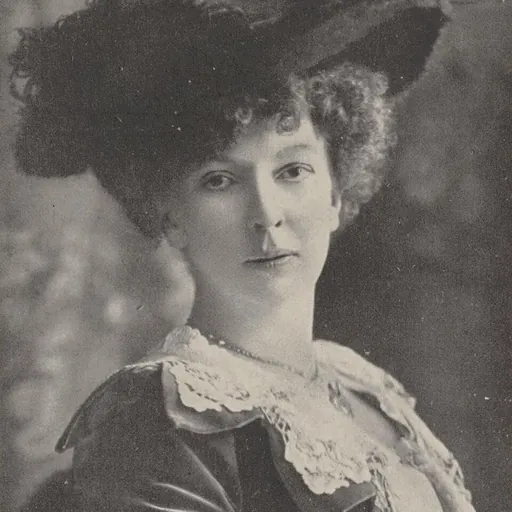
About Cécile Chaminade
Lived 1857 – 1944 (aged 86). Cécile Chaminade was a French pianist, composer and flautist.
Cécile Louise Stéphanie Chaminade (8 August 1857 – 13 April 1944) was a French composer and pianist. In 1913, she was awarded the Légion d'Honneur, a first for a female composer.
Biography Born in Batignolles (a village then outside Paris), Chaminade was raised in a musical family. She received her first piano lessons from her mother. Her father forbade it because he believed it was improper for a girl of Chaminade's class. and music composition with Marie Gabriel Augustin Savard and Benjamin Godard. Chaminade as sketched in St. Louis by Marguerite Martyn, November 1908
Chaminade experimented in composition as a young child, composing pieces for her cats, dogs and dolls. In 1869, she performed some of her music for Georges Bizet, who was impressed with her talents. . In her early years, she gave recitals throughout France, Switzerland, Belgium and Holland. In 1892, she debuted in England, where her work was popular. She visited England again in 1907 and performed at the Aeolian Hall in London, and in Bath. Queen Victoria was known to enjoy Chaminade's music and in 1901 at her funeral, the Prélude for Organ, Op. 78, by Chaminade was played.
Chaminade married a music publisher from Marseille, Louis-Mathieu Carbonel, in 1901.
In 1908, she performed concerts in twelve cities in the United States. and such pieces as the "Scarf Dance" or the Ballet No. 1 were to be found in the music libraries of many lovers of piano music of the time. She composed a Konzertstück for piano and orchestra, the ballet music to Callirhoé and other orchestral works. Her songs, such as "The Silver Ring" and "Ritournelle", were also great favorites.
Chaminade was the recipient of numerous honours, both in France and abroad. In 1888 and 1892, she was honoured by the Académie Française. In 1897, she was honoured by Queen Victoria and given the Jubilee Medal. She received the Laurel Wreath from the Athens Conservatory and the Order of the Chefakat by Sultan Abdul Hamid II of the Ottoman Empire.
Chaminade was relegated to obscurity for the second half of the 20th century, her piano pieces and songs mostly forgotten, with the exception being the Concertino for flute and orchestra in D major, Op. 107, composed for the 1902 Conservatoire de Paris flute competition; it is her most popular piece today. This is also quoted as "Ce n'est pas une femme compositeur, c'est un compositeur femme." ("This is not a woman who composes, but a composer who is a woman." )
Most of her compositions were published during her lifetime and were financially successful.
Compositional style Chaminade affiliated herself with nationalist composers such as Camille Saint-Saëns and Charles Gounod. Her musical style was rooted in both Romantic and French tradition throughout her career and her music has been described as tuneful, highly accessible and mildly chromatic. In describing her own style, Chaminade wrote, "I am essentially of the Romantic school, as all my work shows."
Selected works
Opera Op. 19 La Sévillane, comic opera (1882)
Orchestral
Op. 20 Suite d'Orchestre (1881) Op. 26 Symphonie Dramatique Les Amazones (1884) Op. 37 Callirhoë, ballet symphonique (1888) Op. 40 Konzertstück in C-sharp minor for piano and orchestra (1888) Op. 107 Concertino for flute and orchestra in D major (1902)
Choral Op. 44 Les Feux de la Saint-Jean for soloists, women's chorus and piano (1890) Op. 45 Sous l'Aile Blanche des Voiles for soloists, women's chorus and piano (1890) Op. 46 Pardon Breton for soloists, women's chorus and piano (1890) Op. 47 Noce Hongroise for soloists, women's chorus and piano (1890) Op. 48 Noël des Marins for soloists, women's chorus and piano (1890) Op. 49 Les Filles d'Arles for soloists, women's chorus and piano (1890)
Piano
Op. 21 Piano Sonata in C minor (1893) Op. 35 Six Études de Concert (1886) Op. 54 Lolita. Caprice espagnol (1890) Op. 60 Les Sylvains (1892) Op. 61 Arabesque (1892) Op. 89 Thème varié (1898) Op. 120 Variations sur un thème original (1906) Op. 117 Duo Symphonique for 2 pianos (1905) Op. 123 Album des enfants, première série (1906) Op. 126 Album des enfants, deuxième série (1907)
Piano duets Op. 55 Six Pièces Romantiques, Op. 55 (1890)
Two pianos, four hands Op. 59 Andante et Scherzettino (from Callirhoë) (1889) Op. 73 Valse Carnavalesque (1894) Op. 117 Duo Symphonique (1905) WU 19 Marche Hongroise (1880), unpublished
Solo instrument with piano Op. 18 Capriccio for violin and piano (1890) Op. 19 Trois Morceaux for violin and piano (1885) Op. 97 Rondeau for violin and piano (1899) Op. 107 Concertino for flute and Piano (1902) Op. 142 Sérénade aux étoiles for flute and piano (1911)
Chamber music Op. 11 Piano Trio No. 1 in G minor (1880) Op. 34 Piano Trio No. 2 in A minor (1886)
Songs
"Chanson slave" (1890) "Les rêves" (1891) "Te souviens-tu?" (1878) "Auprès de ma mie" (1888) "Voisinage" (1888) "Nice la belle" (1889) "Rosemonde" (1878) "L'anneau d'argent" (1891) "Plaintes d'amour" (1891) "Viens, mon bien-aimé" (1892) "L'Amour captif" (1893) "Ma première lettre" (1893) "Malgré nous" (1893) "Si j'étais jardinier" (1893) "L'Été" (1894) "Mignonne" (1894) "Sombrero" (1894) "Villanelle" (1894) "Espoir" (1895) "Ronde d'amour" (1895) "Chanson triste" (1898) "Mots d'amour" (1898) "Alléluia" (1901) "Écrin" (1902) "Bonne humeur!" (1903) "Menuet" (1904) "La lune paresseuse" (1905) "Je voudrais" (1912) "Attente (Au pays de provence)" (1914)
Don’t just read it —
keep it.
Full-length biographies made to live with: read them, listen on the way to work, watch them tonight.
- E-book
- Audio
- Video
Instant download · yours to keep · every purchase keeps this site free
Important facts
People in Cécile Chaminade's life
Named in this biography and alive at the same time





Related people
Same field, nearest in time


Contemporaries
People whose lives overlapped Cécile Chaminade's



Frequently asked questions
Who was Cécile Chaminade?
French composer and pianist (1857-1944)
When was Cécile Chaminade born?
Cécile Chaminade was born on 8 August 1857 in Paris, Batignolles-Monceau.
When did Cécile Chaminade die?
Cécile Chaminade died on 13 April 1944 in Monte Carlo.
What was Cécile Chaminade's occupation?
Cécile Chaminade was a pianist, composer and flautist.
What nationality was Cécile Chaminade?
Cécile Chaminade was French.
Sources & further reading
Cite this page
APA: Biography.guide. (2026). Cécile Chaminade. https://biography.guide/cecile-chaminade/
MLA: "Cécile Chaminade." Biography.guide, https://biography.guide/cecile-chaminade/.
Chicago: "Cécile Chaminade." Biography.guide. https://biography.guide/cecile-chaminade/.
Data last updated: 2026-09-22 · Spot an error? Report a correction.
Portrait: Wikimedia Commons · author & licence
Page generated 2026-09-27 05:02 UTC