
About Caspar Buberl
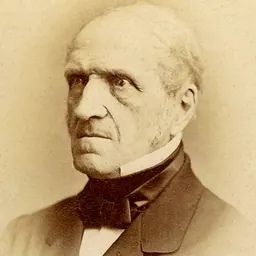
Lived 1832 – 1899 (aged 66). Caspar Buberl was an American sculptor.
Caspar Buberl (1834 – August 22, 1899) was an American sculptor. He is best known for his Civil War monuments, for the terra cotta relief panels on the Garfield Memorial in Cleveland, Ohio (depicting the various stages of James Garfield's life), and for the -long frieze on the Pension Building in Washington, D.C.
Biography Born in Königsberg, Bohemia, (now Kynšperk nad Ohří, Czech Republic), as a young man Buberl studied art in Prague and Vienna before immigrating to the United States in 1854 to train under sculptor Robert Eberhard Launitz.
He married Anna Stubner in 1856, and they had nine children.
In 1882 Montgomery C. Meigs was chosen to design and construct the new Pension Building, now the National Building Museum, in Washington D. C. and, in doing so, broke away from the established Greco-Roman models that had been the basis of government buildings in Washington up until then, and was to continue to be following the Pension Building's completion. Meigs based his design on Italian Renaissance precedents, notably Rome's Palazzo Farnese and Plazzo della Cancelleria.
Included in his design was a -long sculptured frieze executed by Buberl. Since creating a work of sculpture of that size was well out of Meigs' budget, he had Buberl create 28 different scenes [totaling in length), which were then mixed and slightly modified to create the continuous parade that includes over 1,300 individual figures. Because of the way that the 28 sections were modified and intermixed, it is only by somewhat careful examination that the frieze reveals itself to be the same figures repeated some eighteen times. The sculpture includes infantry, navy, artillery, cavalry and medical components as well as a good deal of the supply and quartermaster functions, since Meigs had overseen the latter two functions during the Civil War.
Meigs insisted that any teamster included in the Quartermaster panel "must be a negro, a plantation slave, freed by war". This figure was ultimately to assume a position in the center, over the west entrance to the building.
Buberl created dozens of Civil War statues and monuments for various cities and states, including several for New York veterans associations to be placed on the Gettysburg Battlefield and a bronze bust of President Abraham Lincoln, which was recently sold for $5,800. His impressive New York State Monument crowns Cemetery Hill, and a number of individual memorials for specific regiments dot the battlefield.
He died at his studio in New York City.
Leading works Monuments on the Gettysburg battlefield 9th New York Cavalry Monument – dedicated July 1, 1888 4th New York Independent Battery – dedicated July 2, 1888 5th New York Cavalry Monument – dedicated July 3, 1888 126th New York Infantry – dedicated October 3, 1888 10th New York Cavalry Monument – dedicated October 9, 1888 54th New York Infantry – dedicated July 4, 1890 111th New York Infantry Monument – dedicated June 26, 1891 New York State Monument – dedicated July 2, 1893 41st New York Infantry – dedicated July 3, 1893 52nd New York Infantry – dedicated July 3, 1893
Other Civil War monuments
Civil War Monument, Manchester, New Hampshire, George Keller, architect, 1879 Soldiers and Sailors Monument, Buffalo, New York, George Keller, architect, 1884 Soldiers and Sailors Monument, Nashua, New Hampshire, 1889 Alexandria Confederate Memorial, Alexandria, Virginia, 1889 Soldiers and Sailors Monument, Troy, New York, 1890. Four relief panels: Cavalry, Artillery, Infantry, The Monitor and the Merrimac A.P. Hill Monument, Richmond, Virginia, 1892 Howitzer Monument, Richmond, Virginia, 1892 Confederate Monument, University of Virginia Cemetery, Charlottesville, Virginia, 1893 Raphael Semmes Monument, Mobile, Alabama, 1899
Other memorials and monuments Fulton Memorial, Fulton Park, Brooklyn, New York, 1872 Fireman's Memorial, Church Square Park, Hoboken, New Jersey, 1891 Dewey Triumphal Arch, Spanish–American War, New York City, 1899
Architectural sculpture
Columbia Defending Science and Industry, National Museum/Art and Industries Building, Washington, D.C., Adolph Cluss, architect, Montgomery Meigs, associate architect, 1881 Pension Building Frieze, National Building Museum, Washington, D.C., Montgomery Meigs, architect, 1883 James A. Garfield Memorial, Lake View Cemetery, Cleveland, Ohio, George Keller, architect, 1890 Soldiers and Sailors Memorial Arch, Hartford, Connecticut, George Keller, architect, 1890
Pension Building frieze
Images of the James A. Garfield Memorial
Images of Hartford memorial
Images of Buffalo memorial
Footnotes
Don’t just read it —
keep it.
Full-length biographies made to live with: read them, listen on the way to work, watch them tonight.
- E-book
- Audio
- Video
Instant download · yours to keep · every purchase keeps this site free
Important facts
People in Caspar Buberl's life
Named in this biography and alive at the same time



Related people
Same field, nearest in time



Contemporaries
People whose lives overlapped Caspar Buberl's


Frequently asked questions
Who was Caspar Buberl?
Bohemian sculptor, active in the United States
When was Caspar Buberl born?
Caspar Buberl was born on 22 September 1832 in Kynšperk nad Ohří.
When did Caspar Buberl die?
Caspar Buberl died on 22 August 1899 in New York City.
What was Caspar Buberl's occupation?
Caspar Buberl was a sculptor.
What nationality was Caspar Buberl?
Caspar Buberl was American.
Sources & further reading
Cite this page
APA: Biography.guide. (2026). Caspar Buberl. https://biography.guide/caspar-buberl/
MLA: "Caspar Buberl." Biography.guide, https://biography.guide/caspar-buberl/.
Chicago: "Caspar Buberl." Biography.guide. https://biography.guide/caspar-buberl/.
Data last updated: 2026-09-24 · Spot an error? Report a correction.
Page generated 2026-09-27 05:06 UTC