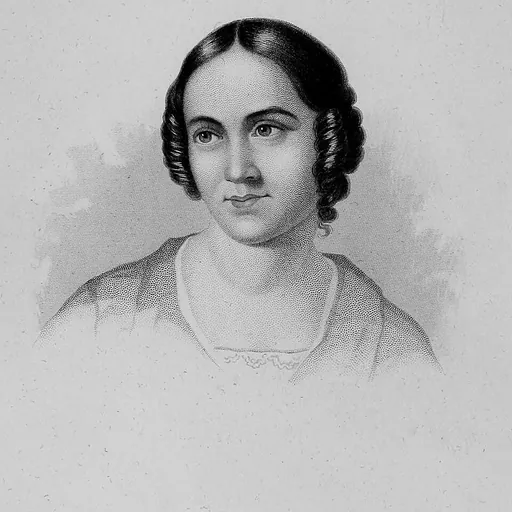
About Caroline Lee Hentz
Lived 1800 – 1856 (aged 55). Caroline Lee Hentz was an American novelist, writer and teacher.
Caroline Lee Whiting Hentz (June 1, 1800 – February 11, 1856) was an American novelist. She is most noted for her defenses of slavery and opposition to the abolitionist movement. Her widely read The Planter's Northern Bride was one of the genre known as anti-Tom novels, by which writers responded to Harriet Beecher Stowe's bestselling anti-slavery novel, Uncle Tom's Cabin (1852).
Early life Caroline Hentz was born as Caroline Lee Whiting on June 1, 1800, to Colonel John and Orpah Whiting in Lancaster, Massachusetts. The youngest of eight children, her father served as a Continental Army soldier in the American Revolutionary War and three of her brothers fought in the War of 1812.
As a child, Whiting attended a private school run by Jared Sparks. By the time she was twelve, she had already composed a fantasy about the Far East, as well as a play. At seventeen she was teaching at a local Lancaster school.
On September 30, 1824, Caroline married Nicholas Marcellus Hentz. Shortly after, the couple moved to Chapel Hill, North Carolina with their first child, where her husband became chair of modern languages at the University of North Carolina. She is described as being "a northerner who traveled and worked throughout the South for nearly thirty years." Their letters home and “tales of patriotic adventure”
The Hentzes left shortly after for Covington, Kentucky, where Nicholas founded a girls' school in 1830. During their time in Cincinnati, Nicholas displayed an irrational jealousy that may have served as inspiration for Hentz's Byronic heroes. “According to their son, Dr. Charles Arnould Hentz, Colonel King of the Semi-Colon Club, sent an improper note to the dignified and accomplished Mrs. Hentz.” While in Florence, Hentz spent most of her time caring for the family. She wrote less formally during this period, but she did write some poetry and kept a diary that inspired the “letters, deathbed confession, and other lamentations that are hallmarks of her novels.”
Next the family moved to Tuscaloosa, where Hentz and her husband opened another school in 1843. In 1845, the family opened yet another school in Tuskegee, which was a small village at the time. During her husband's illness, Hentz wrote at his bedside, dividing her attention among his care, the demands of the literary public, and the occasional visitors who would disturb her routine. and it was published in 1843.
Hentz's career advanced greatly between the years 1832 and 1856. In March 1832, she published her first work, a short story, "The Sacrifice," in Godey's Lady's Book, a popular magazine for women. While living in Covington, Kentucky, Hentz wrote Constance of Werdenberg, a play performed at the Park Theatre in New York in 1832.
After retiring from her career as an educator, Hentz began to write vigorously and her literary career blossomed as a result.
One of Hentz's most famous novels, The Planter’s Northern Bride, was published in 1854. It has been described as a "polemical and distinctively Southern response to Harriet Beecher Stowe's Uncle Tom's Cabin," which was published in 1852
Achievements "Her five-act tragedy, De Lara; or, The Moorish Bride, Philadelphia, also won a competition sponsored by the Arch Street Theatre in Philadelphia." This "prize [was] offered by Boston actor and manager William Pelby", but he was unable to pay it. The Boston Library named her as one of the top 3 writers of the day." The Mob Cap appeared in the Saturday Courier winning critical praise and a $200 prize."
Writing While at Covington, Kentucky, Hentz competed for a prize of $500 that had been offered for a play by the directors of the Arch Street Theatre in Philadelphia. The prize was awarded to her for her tragedy of De Lara, or the Moorish Bride. It was produced on stage and published in book-form in 1843. Lamorah, or the Western Wild, another tragedy, was performed at Cincinnati after having been published in a newspaper at Columbus, Georgia in 1832. Constance of Werdenberg, a third tragedy, remained unpublished.
Hentz also wrote numerous short poems. She wrote a voluminous number of tales and novelettes that were published in periodicals and newspapers, many of which were collected into volumes.
Hentz introduces several villains in her novel, The Planter's Northern Bride (1854). One is a busybody who tries to free slaves against their will. By doing so, Hentz tries to discredit the abolitionist argument of inhumane treatment of the Southern slaves. She portrays the people wanting to abolish the institution of slavery as being motivated for personal gain, not by a desire to improve mankind. She expanded on this motive to attribute abolitionist sentiment to the industrial revolution that was taking place in the North, which she said would require the massive amounts of cheap labor that only the South could provide by way of slavery.
Primary works
Lamorah; or, the Western Wild (play, 1832) Constance of Werdenberg; or, The Forest League (play, 1832) Lovell's Folly (1833) De Lara; or, The Moorish Bride (play, 1843) "Human and Divine Philosophy: A Poem Written for the Erosophic Society of the University of Alabama" (1844) Aunt Patty's Scrap-bag (1846) Linda; or, The Young Pilot of the Belle Creole (1850) Rena; or, The Snow Bird (1851) Eoline; or, Magnolia Vale; or, The Heiress of Glenmore (1852) Marcus Warland; or, The Long Moss Spring (1852) The Banished Son and Other Stories of the Heart (short story collection,1852) Helen and Arthur; or, Miss Thusa's Spinning Wheel (1853) The Victim of Excitement, The Bosom Serpent, etc. (short story collection,1853) (reprinted as Love After Marriage and Other Stories of the Heart in 1857) Wild Jack; or, The Stolen Child, and Other Stories (1853) "The Hermit of Rockrest" (1853) The Planter's Northern Bride (1854) Courtship and Marriage; or, The Joys and Sorrows of American Life (1856) Ernest Linwood; or, The Inner Life of the Author (1856) The Lost Daughter and Other Stories of the Heart (short story collection,1857) Robert Graham (1855) Sequel to Linda; or, The Young Pilot of the Belle Creole
Don’t just read it —
keep it.
Full-length biographies made to live with: read them, listen on the way to work, watch them tonight.
- E-book
- Audio
- Video
Instant download · yours to keep · every purchase keeps this site free
Important facts
People in Caroline Lee Hentz's life
Named in this biography and alive at the same time

Related people
Same field, nearest in time


Contemporaries
People whose lives overlapped Caroline Lee Hentz's






Frequently asked questions
Who was Caroline Lee Hentz?
American author and educator (1800-1856)
When was Caroline Lee Hentz born?
Caroline Lee Hentz was born on 1 June 1800 in Lancaster.
When did Caroline Lee Hentz die?
Caroline Lee Hentz died on 11 February 1856 in Marianna.
What was Caroline Lee Hentz's occupation?
Caroline Lee Hentz was a novelist, writer and teacher.
What nationality was Caroline Lee Hentz?
Caroline Lee Hentz was American.
Sources & further reading
· Wikipedia: Caroline Lee Hentz
Cite this page
APA: Biography.guide. (2026). Caroline Lee Hentz. https://biography.guide/caroline-lee-hentz/
MLA: "Caroline Lee Hentz." Biography.guide, https://biography.guide/caroline-lee-hentz/.
Chicago: "Caroline Lee Hentz." Biography.guide. https://biography.guide/caroline-lee-hentz/.
Data last updated: 2026-09-22 · Spot an error? Report a correction.
Portrait: Wikimedia Commons · author & licence
Page generated 2026-09-27 05:01 UTC