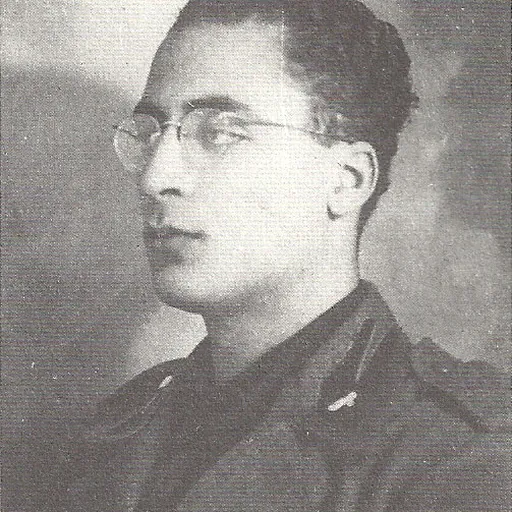
About Carmelo Borg Pisani
Lived 1915 – 1942 (aged 27). Carmelo Borg Pisani was an Italian spy, artist and painter.
Carmelo Borg Pisani (10 August 1915 – 28 November 1942) was a Maltese artist and Italian Fascist spy, condemned to death for treason in 1942. Pisani was a nationalist who believed that Malta's best chance for independence was to expel the British and unite the island with Italy.
Early life
Born into a Maltese Nationalist family in Senglea on 10 August 1915, Borg Pisani enrolled as a student at the pro-Italian Umberto I art lyceum in Valletta. In his teens he attended the network of pro-Italian and pro-fascist organisations in Malta: Valletta's Casa del Fascio (headed by professor Umberto Biscottini) and OGIE (Organizzazioni Giovanili Italiane all'Estero), through which he attended youth camps in Italy, such as Campo Dux in Viareggio in 1930 and another camp in Rome in 1932. Carmelo Borg Pisani’s passport application photo before leaving to Rome for his artistic studies (1932). Since Carmelo was only 17, the application was submitted by his father Gaetano. He moved to Italy to attend the Accademia di belle arti di Roma along with other prominent Maltese artists such as Emvin Cremona. He lived in the Italian government-funded "Casa della Redenzione Maltese", where he met other Maltese irredentists, with whom he shared the conviction that the British colonial government was destroying the "Italian soul" of Malta. He also believed that the best opportunity to restore Malta to its original state was to expel the British and unite the island to the Kingdom of Italy. In Rome, Borg Pisani chaired the "Circolo degli Amici della Storia di Malta" and joined the "Comitato d'Azione Maltese", headed by exiled activist Carlo Mallia from the University of Malta. As Director, Borg Pisani took part in the publication in exile of the irredentist newspaper Malta, which had been forbidden by the British colonial authority. Carmelo Borg Pisani (far left) with friends in Rome. Giuseppe Galea (far right) was also a Maltese artist studying in Rome. Borg Pisani was a supporter of Fascism. In 1935, he unsuccessfully tried to embark as a volunteer for the fascist war in Ethiopia.
Between 1939 and 1940, he joined the Gruppi Universitari Fascisti and then the Partito Nazionale Fascista.
During World War II Carmelo Borg Pisani's PNF Party membership cardAfter the entry of Italy into the Second World War on 10 June 1940, Borg Pisani renounced his British citizenship, returning his British passport through the American embassy (which represented British interests in Rome). Yet he never formally requested nor obtained Italian citizenship, despite later serving in the Italian army.
He also wrote a letter to Mussolini to volunteer for service, but was refused by the Italian Army due to his strong myopia. With the Blackshirts, he participated in the Italian occupation of Kefallinia in Greece, where he was injured.
Together with other Maltese irredentists, he then attended the military school of Messina.
On 18 May 1942, Borg Pisani volunteered for an espionage mission to Malta, to check British defences and help prepare for the planned Axis invasion of the island (Operation Herkules). He disembarked at the Dingli Cliffs in Ras id-Dawwara and transferred all his rations to a cave that he knew well from his youth. Unusually inclement weather and a rough sea, however, washed all his possessions away within 48 hours, and he proved unable to climb the cliffs. He was forced to wave down a local boat. Upon rescue by a British patrol boat, he was brought to the naval hospital RNH Mtarfa.
There, Borg Pisani was recognized by one of his childhood friends, Cpt. Tom Warrington (1912-1994), who denounced him. British Intelligence kept him under arrest in a house in Sliema till August. He was then transferred to Corradino prison, accused of treason. On 12 November 1942, he stood trial under closed doors in front of three judges, headed by Chief Justice of Malta Sir George Borg, and defended by two lawyers.
Borg Pisani's brother, Paulo Borg, who was a priest, tried in vain to save Carmelo's life by submitting a petition to the Governor of Malta, John Vereker, 6th Viscount Gort and beseeched him to use the prerogative of mercy and to reverse the sentence to long-term or life imprisonment instead of execution. The petition for clemency was denied with a note stating that the Governor "sees no reason to interfere with the course of the law".thumb Excerpt of the Sunday Times of Malta about Borg Pisani's executionHis execution by hanging took place at 7:30 am on Saturday, 28 November. Frank Leighton considered him "a gullible victim of fascist Italy's propaganda".
Legacy
After his death, inside his own jail was found written by him: "I vili ed i servi non sono graditi al Signore" (The cowards and the servants are not esteemed by the Lord). These "last words" have been taken up by many of his supporters. In Italy, Borg Pisani was posthumously awarded the Gold Medal of Military Valor, the highest Italian military award, by King Victor Emmanuel III a few days after his death.
Benito Mussolini called him a "Maltese Martyr" and in November 1943 created in his honour in Liguria the blackshirts Battaglione Borg Pisani in which other Maltese irredentists fought.
The art academy where he had studied in Rome was for a brief time rechristened La Regia Accademia di Belle Arti Borg Pisani, and streets in Rome, Turin, Bari and Legnano are still named after him. A neo-fascist group commemorated his death in front of Malta's embassy in Rome in 2010. Requests have been made by his family and the Italian government to exhume his remains and give them a proper burial, but so far not acceded to.
In his native Malta, Borg Pisani remains a controversial figure. Many view him as a traitor who betrayed the nation to fight for Fascist Italy. On the other hand, many others view him as a patriotic hero who wanted the very best for Malta by breaking free from British rule and uniting the island with Italy.
Norman Lowell, the former leader of the far-right political party Imperium Europa, is known to be a staunch admirer of Borg Pisani. He is known for the quotes "Carmelo Borg Pisani, presente!" and "Onore a Carmelo Borg Pisani!" during a tribute to him in a television interview on One.
In popular culture A person similar to Borg Pisani appears in the 1953 film, Malta Story.
Borg Pisani appears in the game Hearts of Iron IV as an espionage operative.
Borg Pisani appears in the game Enlisted as Carmelo Borg.
Don’t just read it —
keep it.
Full-length biographies made to live with: read them, listen on the way to work, watch them tonight.
- E-book
- Audio
- Video
Instant download · yours to keep · every purchase keeps this site free
Important facts
People in Carmelo Borg Pisani's life
Named in this biography and alive at the same time





Related people
Same field, nearest in time



Contemporaries
People whose lives overlapped Carmelo Borg Pisani's






Frequently asked questions
Who was Carmelo Borg Pisani?
Maltese-born artist and Italian Fascist, who was executed for treason (1915-1942)
When was Carmelo Borg Pisani born?
Carmelo Borg Pisani was born on 10 August 1915 in Senglea.
When did Carmelo Borg Pisani die?
Carmelo Borg Pisani died on 28 November 1942 in Corradino prison.
What was Carmelo Borg Pisani's occupation?
Carmelo Borg Pisani was a spy, artist and painter.
What nationality was Carmelo Borg Pisani?
Carmelo Borg Pisani was Italian.
Sources & further reading
· Wikipedia: Carmelo Borg Pisani
· DBpedia: Carmelo Borg Pisani
Cite this page
APA: Biography.guide. (2026). Carmelo Borg Pisani. https://biography.guide/carmelo-borg-pisani/
MLA: "Carmelo Borg Pisani." Biography.guide, https://biography.guide/carmelo-borg-pisani/.
Chicago: "Carmelo Borg Pisani." Biography.guide. https://biography.guide/carmelo-borg-pisani/.
Data last updated: 2026-09-23 · Spot an error? Report a correction.
Portrait: Wikimedia Commons · author & licence
Page generated 2026-09-27 05:06 UTC