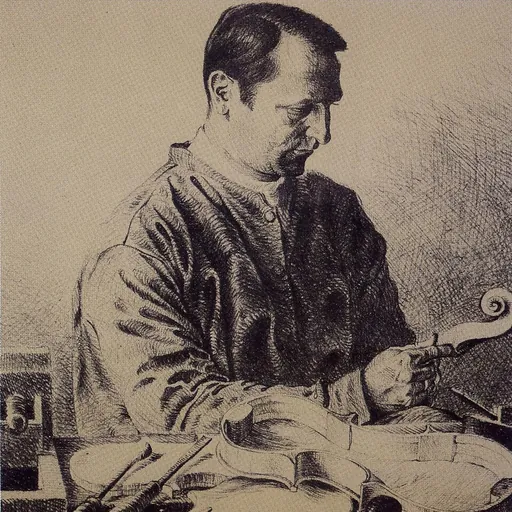
About Carlo Bisiach
Lived 1892 – 1968 (aged 75–76). Carlo Bisiach was an Italian musical instrument maker.
Carlo Bisiach (9 March 1892 – 23 April 1968) was an Italian violin maker. Bisiach's work contributed to the rebirth of violin making in the region after the difficult times of World War I and World War II. After working with his father Leandro in Milan and then Siena, Carlo established himself at Florence in 1922. The most talented of Leandro's sons, Carlo went on to develop his own style, distinct from the Antoniazzi-derived work of his father and brothers.
Biography Carlo Bisiach was born in Milan on 9 March 1892 and died on 23 April 1968.
The son and student of Leandro Bisiach, descendant of the Cremonese school, he began studying the art of stringed-instrument making in the early years of his life. In 1922, after marrying Daria Guidi in Siena, he moved to Florence. They first lived in via della Spada; later they moved to via San Zanobi, and in 1929 to via Puccinotti. Here Bisiach lived for the rest of his life.
As a young man, Carlo studied cello with Giovanni Buti and for a time seriously considered a career as a performer. In 1906, at the age of 14, he along with his older brother Andrea (two years his senior), traveled to Mirecourt to study violin making with Leon Mougenot. Between 1909 and 1914, Carlo studied the art of bow making with Eugene Sartory in Paris, working alongside Andre Vigneron (1881–1924). Next, he traveled to Amsterdam where he spent several years in the workshop of Karel Van der Meer. Then spent close to a year in Germany until World War I, where he acquired a wealth of knowledge in restoration techniques and expertise in classic instruments establishing contacts with the top English and German dealers and experts.
With the outbreak of World War I, Carlo and Andrea returned to Italy for military service where to Carlo's fortune, they made use of his musical talents. He had been assigned to playing concerts for the troops, which included solo w/orchestra, orchestral music, chamber music as well as recitals with pianist Tullio Serafin (1878–1968), who was later to become an outstanding opera conductor.
Siena years By 1916, Milan was being bombed by Austrian Zeppelins, which brought a stop to most normal activities. With most of his pupils as well as his sons in the war, it was at this point that Leandro Sr. closed his Milan studio and moved to the safer and beautiful medieval city of Siena at the invitation of Count Guido Chigi-Saracini, and stayed there from 1916 to 1922, where he worked on restoring and building up the Counts collection by acquiring great examples of the best instruments. For several years, the Chigi-Bisiach studio attracted clients including famous concert artists from all over to have their instruments repaired, adjusted and appraised.
In 1917 Sderci was introduced to Leandro Bisiach by Don Fortunato (Sderci's brother) and Count Chigi Saracini. To Sderci's good fortune, he did not serve in the war owing to circulatory problems in his legs, a lifelong condition. Sderci had worked as a sculptor & carver for his uncles Tito and Giuseppe Corsini in Siena making richly decorated furniture, and then in a factory making ladies’ shoes, even designing some with removable heels. Recognizing his innate talent and needing an assistant, Sderci was taken on by Leandro. At the end of the war, when Carlo Bisiach joined his family in Siena, Igino was put under Carlo's guidance for training. Sderci excelled quickly as he was ardent about violin making.
Achievements Among his awards is a gold medal at XIII Exhibition, Padua. Represented with four violins at the prestigious exhibition-competition of modern violin making held in Cremona in 1937 on the occasion of Stradivari's bicentenary. In 1949, he won the diploma of honour at the exhibitions mounted at The Hague and in Cremona. Subsequently, he received numerous other prizes and recognitions.
His instruments are distinguished by the care taken in the selection of wood and their elegance of form. "A number of his instruments were made of maple cut from near the root of the tree. Wood from this area is often unpredictable in its marking and occasionally has a unique figure of extraordinary beauty."
Don’t just read it —
keep it.
Full-length biographies made to live with: read them, listen on the way to work, watch them tonight.
- E-book
- Audio
- Video
Instant download · yours to keep · every purchase keeps this site free
Important facts
People in Carlo Bisiach's life
Named in this biography and alive at the same time

Related people
Same field, nearest in time



Contemporaries
People whose lives overlapped Carlo Bisiach's

Frequently asked questions
Who was Carlo Bisiach?
Italian luthier
When was Carlo Bisiach born?
Carlo Bisiach was born in 1892.
When did Carlo Bisiach die?
Carlo Bisiach died in 1968.
What was Carlo Bisiach's occupation?
Carlo Bisiach was a musical instrument maker.
What nationality was Carlo Bisiach?
Carlo Bisiach was Italian.
Sources & further reading
Cite this page
APA: Biography.guide. (2026). Carlo Bisiach. https://biography.guide/carlo-bisiach/
MLA: "Carlo Bisiach." Biography.guide, https://biography.guide/carlo-bisiach/.
Chicago: "Carlo Bisiach." Biography.guide. https://biography.guide/carlo-bisiach/.
Data last updated: 2026-09-23 · Spot an error? Report a correction.
Portrait: Wikimedia Commons · author & licence
Page generated 2026-09-27 05:05 UTC