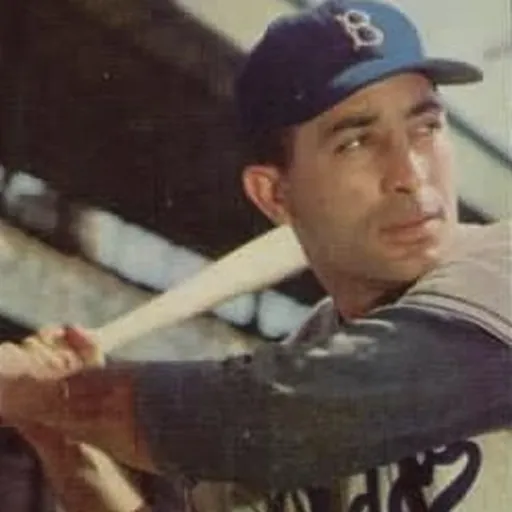
About Carl Anthony Furillo
Lived 1922 – 1989 (aged 66). Carl Anthony Furillo was an American baseball player.
Carl Anthony Furillo (March 8, 1922 – January 21, 1989), nicknamed "the Reading Rifle" and "Skoonj", was an American professional baseball player who played in Major League Baseball (MLB), spending his entire career with the Brooklyn/Los Angeles Dodgers, primarily as a right fielder.
A member of seven National League (NL) champion teams between and , Furillo batted over .300 five times, winning the batting title, with a .344 average—then the highest by a right-handed hitting Dodger since 1900. Noted for his strong and accurate throwing arm, he recorded ten or more assists in nine consecutive seasons, leading the league twice, and retired with the fifth-most games in right field (1,408) in NL history.
Early years Furillo was born in Stony Creek Mills, Pennsylvania. He was born from Italian immigrants from Campania. His father was from the province of Caserta and his mother was from the province of Benevento.
He was affectionately called "Skoonj", a nickname derived from the Italian word scungilli ("conch"), which was his favorite dish.
Furillo dropped out of school in the eighth grade and began working in various jobs, including apple-picking and work in a woolen mill. He continued to play baseball in his spare time. After the death of his mother, when he was eighteen, he decided to pursue baseball professionally.
Professional career Minor leagues and military service In 1940, Furillo signed with the Reading Chicks of the Interstate League, earning one of his nicknames with his powerful arm: "the Reading Rifle"; the Dodgers were sufficiently impressed by his ability that they purchased the entire minor league franchise to acquire him. Following the 1941 season with the Reading Brooks (renamed after being acquired by the Dodgers), he was assigned to the Montreal Royals of the International League where he batted .281 in 129 games.
Furillo's career was interrupted by the Second World War. In 1942, he enlisted in the United States Army and served for three years. He served in combat in the Pacific Theater, receiving three battle stars and the Purple Heart for being wounded in action.
Major leagues Upon returning from the army, Furillo reported to the Dodgers camp in Sanford, Florida for "advanced training" which had been designed for returning servicemen. He made the major leagues in . The following season, he batted .295 for the NL pennant winners, finishing the year ninth in the league with 88 runs batted in.
Furillo was one of the key members on the Dodgers' champions, hitting .322 (4th in the NL) with 18 home runs, and placing among the league's top ten players in RBI (106), slugging average (.506), hits (177), runs (95), triples (10) and total bases (278); he finished sixth in the voting for the MVP Award. In 1950 he batted .305 (7th in the league) with 18 home runs, 106 RBI, and a career-high 99 runs. He achieved a personal best with 197 hits, finishing third in the NL for the second year in a row, for the 1951 team which lost a legendary pennant playoff to the New York Giants; he also batted .295 (9th in the NL) with 91 RBI and 93 runs.
Furillo batted only .247 for the pennant winners, though he was selected to his first All-Star team. His .344 average was the highest by a right-handed Dodgers hitter since Oyster Burns hit .354 in 1894; Tommy Davis bettered him with a .346 mark in 1962. He was again named an All-Star, ending the year fifth in the league in slugging (.580), and finished ninth in the MVP balloting.
For the champions he was seventh in the league with a .314 average, along with 95 RBI and a career high of 26 homers. With the team which repeated as NL champions, earning the team's seventh pennant in ten years, he slipped to a .289 average but maintained solid power totals with 21 homers, 83 RBI and 30 doubles. He hit .306 in the Dodgers' last season in Brooklyn in 1957, and batted .290 in their first year in Los Angeles, finishing eighth in the league with 83 RBI. With the pennant team, his playing time was reduced to only 50 games, with just 25 of them in the outfield.
The Dodgers released Furillo in May while he was injured with a torn calf muscle; he sued the team, claiming they released him to avoid both the higher pension due a 15-year player and medical expenses, eventually collecting $21,000. He later maintained he was blackballed as a result and was unable to find a job within the sport – a charge denied by Commissioner Ford Frick.
World Series exploits Furillo had an excellent 1947 World Series, batting .353 in a seven-game loss; he had two RBI and scored a run in a 9–8 Game 3 victory, and scored the run which gave Brooklyn the lead for good in an 8–6 win in Game 6. He preserved a 6–5 victory in Game 5 of the 1952 World Series when he made a spectacular catch over the fence of an apparent home run by Johnny Mize – who had already homered three times in the Series – with one out in the eleventh inning.
In the 1953 World Series he hit .333, and drove in the tying run in the seventh inning of Game 1, though Brooklyn went on to lose; in the final Game 6, his 2-run homer with one out in the ninth tied the game 3–3, but New York scored in the bottom of the inning to win the game and the Series.
It was later reported by former teammates that Furillo overcame his bitterness towards baseball and became a regular attender of fantasy baseball camps at Dodgertown in Vero Beach, Florida, towards the end of his life.
Furillo developed leukemia, and died in Stony Creek Mills, Pennsylvania, at 66 years of age of an apparent heart attack. He was survived by his wife Fern ( Reichart), his two sisters, his sons, and five grandchildren. He is interred at Forest Hills Memorial Park in Reiffton, Pennsylvania. Although Furillo felt that baseball completely forgot about him and his accomplishments, his funeral was attended by a number of his former Dodger teammates, including Hall of Famer Sandy Koufax who was once Furillo's roommate as a young pitcher.
Don’t just read it —
keep it.
Full-length biographies made to live with: read them, listen on the way to work, watch them tonight.
- E-book
- Audio
- Video
Instant download · yours to keep · every purchase keeps this site free
Important facts
People in Carl Anthony Furillo's life
Named in this biography and alive at the same time





Related people
Same field, nearest in time

Contemporaries
People whose lives overlapped Carl Anthony Furillo's


Frequently asked questions
Who was Carl Anthony Furillo?
American baseball player
When was Carl Anthony Furillo born?
Carl Anthony Furillo was born on 8 March 1922 in Stony Creek Mills.
When did Carl Anthony Furillo die?
Carl Anthony Furillo died on 21 January 1989 in Stony Creek Mills.
What was Carl Anthony Furillo's occupation?
Carl Anthony Furillo was a baseball player.
What nationality was Carl Anthony Furillo?
Carl Anthony Furillo was American.
Sources & further reading
· Wikipedia: Carl Anthony Furillo
Cite this page
APA: Biography.guide. (2026). Carl Anthony Furillo. https://biography.guide/carl-anthony-furillo/
MLA: "Carl Anthony Furillo." Biography.guide, https://biography.guide/carl-anthony-furillo/.
Chicago: "Carl Anthony Furillo." Biography.guide. https://biography.guide/carl-anthony-furillo/.
Data last updated: 2026-09-21 · Spot an error? Report a correction.
Portrait: Wikimedia Commons · author & licence
Page generated 2026-09-27 05:00 UTC