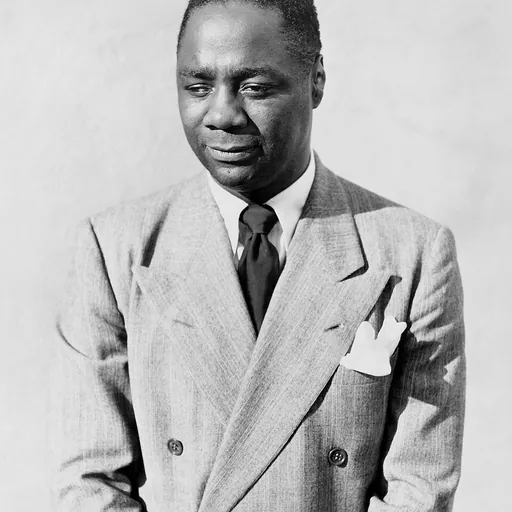
About Canada Lee
Lived 1907 – 1952 (aged 45). Canada Lee was an American bandleader, stage actor, film actor, jockey, boxer and actor.
Leonard Lionel Cornelius Canegata (March 3, 1907 – May 9, 1952), known professionally as Canada Lee, was an American professional boxer and actor who pioneered roles for African Americans. After careers as a jockey, boxer and musician, he became an actor in the Federal Theatre Project, including the 1936 production of Macbeth adapted and directed by Orson Welles. Lee later starred in Welles's original Broadway production of Native Son. A champion of civil rights in the 1930s and 1940s, Lee was blacklisted and died shortly before he was scheduled to appear before the House Un-American Activities Committee. He advanced the African-American tradition in theatre pioneered by such actors as Paul Robeson. Lee is the father of actor Carl Lee.
Biography Early life Lee was born Leonard Lionel Cornelius Canegata on March 3, 1907, in the San Juan Hill neighborhood of Manhattan in New York City. His father, James Cornelius Lionel Canegata, was born on the Caribbean island of St. Croix, and as a youth had migrated to New York, where he married Lydia Whaley Gadsen. due to incomplete coverage and record keeping for the sport in the 1920s and 1930s. Boxing historian Donald R. Koss documents Lee having 60 bouts 1927–31, the majority of them taking place 1927–28. Lee discovered a love for Broadway theatre during his years as a prizefighter. He remembered Show Boat as the first stage production he ever saw: "A big, tough fighter, all muscle, just sobbing," he recalled. which toured to Chicago, Detroit and other U.S. cities after its run on Broadway. It was his first professional role.
"I never would have amounted to anything in the theatre if it hadn't been for Orson Welles," Lee recalled. "The way I looked at acting, it was interesting and it was certainly better than going hungry. But I didn't have a serious approach to it until … I bumped into Orson Welles. He was putting on a Federal Theatre production of Macbeth with Negro players and, somehow, I won the part of Banquo. He rehearsed us for six solid months, but when the play finally went on before an audience, it was right—and it was a wonderful sensation, knowing it was right. Suddenly, the theatre became important to me. I had a respect for it, for what it could say. I had the ambition—I caught it from Orson Welles—to work like mad and be a convincing actor."
Macbeth was sold out for ten weeks at the Lafayette Theatre. After an additional two weeks on Broadway it toured the nation, including performances at the Texas Centennial Exposition in Dallas.
After five months in a supporting role, Lee succeeded Rex Ingram as the lead in the stage production Haiti (1938), portraying Haitian slave turned emperor Henri Christophe. One of the Federal Theatre Project's most popular productions, Haiti was seen by some 90,000 people at the Lafayette Theatre in Harlem and at Boston's Copley Theatre. As that regular series came to an end, he opened a restaurant at 102 West 136th Street, Canada Lee's Chicken Coop, which offered authentic South Carolina cuisine, jazz and blues. Lee kept it going despite chronic financial difficulties.
Lee became a star overnight in his ultimate stage success, Native Son (1941), an adaptation of Richard Wright's novel staged on Broadway by Orson Welles. who starred in the initial New York run, a 19-month national tour, and a second run on Broadway with accessible ticket prices. "Mr. Lee's performance is superb," wrote Brooks Atkinson of The New York Times, who called him "certainly the best Negro actor of his time, as well as one of the best actors in this country." Wright also applauded the performance, noting the contrast between Lee's affable personality and his intensity as Bigger Thomas. The sympathetic portrayal of a black man driven to murder by racial hatred brought much criticism however, especially from the Catholic Diocese of Brooklyn and the Legion of Decency, and the ensuing pressure forced the play to close.
During World War II, Lee continued to act in plays and in films. In 1942, he played in two comedies by William Saroyan, and earned approving reviews despite the generally negative response to these plays. In 1943, his name was above the title on the marquee for South Pacific, a race-themed drama directed by Lee Strasberg that again was panned by critics but won Lee critical praise. The script was criticized for making Joe "too stereotypical". Lee testified that he attempted to round out the character by revising dialogue, primarily eliminating repeated "yessir"s and "nossir"s that sounded subservient, and cutting some actions. An NAACP critique of the film condemned the role of Joe and praised Lee's performance. The Baltimore Afro-Americans review, while commenting on the character's shortcomings, praised Lee's portrayal. He is the only one who resists the impulse of mob fury that leads the other characters to kill the German. He is the only character who steps forward to disarm the wounded German sailor rescued at the end of the film.
Lee's successful radio career continued with New World A-Comin, which made its debut in March 1944. He narrated the first two seasons of the groundbreaking WMCA radio series that presented Negro history and culture to mainstream American audiences.
He became the first African American to play Caliban, in Margaret Webster's 1945 Broadway production of The Tempest. Lee had admired Shakespeare since his turn in Macbeth; indeed, at the time of his death he was preparing to play Othello on film.
In 1946, Lee played a principal role in On Whitman Avenue, a drama by Maxine Wood about racial prejudice directed by Margo Jones. Lee produced the play, making him the first African-American producer on Broadway. The play spoke directly to the need for interracial housing following World War II and won the praise of former First Lady Eleanor Roosevelt, who wrote weekly columns encouraging readers to see it.
In the autumn of 1946, Lee made American theatre history when he portrayed the villain Daniel de Bosola in John Webster's The Duchess of Malfi. Presented in Boston and on Broadway, the production marked the first time a black actor had played a white role on the stage. Lee wore a special white paste that had been used medically, to cover burns and marks, but had never before been used in the theatre. He had a supporting role in Robert Rossen's Body and Soul (1947), another boxing picture.
In 1948, Lee played his last stage role, that of a devoted slave in Set My People Free, Dorothy Heyward's drama based on the aborted 1822 slave revolt led by Denmark Vesey.
Civil rights activism As an actor, Lee came into contact with many of the leading progressive figures in the country. Langston Hughes, for instance, wrote two brief plays for Lee; these were submitted to the Theater Project, but their criticism of racism in America was deemed too controversial, and neither was staged. Lee spoke to schools, sponsored various humanitarian events, and began speaking directly against the existing segregation in America's armed forces, while simultaneously acknowledging the need to win World War II. To this latter end, he appeared at numerous USO events; he won an award from the United States Recruiting Office and another from the Treasury Department for his help in selling war bonds. These sentiments would carry on throughout his life, culminating in his early firsthand account of apartheid in South Africa.
Lee was an early influence on physician and human rights activist H. Jack Geiger. They met in 1940 when Geiger, a 14-year-old middle-class Jewish runaway, was backstage at a Broadway production of Native Son. Lee agreed to take Geiger in when he showed up at his door in Harlem asking for a place to stay. With the consent of his parents, Geiger stayed with Lee for over a year. Lee took on the role of surrogate father and introduced Geiger to Langston Hughes, Billy Strayhorn, Richard Wright, and Adam Clayton Powell. Geiger eventually became a journalist, then a doctor who co-founded the first community health center in the United States, Columbia Point Health Center in Dorchester, Massachusetts. He became a founder of Physicians for Social Responsibility and Physicians for Human Rights, and established community health centers in Mississippi and South Africa. Geiger says he would never have moved so deeply in these worlds so quickly if not for his experiences with Canada Lee.
In March 1951, Lee married Frances Pollack. They remained together until he died just over a year later.
Death Lee died of a reported heart attack at the age of 45 on May 9, 1952, in Manhattan. It was later revealed by his widow, Frances Pollack, that he had been diagnosed with uremia and died of kidney disease, slipping into a coma and dying 10 days after his diagnosis.
Theatre credits
Date Title Role Notes 1934 Brother Mose Nathan Debut; tour of New York City boroughs under the Civil Works Administration ? – Spring 1935 Stevedore Blacksnake Tour of U.S. cities including Chicago and Detroit April 12, 1936 Macbeth Banquo Lafayette Theatre, Harlem, New YorkA free preview draws 3,000 more people than can be seated July 21–25, 1936 July 28 – August 1, 1936 Macbeth Banquo Exhibit Theatre, Dallas, Texas August 13–23, 1936 Integrated seating was a unique experience for theatergoers in Dallas Macbeth Banquo Keith's Theatre, Indianapolis, Indiana September 1–13, 1936 Macbeth Banquo Great Northern Theater, Chicago, Illinois September 1936 Macbeth Banquo Detroit, Michigan September 1936 Macbeth Banquo Cleveland, Ohio September 23–25, 1936 Macbeth Banquo Civic University, Syracuse, New York October 6–17, 1936 Macbeth Banquo Majestic Theatre, Brooklyn, New York October 29, 1937 – January 15, 1938 December 2–4, 1937 Brown Sugar Henry Biltmore Theatre, New York March 2 – August 7, 1938 Haiti Bertram Lafayette Theatre, Harlem, New York August 9 – September 24, 1938 Haiti Henri Christophe Lafayette Theatre, Harlem, New York January 3 – May 1939 Mamba's Daughters Drayton Empire Theatre, New York September 1939 – ? Mamba's Daughters Drayton Tour of U.S. cities including Detroit, Toronto, Chicago and St. Louis October 22 – December 14, 1940 Big White Fog Victor Mason Lincoln Theatre, Harlem, New York March 24 – June 28, 1941 Native Son Bigger Thomas St. James Theatre, New York July–August 1941 Native Son Bigger Thomas Tour of New York City boroughs August 17–22, 1942 Talking to You Blackstone Boulevard Belasco Theatre, New York December 29, 1943 – January 1, 1944 South Pacific Sam Johnson Cort Theatre, New York August 30 – October 1944 Anna Lucasta Danny Mansfield Theatre, New York May 8 – September 14, 1946 On Whitman Avenue David Bennett Cort Theatre, New York September 23 – ?, 1946 The Duchess of Malfi Daniel de Bosola Shubert Theatre, Boston July 1948 Othello Othello Week long production in Boston also starred Clare Luce and Wesley Addy. November 3–27, 1948 Set My People Free George Hudson Theatre, New York July 1949 Anna Lucasta Danny Two-week revival at the Apollo Theater, Harlem 1942 Henry Browne, Farmer Narrator Oscar-nominated documentary short 1944 Lifeboat Joe Spencer 1945 Ask the OPA Narrator Documentary short about the Office of Price Administration 1947 Body and Soul Ben Chaplin 1947 The Roosevelt Story Narrator (Joe, the voice of the Depression) Documentary biography of Franklin D. Roosevelt 1949 Lost Boundaries Lt. Thompson 1950 The Chevrolet Tele-Theatre (TV series) UnknownPolice Officer "The Final Bell" "Oropalo" 1951 Cry, the Beloved Country Stephen Kumalo 1952 American Inventory George Washington Carver Episode titled "Biography Book" aired by NBC on April 13, 1952. This also featured his son, billed as Canada Lee Jr, playing a student at Tuskegee Institute.
Radio credits Date Title
Don’t just read it —
keep it.
Full-length biographies made to live with: read them, listen on the way to work, watch them tonight.
- E-book
- Audio
- Video
Instant download · yours to keep · every purchase keeps this site free
Important facts
Family & relationships
People in Canada Lee's life
Named in this biography and alive at the same time




Related people
Same field, nearest in time


Contemporaries
People whose lives overlapped Canada Lee's

Frequently asked questions
Who was Canada Lee?
American actor
When was Canada Lee born?
Canada Lee was born on 3 March 1907 in Manhattan.
When did Canada Lee die?
Canada Lee died on 9 May 1952 in New York City.
What was Canada Lee's occupation?
Canada Lee was a bandleader, stage actor, film actor, jockey, boxer and actor.
What nationality was Canada Lee?
Canada Lee was American.
Sources & further reading
Cite this page
APA: Biography.guide. (2026). Canada Lee. https://biography.guide/canada-lee/
MLA: "Canada Lee." Biography.guide, https://biography.guide/canada-lee/.
Chicago: "Canada Lee." Biography.guide. https://biography.guide/canada-lee/.
Data last updated: 2026-09-20 · Spot an error? Report a correction.
Portrait: Wikimedia Commons · author & licence
Page generated 2026-09-27 04:57 UTC