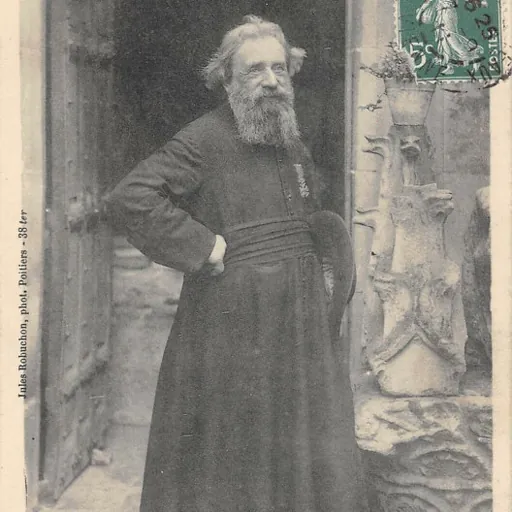
About Camille de La Croix
Lived 1831 – 1911 (aged 79). Camille de La Croix was a Belgian historian, archaeologist and catholic priest.
Camille de La Croix (born Camille Adolphe Ferdinand Marie de La Croix on July 21, 1831, in Mont-Saint-Aubert, Belgium) was a Belgian Jesuit priest who made significant contributions to both music education and archaeology. He resided in Poitiers, France, from 1864 until his death on April 13, 1911.
After beginning his theological studies, de La Croix moved to France, where he was ordained a priest in 1864. His interest in archaeology emerged in 1877, leading him to conduct numerous excavations. His work focused particularly on ancient and early Christian periods, and he is noted for discovering the , the Saint-Jean Baptistery in Poitiers, and the Hypogeum of the Dunes in the same city.
Although his occasionally empirical methodology was not universally accepted and his conclusions were sometimes contested, his contributions were recognized with his appointment as a Knight in the National Order of the Legion of Honour in 1896.
Biography
Early life and education
Camille de La Croix was born on July 21, 1831, at the family estate of Château du Rinval in Mont-Saint-Aubert, a village that is now part of the city of Tournai in Belgium. His ancestors, the de La Croix d'Ogimont family, were members of a noble family that originated in Valenciennes and had settled in the Tournai region since the 17th century. Consequently, he owned a considerable personal fortune at the outset of his career.
He was resolved to pursue a vocation in the religious life, as had his two elder sisters and younger brother. Accordingly, he commenced his studies at the Jesuit college in exile in Brugelette, in consequence of the anti-religious legislation that was then in force in France. He subsequently attended the in Vannes, where he was able to follow the same teachers who had returned to France in 1850.
He began his spiritual and religious training on January 30, 1854, at the Jesuit novitiate in Issenheim, Alsace. There, he met Father Magloire Tournesac, a musician and architect from Sarthe, an inspector of historical monuments, under whom he learned to master the art of drawing and architecture. However, he was assigned to direct musical studies at the .
In 1877, he fully and permanently transitioned his focus to archaeological research. The Bishop of Poitiers, Louis-Édouard Pie, relieved him of his teaching responsibilities, allowing him to dedicate his time exclusively to archaeology. Although he had taken up permanent residence in France, which he considered his second homeland; nevertheless, he consistently asserted his true nationality. For example, at the Sanxay excavation site, he flew the French and Belgian flags. It was as a foreigner that, after numerous archaeological discoveries to his credit, the French government awarded him the title of Knight of the Legion of Honour in 1896. Notably, the decree was indeed issued by the Minister of Foreign Affairs. He died at his modest residence in Poitiers on April 13, 1911. Financially, he was impoverished, having expended his entire fortune on the numerous excavation campaigns he spearheaded. He bequeathed his archives, collections, library, and the land of the Hypogeum of the Dunes, which he had acquired to safeguard the site, to the Société des Antiquaires de l'Ouest. Camille de La Croix was laid to rest in the in Poitiers. A plaster copy of the bust is kept at the Sainte-Croix Museum in Poitiers. Two public roads in Béruges and Poitiers—the latter of which runs alongside the Hypogeum of the Dunes—have been designated "rue du Père de La Croix."
Contributions to archaeology Camille de La Croix's dedication to archaeological research first became evident in 1877. his primary objective was to return to Poitiers to resume his excavations, as documented by Octave Mirbeau, a former student at the Vannes College with whom he shared a similar academic background.
He was willing to initiate archaeological excavations without assistance and to finance them with his funds (renting or even purchasing land, buying equipment, paying the workers). This archaeologist, described as "hardworking and tenacious," did not maintain a detailed excavation journal, and did not compile an inventory of archaeological artifacts, which were sometimes dispersed as gifts to his friends. Nevertheless, his intuitive insights were seldom misguided, and he consistently produced meticulous site plans. His character elicited a multifaceted response, encompassing both criticism and praise, within the context of a political environment that was often anti-religious. The objective was to ascertain whether any traces of the burial of Saint Hilaire could be found. In 1877–1878, he successfully identified the Roman baths of Poitiers and mapped them in detail. The discovery and comprehensive excavation of the Hypogeum of the Dunes from 1878 to 1880 solidified his reputation as an archaeologist.
Another significant discovery was the , which he excavated from 1880 to 1883. During this period, he uncovered the majority of the site's main features. However, some structures were unfortunately destroyed during the excavation process, and many others had to be reburied after the project. Subsequently, this discovery was regarded as the most significant in Gaul since the discovery of the Temple of Mercury at Puy-de-Dôme. In 1884, the General Council of Vienne requested that he create an archaeological map of the department, spanning from the Iron Age to the Merovingian period. To this end, he conducted excavations at numerous sites until 1896.
In Poitiers, Father de La Croix undertook comprehensive research on the Saint-Jean Baptistery, commencing in 1890 and concluding between 1898 and 1902. He was able to discern the edifice's true purpose and corroborate the findings initially documented by at the beginning of the century. From the mid-1890s onwards, he directed many excavations in other departments. In 1895, he researched the pillar of Yzeures-sur-Creuse (Indre-et-Loire), where he made significant advancements beyond the scope of the Société archéologique de Touraine, which was also involved in investigating these remains. The following year, he conducted research at the site of the Saint-Philibert Abbey in Saint-Philbert-de-Grand-Lieu (Loire-Atlantique). He posited that this building was an ancient monument that had been remodeled several times, a theory that was later disproved. Between 1896 and 1897, he identified the theater and temples of the ancient site of Villeret (Canetonum) in Berthouville (Eure), where a treasure had already been discovered. In 1898-1899, he excavated the Saint-Maur Abbey in Glanfeuil (Maine-et-Loire).
In the initial decade of the 20th century, Camille de La Croix's physical presence on the field was less pronounced.
Camille de La Croix and learned societies On November 15, 1877, Father de La Croix became a member of the (SAO). In 1881, he was appointed treasurer, a role which entailed the management of the society's properties. He concurrently held the position of curator of collections, a post he retained until his death.
He commenced his tenure as a correspondent for the Ministry of Public Instruction and Fine Arts in 1886. In 1897, he was designated a "non-resident member" of the Committee for Historic and Scientific Works. However, following a campaign in which his characteristics, status as a Jesuit, and his Belgian nationality were subjected to greater scrutiny than the merits of his work, he was removed from this organization in May 1902. or the contentious controversy that opposed him to , president of the Société Archéologique de Nantes et de la Loire-Inférieure, concerning the excavations at the Saint-Philbert-de-Grand-Lieu Abbey. Nevertheless, other archaeologists, such as Émile Espérandieu and Jules Quicherat, enjoyed excellent relations with de La Croix, with whom they corresponded regularly.
Don’t just read it —
keep it.
Full-length biographies made to live with: read them, listen on the way to work, watch them tonight.
- E-book
- Audio
- Video
Instant download · yours to keep · every purchase keeps this site free
Important facts
People in Camille de La Croix's life
Named in this biography and alive at the same time

Related people
Same field, nearest in time




Contemporaries
People whose lives overlapped Camille de La Croix's


Frequently asked questions
Who was Camille de La Croix?
Belgian historian (1831-1911)
When was Camille de La Croix born?
Camille de La Croix was born on 14 July 1831 in Mont-Saint-Aubert.
When did Camille de La Croix die?
Camille de La Croix died on 13 April 1911 in Poitiers.
What was Camille de La Croix's occupation?
Camille de La Croix was a historian, archaeologist and catholic priest.
What nationality was Camille de La Croix?
Camille de La Croix was Belgian.
Sources & further reading
· Wikipedia: Camille de La Croix
· DBpedia: Camille de La Croix
Cite this page
APA: Biography.guide. (2026). Camille de La Croix. https://biography.guide/camille-de-la-croix/
MLA: "Camille de La Croix." Biography.guide, https://biography.guide/camille-de-la-croix/.
Chicago: "Camille de La Croix." Biography.guide. https://biography.guide/camille-de-la-croix/.
Data last updated: 2026-09-23 · Spot an error? Report a correction.
Portrait: Wikimedia Commons · author & licence
Page generated 2026-09-27 05:06 UTC