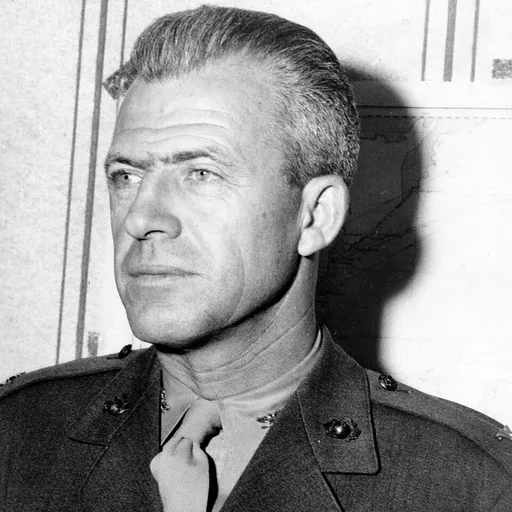
Caleb Bailey
United States Marine Corps general
About Caleb Bailey
Lived 1898 – 1957 (aged 58). Caleb Bailey was an American military officer, baseball player and american football player.
Caleb Thayer "Zeke" Bailey (August 28, 1898 – January 13, 1957) was a decorated officer and naval aviator in the United States Marine Corps with the rank of brigadier general. An excellent athlete while at the University of Maryland, he distinguished himself as center in the UM Terrapins football team and following his commissioning in the Marine, he also excelled in Quantico Marines Devil Dogs football.
Bailey rose through the ranks and became the first commander of Marine Corps Air Depot Miramar during World War II. He later served successively as chief of staff to the Commander, Aircraft, Northern Solomons, Brigadier general Field Harris, and commander of Marine Aircraft Group 11 during the combats in the Pacific and received several decorations. He later served as chief of staff of the 1st Marine Aircraft Wing during Korean War, before retiring in June 1954. The Baltimore Sun wrote in 1922 that Bailey was among those "men whose work can be attributed much of the Black and Gold's success of the last few years." He also played on the Maryland baseball team as a catcher. In May 1923, he tried out for the Newark Bears, a professional baseball team in the International League.
Bailey graduated with Bachelor of Science degree in chemical engineering in June 1923 and was able to secure the commission in the United States Marine Corps. He was commissioned second lieutenant in the Marines on July 17, 1923, and ordered to the Marine Barracks, Quantico for Officers' instruction. Upon the completion of the course, Bailey joined the Quantico Marines Devil Dogs football team as a center and played for next four years with many future distinguished officers including: William J. Whaling, Harry B. Liversedge, Elmer E. Hall, William S. Fellers, Frank B. Goettge, Lawson H. M. Sanderson, George W. McHenry, and Henry Crowe.
After the Marines defeated the Army team from Fort Benning in November 1926, Bailey received the President's Cup from First Lady Grace Coolidge on behalf of his team. Bailey was detached from Quantico in December 1927 and sailed for Haiti, where he participated in the peacekeeping operations as a member of 1st Brigade of Marines.
In September 1928, he returned stateside and rejoined the Quantico Marines as Assistant Coach, a position he held for next two seasons. Bailey was promoted to First lieutenant on December 22, 1928. However, during his tour of duty in Haiti, Bailey became influenced with flying, when he had the opportunity to observe Marine squadrons operating there. He requested for flight training and was ordered to the Naval Air Station Pensacola, Florida, in February 1930.
Bailey successfully completed the training in December that year and was designated Naval aviator. He was ordered to the Naval Air Station North Island in San Diego, California, and joined the Scouting Squadron 14-M there. His squadron was later assigned to the aircraft carrier Saratoga and took part in the fleet exercise in the Caribbean side of the Panama Canal. Bailey served with the squadron aboard Saratoga until July 1934 and participated in the fleet exercises with the Pacific Fleet off Hawaii and the coast of California.
He was subsequently ordered back to Marine Barracks, Quantico, Virginia, and completed Junior Course at the Marine Corps Schools there. Bailey was promoted to Captain in June 1935 and remained at Quantico until May of the following year, when he was ordered to Washington, D.C., for duty at the Bureau of Aeronautics, Navy Department under Rear admiral Arthur B. Cook.
In August 1943, Bailey was ordered to South Pacific and assumed duty as chief of staff to the commander, aircraft, Northern Solomons, Brigadier General Field Harris. He joined his new unit on Guadalcanal, where it was stationed for last several months. Bailey then participated in the formulation of the Air Operations plans, supervised the equipping, indoctrination and then embarkation of units of his command for Bougainville Campaign.
On November 1, 1943, Bailey during the landing and movement inland, he established friendly lines and under his supervision, all of the following services were functioning by 1830, D-Day: Air Warning Service (including radar telling); Fighter Direction Service; Close Support Bomber Control; Communications with ComAirSols; and Communications with Divisional Headquarters. For his service during the preparation of his command and during the attack on Bougainville, Bailey was decorated with Legion of Merit with Combat "V".
In March 1944, Bailey participated in the Landing on Emirau, where he then helped to establish an U.S. airbase and received Navy Commendation Medal for his service. Upon the departure of general Field Harris to the United States in August 1944, Bailey assumed command of Marine Aircraft Group 11 and led his unit during the Battle of Peleliu in September–November 1944. His group provided close air support to the 81st Infantry Division and 1st Marine Division during the War in the Pacific.
He then established his headquarters on that island and held additional duty as Air Defense Commander, Peleliu. For the rest of the year, Bailey's planes flew routine antisubmarine and combat air patrols, and bombing and rocket missions over other Palau Islands (Koror and Babelthuap) and over Yap. Three Japanese Aichi E13A "Jake" planes were destroyed during that period and Bailey received Bronze Star Medal with Combat "V" and Air Medal for his service at Peleliu.
While group commander of MAG-11 at Peleliu, his pilots of VMF-122 began what they called "Operation Freeze". In these missions, a single F4U Corsair flew at 30,000 to 33,000 feet under the guise of practicing high-altitude operations, which also had the side benefits of drawing ineffective Japanese anti-aircraft artillery fire (thereby wasting their ammunition stores), and creating ten gallons of chocolate ice cream. The field-expedient dessert was made from a concoction of canned milk and cocoa powder stored in an underwing tank, which froze during flight at the high altitude. According to the book Corsair: The F4U in World War II and Korea, Bailey called the unit regarding the "practice" sorties and told them, "You guys aren't fooling me, I've got spies. You tell Hunter I'm coming over there tomorrow and get my ration."
Bailey was succeeded by Colonel Clarence J. Chappell in January 1945 and returned to the United States for duty on the staff of Marine Air, West Coast under Major general Claude A. Larkin. He remained in that capacity for the remainder of the War.
Postwar service
Following the war, Bailey remained in the Marine Corps serving as the chief of staff of Marine Corps Air Station Cherry Point, North Carolina, under Brigadier General Ivan W. Miller. In this capacity, he was co-responsible for the training of replacement air crews and other personnel.
In November 1950, his former superior officer, now Major General Field Harris, and commanding general of the 1st Marine Aircraft Wing in Korea, requested Bailey to be his chief of staff. He succeeded Colonel Kenneth H. Weir and took part in the Battle of Chosin Reservoir. During the subsequent Hungnam evacuation, Bailey was responsible for supervising and coordinating the activities of the Wing's staff and was later charged with supervising the construction of K-1 Airfield and the design of Wing facilities at that field.
During the first part of 1951, Bailey took part in the planning and execution of Wing's air operations during the Chinese Spring Offensive and remained in Korea until the end of August 1951. For his service with 1st Marine Aircraft Wing, Bailey was decorated with his second Legion of Merit with Combat "V" and second Air Medal.
Decorations Brigadier general Bailey's personal decorations include:
Honors The University of Maryland Athletic Hall of Fame inducted him in 1984.
Don’t just read it —
keep it.
Full-length biographies made to live with: read them, listen on the way to work, watch them tonight.
- E-book
- Audio
- Video
Instant download · yours to keep · every purchase keeps this site free
Important facts
People in Caleb Bailey's life
Named in this biography and alive at the same time



Related people
Same field, nearest in time


Contemporaries
People whose lives overlapped Caleb Bailey's


Frequently asked questions
Who was Caleb Bailey?
United States Marine Corps general (1898-1957)
When was Caleb Bailey born?
Caleb Bailey was born on 28 August 1898 in Bladensburg.
When did Caleb Bailey die?
Caleb Bailey died on 13 January 1957 in San Diego.
What was Caleb Bailey's occupation?
Caleb Bailey was a military officer, baseball player and american football player.
What nationality was Caleb Bailey?
Caleb Bailey was American.
Sources & further reading
Cite this page
APA: Biography.guide. (2026). Caleb Bailey. https://biography.guide/caleb-bailey/
MLA: "Caleb Bailey." Biography.guide, https://biography.guide/caleb-bailey/.
Chicago: "Caleb Bailey." Biography.guide. https://biography.guide/caleb-bailey/.
Data last updated: 2026-09-22 · Spot an error? Report a correction.
Portrait: Wikimedia Commons · author & licence
Page generated 2026-09-27 05:03 UTC