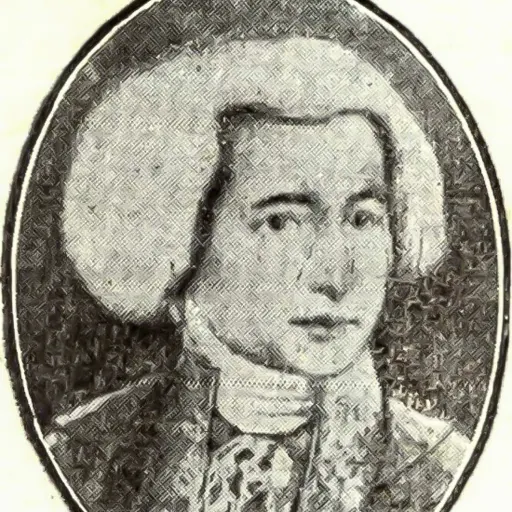
About Caetano Pinto de Miranda Montenegro
Lived 1748 – 1827 (aged 78). Caetano Pinto de Miranda Montenegro was a Brazilian politician.
Caetano Pinto de Miranda Montenegro, 1st Marquis of Vila Real da Praia Grande (16 September 1748 – 11 January 1827) was a Portuguese colonial administrator and nobleman, known for being the Governor-General of the Captaincies of Mato Grosso and Pernambuco. He was taken off his role on the later as a result of the Pernambucan Revolt, as he was perceived as an ally to the Portuguese Crown interests. After the independence of Brazil, he partook several roles in the government.
First years
Caetano Pinto was born on 16 September 1748 in Lamego, Kingdom of Portugal. He was the second son of Bernardo José Pinto de Miranda Montenegro, fidalgo squire of the House of Braganza, with Antônia Matilde Leite Pereira de Bulhões.
He began his studies on the University of Coimbra in 1777, obtaining his Bachelor of Letters in 1781. He concluded his Licentiate and obtained his Doctorate of Law in 1783. He was contemporaneous of brothers José Bonifácio and Antônio Carlos. Catarina Balsemão, wife of Luís Pinto de Sousa Coutinho, asked to nominate him as Governor of Mato Grosso, but instead he was nominated as Manager of Gold from Rio de Janeiro in 1791.
During his governance, the Marquis of Pombal made several changes on Brazilian education, taking it out of the hands of the Jesuits and establishing public colleges. The professors should be chosen by a bishop, but as Mato Grosso hadn't got one, Prince Regent John gave permission to Caetano Pinto to choose them. On 14 May 1800, Caetano Pinto also made reforms on the taxes in order to better collect the "Literary Subsidy".
On 3 November 1797, he ordered the construction of the Miranda Prison near the Mboteteí River to fight the Spanish invasion in the region. The prison is considered the founding of the Miranda city. He was also responsible for constructing the São José de Montenegro Prison in 1799.
On 26 March 1804, Caetano Pinto intimated Lopo Joaquim de Almeida Henriques, Governor of Rio Grande do Norte, to come to Pernambuco in eight days due several crimes committed by him, including the slashing of white men in a pelourinho for not paying tribute of his watermelon plantation.
On 4 January 1808, he sent a letter to João Rodrigues de Sá e Melo regarding the transfer of the Portuguese court to Brazil, looking for instructions about the opening of the ports for friendly nations.
In 1808, Caetano Pinto tried to create a cemetery for new blacks and other people near Capela da Ordem Terceira do Carmo, possibly on the river islands on the Capibaribe and Beberibe Rivers, but his proposal was denied. In 1810, he built the British Cemetery, near Lazareto de Santo Amaro. In 1814, Caetano Pinto designated an area of 120 x 200 spans previously belonging to João Policarpo do Rêgo Barros for the British Consul, that built a cemetery.
In 1808, Caetano Pinto asked for the recruitment of a thousand Pernambucanos for the occupation of Cayenne, during the Peninsular War. Despite the protests from the population, 300 men were recruited for the military operation in 1809.
Caetano Pinto received a report about the Pernambucan Revolt conspiracy on 1 March 1817. On 4 March, he made his troops swear obedience to the monarchy and the harmony between Brazilians and Portuguese and on the 5th he made a speech to Recife population, saying that Brazil would be elevated to a United Kingdom and all of them obeyed the same king.
On the 6th, he issued an arrest order to several Freemasons of the English rite. Amongst the accused were three artillery Captains, Domingos Teotônio Pessoa de Melo, José de Barros Lima and Pedro da Silva Pedroso. The Brigadeer Manoel Joaquim Barbosa de Castro went to Forte de São Tiago das Cinco Pontas to fulfill the order, but he was murdered by Lima. Most of the officials unleashed their swords in support of the conspirators and two Portuguese officials fled.
After a few hours, the conspirators filled the streets and Caetano Pinto and his family fled to Forte de São João Batista do Brum. He then was obligated to renounce his post as governor and fled to Rio de Janeiro.
There is a street with his name in Jardim do Marquês, Jacareí.
Don’t just read it —
keep it.
Full-length biographies made to live with: read them, listen on the way to work, watch them tonight.
- E-book
- Audio
- Video
Instant download · yours to keep · every purchase keeps this site free
Important facts
People in Caetano Pinto de Miranda Montenegro's life
Named in this biography and alive at the same time

Related people
Same field, nearest in time



Contemporaries
People whose lives overlapped Caetano Pinto de Miranda Montenegro's





Frequently asked questions
Who was Caetano Pinto de Miranda Montenegro?
Brazilian politician
When was Caetano Pinto de Miranda Montenegro born?
Caetano Pinto de Miranda Montenegro was born on 16 September 1748 in Lamego.
When did Caetano Pinto de Miranda Montenegro die?
Caetano Pinto de Miranda Montenegro died on 11 January 1827 in Rio de Janeiro.
What was Caetano Pinto de Miranda Montenegro's occupation?
Caetano Pinto de Miranda Montenegro was a politician.
What nationality was Caetano Pinto de Miranda Montenegro?
Caetano Pinto de Miranda Montenegro was Brazilian.
Sources & further reading
· Wikipedia: Caetano Pinto de Miranda Montenegro
· DBpedia: Caetano Pinto de Miranda Montenegro, 1st Marquis of Vila Real da Praia Grande
Cite this page
APA: Biography.guide. (2026). Caetano Pinto de Miranda Montenegro. https://biography.guide/caetano-pinto-de-miranda-montenegro/
MLA: "Caetano Pinto de Miranda Montenegro." Biography.guide, https://biography.guide/caetano-pinto-de-miranda-montenegro/.
Chicago: "Caetano Pinto de Miranda Montenegro." Biography.guide. https://biography.guide/caetano-pinto-de-miranda-montenegro/.
Data last updated: 2026-09-20 · Spot an error? Report a correction.
Portrait: Wikimedia Commons · author & licence
Page generated 2026-09-27 04:58 UTC