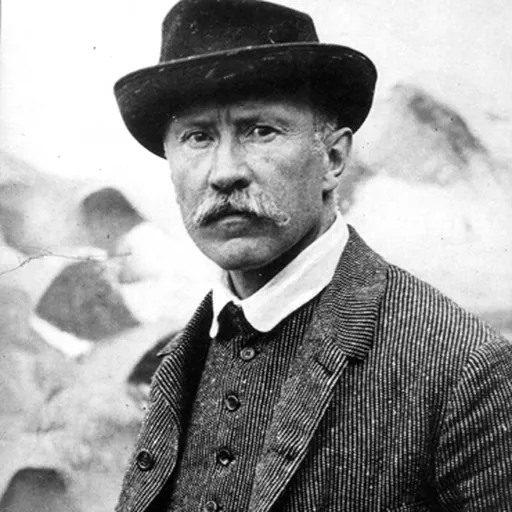
About Bruno Liljefors
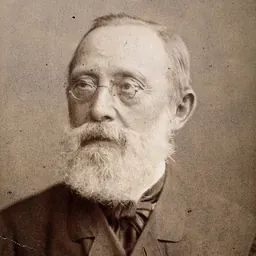
Lived 1860 – 1939 (aged 79). Bruno Liljefors was a Swedish painter, cartoonist, comics artist, visual artist, graphic artist and sculptor.
Bruno Andreas Liljefors (; 14 May 1860 – 18 December 1939) was a Swedish artist. He is perhaps best known for his nature and animal motifs, especially in dramatic situations. He was the most important and probably most influential Swedish wildlife painter of the late nineteenth and early twentieth centuries. He also drew some sequential picture stories, making him one of the early Swedish comic creators.
Biography
Liljefors was born in Uppsala, Sweden, to Anders Liljefors and Maria Margareta Lindbäck. His brother was the composer and conductor Ruben Liljefors (1871–1936). Bruno Liljefors first studied at Katedralskolan for six years and then pursued further education at the Swedish Royal Academy of Fine Arts from 1879 to 1882. Thereafter, he made a study trip to Düsseldorf, Baiern, Venice, Florence, Naples, Rome and Paris between 1882 and 1883. He received inspiration from the Scandinavian artist colony in Grez-sur-Loing. In 1886, he became a member of the Artists' Union (Konstnärsförbundet), which was in opposition to the Royal Academy. From 1888–1889, he taught at Valand Academy in Gothenburg.
In 1887, he married Anna Olivia Olofsson (1864–1947). The marriage ended with a divorce in 1895, at which time he married his first wife's younger sister, Signe Adolfina Helena Olofsson (1871–1944). He was a resident of Uppsala until the summer of 1894, when he sought out the Stockholm archipelago. From 1905–1917, he lived at Ytterjärna in Södermanland and from 1917 to Österbybruk in Uppland. He established a studio in Österbybruk, where he lived and worked between 1917 and 1932.
During the last years of the nineteenth century, a brooding element entered his work, perhaps the result of turmoil in his private life. He was often short of money and in 1925, he suffered a facial neuralgia with severe pain. From 1932, Liljefors lived at Kungsholmen in Stockholm. The last two years of his life, he spent in Uppsala. Liljefors died in 1939 and was buried at the Uppsala old cemetery.
Work Liljefors is held in high esteem by painters of wildlife and is acknowledged as an influence by, for example, American wildlife artist Michael Coleman. All his life, Liljefors was a hunter, and he often painted predator-prey action, the hunts engaged between fox and hare, sea eagle and eider, and goshawk and black grouse serving as prime examples.
The darker quality in his paintings gradually began to attract interest, and he had paintings exhibited at the Paris Salon. The influence of the Impressionists can be seen in his attention to the effects of environment and light, and later that of Art Nouveau in his painting of Mallards, Evening Wild Ducks, of 1901, in which the pattern of the low sunlight on the water looks like leopardskin, hence the Swedish nickname .
Style He amassed a collection of animals to act as his living models. Ernst Malmberg recalled:
The greatness of Liljefors lay in his ability to show animals in their environment. Sometimes he achieved this through hunting and observation of the living animal, and sometimes he used dead animals; for example, his Hawk and Black Game, painted in the winter of 1883–84, was based on dead specimens, but he also used his memory of the flocks of black grouse in the meadows around a cottage he once lived in at Ehrentuna, near Uppsala. He wrote:
Assessment Such practices have sometimes led to criticism of Liljefors' work; Lars Jonsson has noted a "heraldisation" of the drama in Golden Eagle Chasing a Hare, 1904, which causes a departure from pure naturalism, and he deduces from the position of the eagle's wing feathers that it would have been gliding rather than turning in reaction to the hare as painted.
Nevertheless, Liljefors was a pioneer at a time when wildlife art was still emerging from its association with scientific depiction and taxidermy. He also set a standard of identification with the landscape that substantially influenced the development of wildlife art in the twentieth century.
Paintings
Don’t just read it —
keep it.
Full-length biographies made to live with: read them, listen on the way to work, watch them tonight.
- E-book
- Audio
- Video
Instant download · yours to keep · every purchase keeps this site free
Important facts
more
Liljefors, Brunno Andreas LiljeforsPeople in Bruno Liljefors's life
Named in this biography and alive at the same time

Related people
Same field, nearest in time


Contemporaries
People whose lives overlapped Bruno Liljefors's


Frequently asked questions
Who was Bruno Liljefors?
Swedish artist (1860–1939)
When was Bruno Liljefors born?
Bruno Liljefors was born on 14 May 1860 in Uppsala Cathedral Assembly, Uppsala.
When did Bruno Liljefors die?
Bruno Liljefors died on 18 December 1939 in Uppsala Cathedral Assembly, Stockholm.
What was Bruno Liljefors's occupation?
Bruno Liljefors was a painter, cartoonist, comics artist, visual artist, graphic artist and sculptor.
What nationality was Bruno Liljefors?
Bruno Liljefors was Swedish.
Sources & further reading
Cite this page
APA: Biography.guide. (2026). Bruno Liljefors. https://biography.guide/bruno-liljefors/
MLA: "Bruno Liljefors." Biography.guide, https://biography.guide/bruno-liljefors/.
Chicago: "Bruno Liljefors." Biography.guide. https://biography.guide/bruno-liljefors/.
Data last updated: 2026-09-23 · Spot an error? Report a correction.
Portrait: Wikimedia Commons · author & licence
Page generated 2026-09-27 05:06 UTC