
About Brigitte Klump
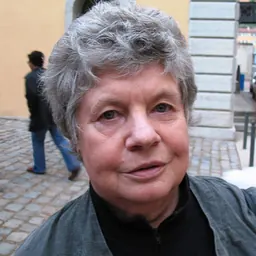
Lived 1935 – 2023 (aged 88). Brigitte Klump was a German writer and journalist.
Brigitte Klump (23 January 1935 – 10 July 2023) was a German author and campaigner. She was born into a relatively poor farming family, originally of Huguenot provenance. She grew up, between 1949 and 1957, in the German Democratic Republic (East Germany) where she trained as a journalist, before undertaking an internship at the Theater am Schiffbauerdamm in Berlin. Here she was mentored by Brecht's widow, the actress-director Helene Weigel. Klump escaped to West Berlin in 1957.
Subsequently, invoking United Nations resolution 1503, she was able to help approximately 4,000 East German citizens escape to West Germany, thereby reuniting families divided by the political division of Germany. She later stated that this was, in part, a conscious atonement for the failings of a distant ancestor who had been a noted lawyer in Arles. During a period of religious persecution, he had enabled thousands of Waldensians to escape abroad by successfully delaying a trial, but 4,000 had nevertheless been killed.
Brigitte Klump claimed descent from King Louis XVI and Queen Marie Antoinette of France via their daughter, the twenty minute queen, Marie Thérèse Charlotte de Bourbon.
Klump attended school in Havelberg, passing her school leaving exams (Abitur) in 1953, after which she worked in Berlin as a volunteer on the weekly newspaper "Der Freie Bauer" ("The free peasant"). In 1954 the paper's editorial management sent her to study at the Faculty of Journalism at Leipzig. The faculty, which at this time offered the only university-level journalism courses in the country, was popularly known as "das rote Kloster" ("the red monastery"). The faculty was surrounded by high walls which were lit up through the night. East German journalism students led privileged lives, well-fed in an era of acute austerity, but their mail was censored and there were listening devices in the rooms. The Ministry for State Security (Stasi) were omnipresent. Students were encouraged to spy and report on one another. during the 1956/57 season. As matters turned out, once Klumpe moved to Berlin, Weigel herself also took her in hand. Klumpe learned why the theatre principal showed her such kindness from other actors. was a necessary precondition for receiving the diploma necessary to work as a socialist journalist. It would be more than another three years before the ever more intensive political division of Berlin was reinforced with a physical wall: on 13 November 1957 Brigitte Klump fled to West Berlin and enrolled at the Free University of Berlin in order to progress her studies. She subsequently removed herself from university before completing her degree course.
Highlights
"Das rote Kloster" By 1978 Brigitte Klump was ready to publish her first book, "Das rote Kloster". a long-established publishing house based in Hamburg. Those who knew about it had thus far kept their mouths shut for fear of reprisals, because although the faculty operated formally under the aegis of the university, it was in reality a training academy controlled by the Party Central Committee. Klump indicated that she herself had delayed publication for nineteen years in order sufficiently to distance herself from the emotional encumbrances of her time in Leipzig. When she fled to the west in 1957 she was, like all her fellow students, a "Civil reserve officer" ("Reserveoffiziersbewerber") of the German Democratic Republic. It was a precept of Leninist doctrine that journalists were the sharpest weapon in the party arsenal. Brigitte Klump identifies the principal protagonists in her record by name. None of those named has ever filed a complaint alleging that dialogues reported are not authentic. The book is not presented as any kind of "reckoning" with the past, and shuns defamation. Klump simply provides a factual record of her experiences with the Ministry for State Security and with fellow students such as Reiner Kunze, Helga M. Novak and Wolf Biermann. "Das rote Kloster" was written in 5½ months, and continued to be available in various editions for twenty years, till 1998. Starting in 1980, Klump prepared to present herself as a "private litigant" to the United Nations in Geneva. Klaus Klump and his parents were able to leave East Germany on 13 November 1980, three months after the handing over of the relevant application documents and evidence under UN resolution 1503, which was seen as confirmation of the effectiveness of Brigitte Klump's methods. She took steps to publicise the existence of Resolution 1503, and where negotiations involving locally intransigent East German officials failed, the approach, in the end, succeeded in reuniting families by winning the release of perhaps 4,000 political prisoners from East to West Germany, It set out how the idea of involving the United Nations in attempts to free her nephew had originated from discussions with a family friend who was an Argentinian diplomat. She had then contacted Rüdiger von Wechmar, the West German ambassador to the United Nations, who had sent her with her petition to the UN General Secretariat. Her further research with UN officials in Geneva indicated that a petition on account of a single detainee was unlikely to progress very far, and that she should try and aggregate at least 20 cases that might be bundled together in a joint application. Reports now appeared in the West German press that a housewife had found a "hole in the [Berlin] wall". She received thousands of pleas for help, and she very quickly assembled a first dossier concerning 23 (East) German citizens identified as deserving of release from political imprisonment. This first joint application was submitted early in 1981. East Germany found itself in the dock at the United Nations. For the first time, the UN was concerning itself with cases of human rights abuse in the German Democratic Republic. which was joined by athletes and then also by many high school students. The ensuing media storm persuaded Egon Krenz, at that time the Politburo member responsible for sports politics, to lift the travel ban on the split families of the escaped sportsmen and women.
After reunification in 1990 the lawyer who had negotiated the "Häftlingsfreikauf" releases on behalf of the East German government, Wolfgang Vogel, wrote to Brigitte Klump a letter, dated 13 November 1991, apologizing that he had not been permitted to co-operate with her ("dass sie unter den damaligen Verhältnissen nicht kooperieren durften") under the structures in place before 1990. He also stressed that he had not himself had any involvement in the releases secured as a result of her United Nations applications. The East German authorities had been influenced by a strong fear of any diminution in the country's reputation internationally. It was from Vogel that the figure of 4,000 came, as the number of East German citizens who had been released without any of the financial incentives involved in "Häftlingsfreikauf", because they had appeared on Brigitte Klump's lists for submission to the international body. In cases where the Stasi petitioned against release of victims on Klump's list, a telegramme from Klump to the East German legal authorities could be followed by authorization of their release to the west within fourteen days. The country's senior legal officers were generally keen to avoid United Nations appearances. As soon as a fresh application with a new list of prisoner release applications had been lodged with the UN authorities in Geneva, the authorities in East Germany usually released those listed without waiting for the matter to proceed to a hearing.
Security services After reunification research in the Stasi records disclosed that Brigitte Klump had been identified by the Ministry for State Security as an "enemy of the state" ("Feindperson") across the Inner-German border. to 19 East German departments of state to undertake activities that involved spreading compromising misinformation and espionage activities against the author and her family.
Personal life Brigitte Klump married firstly in 1958 to Johannes Zirwas who later became a sociology professor. Klump's second marriage ended in 1988.
Don’t just read it —
keep it.
Full-length biographies made to live with: read them, listen on the way to work, watch them tonight.
- E-book
- Audio
- Video
Instant download · yours to keep · every purchase keeps this site free
Important facts
People in Brigitte Klump's life
Named in this biography and alive at the same time


Related people
Same field, nearest in time



Contemporaries
People whose lives overlapped Brigitte Klump's


Frequently asked questions
Who was Brigitte Klump?
German author (1935–2023)
When was Brigitte Klump born?
Brigitte Klump was born on 23 January 1935 in Świerczyna.
When did Brigitte Klump die?
Brigitte Klump died on 10 July 2023 in Munich.
What was Brigitte Klump's occupation?
Brigitte Klump was a writer and journalist.
What nationality was Brigitte Klump?
Brigitte Klump was German.
Sources & further reading
Cite this page
APA: Biography.guide. (2026). Brigitte Klump. https://biography.guide/brigitte-klump/
MLA: "Brigitte Klump." Biography.guide, https://biography.guide/brigitte-klump/.
Chicago: "Brigitte Klump." Biography.guide. https://biography.guide/brigitte-klump/.
Data last updated: 2026-09-22 · Spot an error? Report a correction.
Page generated 2026-09-27 05:33 UTC