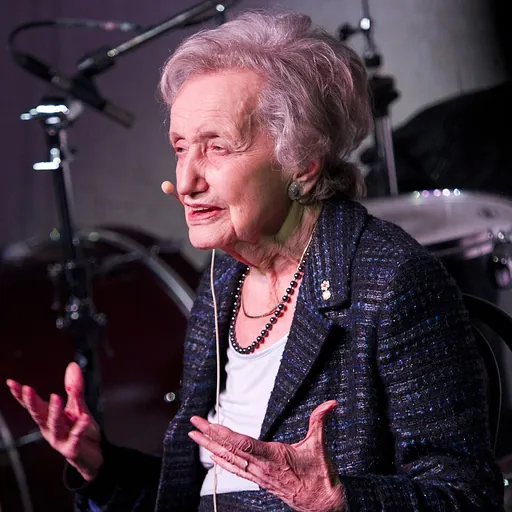
Brenda Milner
Canada-based British neuroscientist and neuropsychologist
About Brenda Milner
Born 1918. Brenda Milner is a Canadian and British neuroscientist, psychologist and university teacher, known for Cognition, Henry Molaison and Memory.
Brenda Milner (née Langford; born 15 July 1918) is a British-Canadian neuropsychologist who has contributed extensively to the research literature on various topics in the field of clinical neuropsychology. Milner is a professor in the Department of Neurology and Neurosurgery at McGill University and a professor of Psychology at the Montreal Neurological Institute. , she holds more than 25 honorary degrees and she continued to work in her nineties. She is sometimes referred to as one of the founders of neuropsychology and has been essential in its development. She received the Balzan Prize for Cognitive Neuroscience in 2009, and the Kavli Prize in Neuroscience, together with John O'Keefe, and Marcus E. Raichle, in 2014. She turned 100 in July 2018.
Early life and education Brenda Langford was born on 15 July 1918, in Manchester, England. Her father Samuel Langford was a musical critic, journalist, and teacher, and her mother (née Leslie Doig, 1885-1980) was one of his students. However, after realising she was not "perceptive" enough for mathematics, Milner changed her field of study to psychology.
After her graduation near the time of World War II, Newnham College awarded her a Sarah Smithson Research Studentship, which allowed her to attend Newnham for the following two years. Both Brenda and her husband were working on radar research. He was an electrical engineer who had also been recruited for the war effort. In Montreal, she became a PhD degree candidate in physiological psychology at McGill University, under the direction of Donald Olding Hebb. While working on her doctorate, Milner and Hebb presented research on their patient P.B. who had undergone a medial temporal lobectomy and had subsequent memory impairment. This garnered the attention of Wilder Penfield. In 1950, Hebb gave Milner an opportunity to study with him at the Montreal Neurological Institute. with a thesis on the cognitive effects of temporal lobe damage in man. Milner has been awarded a number of honorary degrees including an ScD degree from the University of Cambridge in 2000.
Professional career In 1954, Milner published an article in the McGill University Psychological Bulletin entitled 'Intellectual Function of the Temporal Lobes'. In this publication, she presented data that showed that temporal lobe damage can cause emotional and intellectual changes in humans and lower primates. Her review of neuroscience studies conducted in animals discouraged many neurosurgeons from completing surgeries on humans that could negatively impact their lives. She studied the effects of this damage to the medial temporal lobe on memory and systematically described the cognitive deficits exhibited by H.M.
In the early stages of her work with H.M., Milner wanted to completely understand his memory impairments. Milner showed that the medial temporal lobe amnestic syndrome is characterised by an inability to acquire new memories and an inability to recall established memories from a few years immediately before damage, while memories from the more remote past and other cognitive abilities, including language, perception and reasoning were intact. For example, Milner spent three days with H.M. as he learned a new perceptual-motor task in order to determine what type of learning and memory were intact in him. This task involved reproducing the drawing of a star by looking at it in a mirror. She was able to demonstrate two different memory systems - episodic memory and procedural memory. She showed that in patients with this syndrome the ability to learn certain motor skills remained normal. These studies of the relationship between hand preference and speech lateralization led to an understanding of the effects of early unilateral brain lesions on the pattern of cerebral organization at maturity. Her studies were among the first to demonstrate convincingly that damage to the brain can lead to dramatic functional reorganization.
Using mostly prize money from her numerous awards, Milner donated 1 million dollars to the Montreal Neurological Institute in 2007, after establishing a foundation in her name.
Recent research
In more recent times, Milner has expanded her research to the study of brain activity in normal subjects using functional magnetic resonance imaging (fMRI) and positron emission tomography (PET). These studies focus on the identification of brain regions associated with spatial memory and language, including the neural substrates of monolingual and bilingual speech processing.
Milner kept some involvement in teaching and researching past her 100th birthday. She is the Dorothy J. Killam Professor at the Montreal Neurological Institute, and a professor in the Department of Neurology and Neurosurgery at McGill University. Their research on bilingualism entails investigating the difference in neural pathways used to acquire new and native languages. Although she never expected to reach this age, Milner stated that she has "every intention of continuing for many more birthdays." That same year, Milner participated in a video series, launched by the Montreal Neurological Institute, dedicated to promoting female scientists and researchers. During the interview, Milner spoke about her early life and gave an overview of her career.
Early on, Milner was awarded a Sarah Smithson Research Studentship by Newnham College, Cambridge after her graduation, which allowed her to continue her work at Newnham College. In 1985, she was made an Officer of the National Order of Quebec and was promoted to Grand Officer in 2009. She was awarded the Balzan Prize for her contributions to Cognitive Neurosciences in a ceremony held in the Swiss Parliament in December 2009.
Milner was awarded the Kavli Prize in Neuroscience in 2014. Other awards and recognition include: Election to the National Academy of Sciences (1976), the Metlife Foundation Award for Medical Research in Alzheimer's Disease (1996), election to the American Academy of Arts and Sciences (2005), the Canada Gairdner International Award (2005), the Dan David Prize (2014), the from the (2014), induction into the Canadian Science and Engineering Hall of Fame (2012), recipient of a medal of honour from the National Assembly of Quebec (2018), Pearl Meister Greengard Prize (2011), the Norman A. Anderson Lifetime Achievement Award (2010), the Goldman-Rakic Prize for Outstanding Achievement in Cognitive Neuroscience by NARSAD (2009), the NSERC Medal of Excellence (2009 and 2010), the Gairdner Foundation International Award (2005), the Prix Wilder-Penfield (Prix du Québec) (1993), and election as a Fellow of the Royal Society of London, and Fellow of the Royal Society of Canada.
Don’t just read it —
keep it.
Full-length biographies made to live with: read them, listen on the way to work, watch them tonight.
- E-book
- Audio
- Video
Instant download · yours to keep · every purchase keeps this site free
Important facts
People in Brenda Milner's life
Named in this biography and alive at the same time





Related people
Same field, nearest in time




Contemporaries
People whose lives overlapped Brenda Milner's





Frequently asked questions
Who is Brenda Milner?
Canada-based British neuroscientist and neuropsychologist
When was Brenda Milner born?
Brenda Milner was born on 15 July 1918 in Manchester.
What is Brenda Milner's occupation?
Brenda Milner is a neuroscientist, psychologist and university teacher.
What is Brenda Milner known for?
Brenda Milner is known for Cognition, Henry Molaison and Memory.
What nationality is Brenda Milner?
Brenda Milner is Canadian and British.
Sources & further reading
Cite this page
APA: Biography.guide. (2026). Brenda Milner. https://biography.guide/brenda-milner/
MLA: "Brenda Milner." Biography.guide, https://biography.guide/brenda-milner/.
Chicago: "Brenda Milner." Biography.guide. https://biography.guide/brenda-milner/.
Data last updated: 2026-09-24 · Spot an error? Report a correction.
Portrait: Wikimedia Commons · author & licence
Page generated 2026-09-27 05:08 UTC