
About Branko Ćopić
Lived 1915 – 1984 (aged 69). Branko Ćopić was an Austrian and Yugoslav writer, poet, children's writer, playwright and screenwriter.
Branko Ćopić (, ; 1 January 1915 – 26 March 1984) was a Yugoslav and Serbian writer. He wrote poetry, short stories, and novels, and became famous for his stories for children and young adults, often set during World War II in revolutionary Yugoslavia, written with characteristic humor in the form of ridicule, satire, and irony.
As a professional writer, Ćopić was very popular and was able to sell large numbers of copies. This allowed him to live solely from his writings, which was rare for novelists in Yugoslavia at the time. However, the quality of his writings brought him inclusion into primary school curricula, which meant that some of his stories found their way into textbooks, and some novels became compulsory reading.
In the early 1950s, he also wrote satirical stories, criticizing social and political anomalies and personalities from the country's political life of the time, for which he was considered a dissident and "heretic", and had to explain himself to the party hierarchy.
Biography Ćopić was born into a Bosnian Serb family on 1 January 1915 in the village of Hašani, near Bosanska Krupa in the Bosanska Krajina region of western Bosnia. He admitted that after arriving in Belgrade in 1936, he was "afraid of the big city" and was especially concerned he might get lost.
During the uprising in Bosanska Krajina in 1941, he joined the Partisans and remained in their ranks until the end of World War II. He was his detachment's political commissar, war correspondent for the Borba newspaper, and a cultural proletarian.
Many of his novels and stories were included in primary school curricula and textbooks. and some of them have been turned into TV series. He was featured on the 0.50 Bosnia and Herzegovina convertible mark bill, which has been withdrawn from circulation and replaced with coins.
Ćopić's biographer and close friend was , namely Branko Ćopić i njegovi junaci u slici i prilici , Ćopićev humor i zbilja (1 i 2) ( 1 and 2), Ćopić kroz svjetla i pomrčine , one publication Šesdeset godina života i šest miliona knjiga Branka Ćopića: prigodna publikacija , while his daughter published one more from an unpublished manuscript, titled Branko Ćopić: Treba sanjati , after her father died.
Literary career From at least 1951 until his death Branko Ćopić was a professional writer who lived solely of his writings as, due to his popularity, his books sold millions of copies, both in Yugoslavia and abroad. These collection of short stories proved his gift for storytelling and were followed by others, including Planinci (, 1940). In 1939 he was recipient of Milan Rakić Award, with 1,000 dinars money prize, which led him to proclaim "I was richer than the emperor". He was editor of the Pionir magazine from 1944 to 1949 and also a member of the editorial board of Savremenik .
Regional mark of his prose can be recognized in the characters, locations, themes, and language of his home region, Bosnian Krajina. His pre-war prose was predominantly lyrical (collections like Rosa na bajonetima (, 1946), Sveti magarac i druge priče , Surova škola (, 1948) but after the war, he subordinated the lyrical to the ideological and socially engaged. His short stories were often described as the "stories of a dreamer boy".
He published collections of poems Ognjeno rađanje domovine (, 1944) and Ratnikovo proljeće (, 1947). Other short story collections Ljubav i smrt (, 1953).
Using humor and satire, Ćopić targeted what he perceived to be social ills of the fledgling Yugoslav communist society. In 1950, he published Jeretička priča , mocking the new phenomena he observed around him such as state-owned company managers, Yugoslav People's Army (JNA) generals, government ministers, as well as their families and in-laws, misusing publicly funded resources including specific instances of government-provided luxury cars being used by individuals from the above groups in order to be chauffeured to university lectures at faculties they recently enrolled in.
This was enough for the state security agency UDBA to open a file on him. Ćopić's harsh words against the political elite were conveyed to the secret police by one of his friends, who unbeknownst to Ćopić, was an UDBA agent with the code name Remington, after the typewriter. Ćopić's file was placed together with those of other authors, who at the time were being scrutinized by the state for similar reasons: Mira Alečković, Desanka Maksimović, Sava Nikolić, , and Zuko Džumhur. In 1966, Živojin Pavlović wanted to film a movie Silent Gunpowder, but the production house, Avala Film, backed off, because of the "politically unacceptable ideas in the script which depicts leftist errors". The film, to a great success, was made only in 1990, by Bato Čengić.
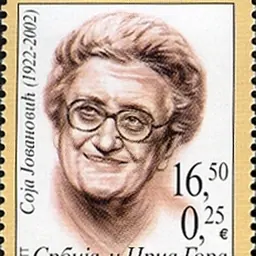
His contemporary comedy Odumiranje medveda from 1958 caused him further problems with the political establishment. After only several rehearsals of the play, dramatized by Soja Jovanović, it was banned from the Belgrade Drama Theatre, as "ordered from the top". It was played later, but never in Belgrade. His brother and sister were both killed in World War II. Brother Rajko was killed in 1942 and sister Smiljka (b. 1921) in 1943. Ćopić dedicated a poem to her, Grob u žitu . As the bridge is an extension of the Brankova Street, named after Branko Radičević, a Serbian romanticist poet, it was named after the street. However, an urban myth developed since then that the bridge was named after Ćopić's jump.
Ćopić repeated several times to his close friend and biographer Enes Čengić that he would kill himself, and the reason he gave was his inability to even remember or recognize the people or things around him, which he blamed on his advanced sclerosis, so that he could no longer write a letter.
Author and literary critic wrote that, no matter whether he was writing poems, novels or stories, Ćopić was always a lyric poet. Pantić added that, standing on the shoulders of his predecessors like Petar Kočić and nameless folk storytellers from his homeland, Ćopić was the constant of Serbian 20th century literature and its last authentic storyteller. Documentarist Dejan Petrović described Ćopić as "Serbian Tolkien".
Works
Novels Prolom – The Break-out (1952) Gluvi barut – Silent Gunpowder (1957) Ne tuguj, bronzana stražo – Bronze Guards, Don't Mourn (1958) Osma ofanziva – The Eighth Offensive (1966)
Works for children Orlovi rano lete – Eagles Fly Early (1957) Slavno vojevanje – Glorious Combat (1960) and Bitka u Zlatnoj dolini – The Battle of Golden Valley (these three are known as „Pionirska trilogija“ – The Pioneer Trilogy); Magareće godine – "Donkey" Years (meaning: The Tough Teens) Balada o ribaru i mačku – Ballad of the Fisherman and the Cat Glava u klancu noge na vrancu – Head in the Col Legs on the Horse Ježeva kućica – Hedgehog's House (1949) Doživljaji mačka Toše – Adventures of Toscho the Cat Bašta sljezove boje – The Mallow Color Garden U carstvu medvjeda i leptirova – In the kingdom of bears and butterflies Priče ispod zmajevih krila – The stories under the dragon's wings
Films and television series made after Ćopić's writings "Živjeće ovaj narod" (1947) "Major Bauk" (1951) "Grob u žitu" (1951) "Nikoletina Bursać (1964) Eagles Fly Early (1966) "Četrdeset prva" (1971) "Hajdučka vremena" (1977) "Mala moja iz Bosanske Krupe" (1978) "Osma ofanziva", TV-series (1979) "Bježaćemo čak u Liku" (1979) "Odumiranje međeda" (1982) "Smiješne i druge priče" TV-series (1986) "Razgovori stari" (1986) Silent Gunpowder (1990) "Magareće godine" (1994) Ježeva kućica (2017)
Don’t just read it —
keep it.
Full-length biographies made to live with: read them, listen on the way to work, watch them tonight.
- E-book
- Audio
- Video
Instant download · yours to keep · every purchase keeps this site free
Important facts
People in Branko Ćopić's life
Named in this biography and alive at the same time


Related people
Same field, nearest in time


Contemporaries
People whose lives overlapped Branko Ćopić's





Frequently asked questions
Who was Branko Ćopić?
Yugoslav writer (1915–1984)
When was Branko Ćopić born?
Branko Ćopić was born on 1 January 1915 in Hašani, Krupa na Uni.
When did Branko Ćopić die?
Branko Ćopić died on 26 March 1984 in Belgrade.
What was Branko Ćopić's occupation?
Branko Ćopić was a writer, poet, children's writer, playwright and screenwriter.
What nationality was Branko Ćopić?
Branko Ćopić was Austrian and Yugoslav.
Sources & further reading
Cite this page
APA: Biography.guide. (2026). Branko Ćopić. https://biography.guide/branko-copic/
MLA: "Branko Ćopić." Biography.guide, https://biography.guide/branko-copic/.
Chicago: "Branko Ćopić." Biography.guide. https://biography.guide/branko-copic/.
Data last updated: 2026-09-26 · Spot an error? Report a correction.
Page generated 2026-09-27 05:15 UTC