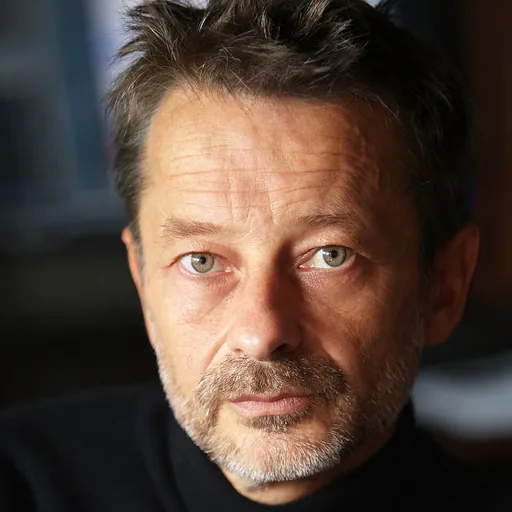
About Borut Kržišnik
Born 1961. Borut Kržišnik is a Slovenian and Yugoslav composer and musician.
Borut Kržišnik (born 7 October 1961) is a Slovenian composer of contemporary music, based in Ljubljana. He is best known for his "polyglot musical style", and his concept of integration of live acoustic music with digital environment and technology.
According to the editorial board of the Music Biennale Zagreb 2014, Kržišnik is considered one of "the most notable representatives of the historical avant-garde." The board highlighted his methodology, particularly his use of sampling, which enables the emulation of a virtual symphony orchestra as well as entirely synthetic sounds.
Biography
Early years
Borut Kržišnik (1961) was born in Zagreb, Croatia, into a diplomatic family. Due to the nature of his father's profession, his family often changed its place of residence, and he therefore lived for various periods of time in Croatia, Serbia, Slovenia (all of which were part of the Federal Republic of Yugoslavia at the time), and Romania. When he was two years old his family moved to Romania, where his father was appointed to the post of diplomatic attaché in Bucharest. When he turned 6, they moved to Belgrade, where he spent his early childhood. In 1973, they finally settled in Ljubljana, which became his permanent residence.
Living in various environments and experiencing many mentalities has greatly influenced his understanding of society, its diversity and ultimately his approach to music.
Career
Kržišnik's musical career started, as he himself said, at the moment he realized that he didn't want to play piano how it was taught at music school – with rigorous discipline and strict instructions on how the piece should be performed. "At least, it is how I perceived it at the time. That's why I decided at one point to take matters into my own hands and approach the music in my own way." They used a variety of instruments, including popular, classical, and electronic, which move about freely within the structure of the compositions. They also brought into play concrète sounds, tape music, and circuit bending, techniques more used in electroacoustic music. It took them three months of editing and additional work before the final mix was achieved in the autumn of 1990. In September 1991, the album was released under the title Currents of Time.
In 1993, Kržišnik founded the five-member group Data Direct, bringing together Slovenian, Italian, and Serbian musicians from various musical backgrounds. Following the trajectory of Kržišnik's previous album, this band continued to work within the concept of eclecticism and built their compositions based on synthesis between predetermined and improvised music. However, they developed this concept further – by pursuing the perspective of the live performing group and, as a result, live performance became the dominant layer in its music. The group performed at festivals (Druga godba, 1993; Synthesis – Music of the 21st Century festival, Skopje; 1994, Vorax, Vicenza, 1994, etc.). In 1995, the album La Dolce Vita was released. Soon after the release of the album, the group quit working.
After the group ceased activities, Kržišnik turned his focus to his home studio and software technology. He started to work with a virtual orchestra, but kept having recording sessions with live musicians, although not as frequently as before. His home studio became the place where most of his work was done. It was there in 1996 and the first half of 1997 that he composed and recorded his new work, Stories from Magatrea. The self-titled album was released in November 1997.
Stories from Magatrea is considered a landmark album, as it laid the foundations of the methodology upon which his subsequent works would be built. Kržišnik described his way of composing as research,
In 2009, after 12 years of intense collaborations in dance, film, and theater, Kržišnik composed and produced his sixth album, Valse Brutal. The album problematizes human violence and wars, their absurdity, and the mechanisms that enable them.
In his article "Brutal Waltz", Jure Potokar from Polet observed that the virtual orchestra is a powerful tool and has potential that exceeds the real sonic environment, but it takes a lot of editing and patience to achieve results, as opposed to the relatively fast intuitive process of playing a real instrument. Potokar also pointed out that its automatized functions, together with its high "democratization", as he put it, contribute to shifting the criteria of originality.
After two years of work, the album Lightning (2013) was released. In his 2013 review for Polet, Potokar noted its stark dynamic contrasts and an expansive range of articulations, from ethereal to tempestuous. He also highlighted its distinctive sonic properties, crediting Kržišnik's integration of organic and digital realms, an approach that transcended, in Potokar's words, "aesthetic, technical, and historical constraints of traditional orchestras." He described the music as "rhythmically unpredictable […] and multilayered"— one that "often merges the incompatible." Further, Mario Batelić from Odzven observed that, "… in places we have the impression that we are listening to industrial music …"
It was in this context that the composer introduced the album's main themes – freedom and free will. He postulated that lightning, a symbol of the cycles of creation and destruction, is not only a natural phenomenon but also a social one. He further questioned the extent to which we can control destructive social phenomena and problematized the power of human will in creating a more just society.
After several years of research, Kržišnik released the album Dancing Machine (2020). It addresses a new big era of human civilization – the information revolution. It focuses on what he considers the key moment of the new paradigm, namely the challenge of integrating human and artificial intelligence, and explores what the role of humans will be in the future, when AI will be increasingly dominant. Artificial intelligence is, as he put it, an extension of our intellect, which not only enables astonishing achievements and development of every aspect of our lives, but also brings challenges that have never existed before, and puts mankind in front of the imperative to redefine the notion of what it means to be human.
Collaborations
Borut Krzisnik has composed music for films, dance and theatre performances, and other productions. He worked intensely with British film director Peter Greenaway and wrote the score for films The Moab Story, Vaux to the Sea and A Life in Suitcases. The former two are the first and the second film of the trilogy The Tulse Luper Suitcases and the latter is trilogy's integral version.
The films narrate the stories of the life of Tulse Luper, the alter ego of the director himself, which intertwines with the events that marked the turbulent history of the twentieth century. An interesting fact that describes Greenaway's working process and his approach to music is that the composer is asked to compose the music before the start of shooting the film, and not after shooting and editing, as is usually the case. In this manner, Peter Greenaway analyzes the music before the start of the filming, which enables him to synchronize the whole process of shooting with the drive and development of the music. (documentary film, director: Saskia Boddeke, acting: Peter Greenaway), Reitdiep Joureys (documentary film/multimedia), Gold – 92 bars in a broken car (theater performance, director: Saskia Boddeke, libretto: Peter Greenaway), Grand Terp ("site-specific" installation), Sex and the Sea (multimedia installation), Compton Verney (installation) and Map to Paradise (installation).
In 2000, he started the collaboration with British-American-Brazilian theater and opera director Gerald Thomas. In the plays Nietzsche Contra Wagner (SESC, São Paulo, 2000) and Anchorpectoris – United States of the Mind (La MaMa, New York, 2004), music drives both performances, and by fusing different theatrical languages, co-creates Thomas’ outrageous, physical, absolute theater.
In 2007 the prolific collaboration with the Romanian born Slovenian choreographer Edward Clug started with the performance Sacre du Temps. It opened in Tilburg and shortly afterwards toured Netherlands, Belgium, France and Germany. The collaboration continued with three performances: Skitzen (2010), Divine Comedy (2011) and Songs for the Mating Season – Homage to Stravinsky (2012).
In the 90s, he worked closely with theater director Emil Hrvatin (later renamed to Janez Janša) and British director Julie Anne Robinson, who were present on European theatre stages in at the Piccolo Teatro in Milan, the Bush Theatre and the Royal National Theatre (educational programme) in London.
His collaborations also include the following artists: Thomas Noone, Ana Lujan Sanchez, Katarzyna Kozielska, Stefanie Nelson, Natalia Horecna, Isabelle Kralj, Felice Lesser, Josh Beamish, Virpi Pahkinen, Gyula Berger, Vinko Möderndorfer, Bojan Jablanovec, Borghesia and Laibach.
Awards
Vesna prize for best film music at Festival of Slovenian Film in 2008 (for the film Landscape No2) 1st prize at the Napoli Danza Festival in 1994 (for the art-video Labyrinth)
Opus
Albums Utopia – Claudio Records, UK, 2024 Dancing Machine – Claudio Records, UK, 2020 Lightning – Claudio Records, UK, 2013 Valse Brutal – Claudio Records, UK, 2014 (KUD France Prešeren, 2009) Sacre du Temps – Claudio Records, 2013, UK (Station Zuid, Tilburg, 2007) A Life in Suitcases – Claudio Records, 2012 UK (First Name Soundtracks, London, 2006; KUD France Prešeren, 2005) Stories from Magatrea – Claudio Records, 2014, UK (Falcata-Galia Recordings, Realto, 1999, for Slovenia: KUD France Prešeren, Ljubljana, 1997) La Dolce Vita – Claudio Records, 2015 UK (FV, Ljubljana / Discordia, Willich, 1995) Currents of Time – Claudio Records, 2014 UK (ReR Megacorp, Point East, London, 1991; re-release: Tone Casualties, Hollywood, 1998)
Music for dance
Fill in the Blank – contemporary dance performance, concept: Stefanie Nelson, choreography: Maya Orchin, Stefanie Nelson Dancegroup, New York, 2023 Trap Ist – contemporary dance performance, choreography: Felice Lesser, Felice Lesser Dance Company, New York, 2023 Metamorphosis – dance/theatre performance, directed and choreographed: Isabelle Kralj and Mark Anderson, Theatre Gigante, Milwaukee, 2018 Take Your Pleasure Seriously – contemporary dance performance, choreography: Katarzyna Kozielska, Stuttgart Ballet, 2018 Lightning – contemporary dance performance, choreography: Felice Lesser, Felice Lesser Dance Company, New York, 2017 The Death That Best Preserves – contemporary dance performance, choreography: Natalia Horecna, The Royal Danish Theatre, Kobenhavn, 2015 Waltz Epoca (Restless Creature) – contemporary dance performance, choreography: Joshua Beamish, New York, 2014 Catch – contemporary dance performance, choreography: Ana Lujan Sanchez, Phoenix Dance Theatre, Leeds, 2012 Songs for the mating season (Hommage a Stravinsky) – contemporary dance performance, choreography: Edward Clug, SNG Maribor, 12 April 2012 Divine Comedy – contemporary dance performance, choreography: Edward Clug, Bitef teatar in Budva grad teatar, 30 Jun 2011 Sketches – contemporary dance performance, choreography: Edward Clug, Opera Graz, 11 June 2010 Proximity Spiral – contemporary dance performance (3 compositions), choreography: Stefanie Nelson, Stefanie Nelson Dancegroup, 19 March 2010 The Tragedy of Maria Macabre – contemporary dance performance (1 composition), choreography: Rechel Klein, New York, 2010 Sacre du Temps – contemporary dance performance, choreography: Edward Clug, Station Zuid, Tilburg, 2007 I still don't know – contemporary dance performance, choreography: Isabelle Kralj, SNG Opera and ballet Ljubljana, 2005
Music for film
The Greenaway Alphabet – documentary film, directed: Saskia Bodekke, BEELD/NTR, 2017 Landscape No.2 – feature film, directed: Vinko Möderndorfer, Forum Ljubljana, 2008 Paper Prince – feature film, director: Marko Kostić, Luksfilm, 2007 Impression of a Great City – documentary film, directed: Amir Muratović, Slovenija, 2009 Fabiani Plečnik – documentary film, directed: Amir Muratović, RTS, 2006 A Life in Suitcases – feature film, directed: Peter Greenaway, Kasander Film, 2005 She Who Remains Nameless – eclectic theatre performance, directed: Vlado Repnik, Kino Šiška, 2 October 2017 Nein – theatre performance, director: Vlado Gotvan, Kino Šiška, 19 September 2016 A Few Messages to the Universe – theatre performance, directed: Sebastjan Horvat, SNG Drama, 25 April 2014 Pilowman (O Homem Travesseiro) – theatre performance, directed: Bruce Gomlevsky, Rio de Janeiro, 2011 Anchorpectoris – theatre performance, directed: Gerald Thomas, La MaMa, New York, 6 March 2004 Camillo – theatre performance, directed: Emil Hrvatin, Picollo Teatro, Milano, 7 May 1998 Two Gentlemen of Verona – theatre performance, directed: Julie-Anne Robinson, Royal National Theatre, London 5 May 1999 Yard – theatre performance, directed: Julie-Anne Robinson, Bush Theatre, London, 1998 Romeo and Juliet – theatre performance, directed: Julie-Anne Robinson, C.F.T.C., Birmingham, 1996 The New Organon – theatre performance, directed: Emil Hrvatin, Društvo 51, 11 June 1994 The Woman Who Talks Incessantly – theatre performance, directed: Emil Hrvatin, Inart, 30 January 1993 Romulus Veliki – theatre performance, directed: Bojan Jablanovec, Municipal Theatre, 12 March 1998 Breakfast on the Lawn – theatre performance, directed & choreography: Nataša Kos, Maska, Ljubljana and Danswerkplaats, Amsterdam, 1 October 1994 Hey, Salvador – theatre performance, directed: Matjaž Pograjc, Glej Theatre, 19 October 1991
Music for intermedia projects, performances, installations and exhibitions
O – Project O, AV performance, Kiblix, KID Kibla, 2022, Maribor Shelters of Babylon – Project O, AV performance, Kiblix, KID Kibla, 2017, Maribor Sex and the Sea – installation by Peter Greenaway and Saskia Boddeke, Maritiem Museum, Rotterdam, 2013 Beyond – to the Freedom – Project O, video-audio-dance performance, Kino Šiška, 24 January 2017 O – Project O, video-audio-dance performance, Cirkulacija 2, Ljubljana, 2016 Grand Terp in Groningen – exhibition/installation, directed: Peter Greenaway, Kasander Film, Groningen, 2001 Map to Paradise – exhibition / installation, directed: Peter Greenaway, Museum, Ljubljana, 2000 The Labyrinth – art-video, directed: Marina Gržinič & Aina Šmid, RTV Slovenia, 1993
Compilations
Dancing/Listening – Unknown Public, London, 2003 Music for the Next Century – Tone Casualties, 1999 Trans Slovenia Express Vol.1 – Dallas, Ljubljana, 1994
Live performances
Love Song No.1 – Orchestra of Slovenian Philharmony, conductor: Marko Letonja, Cankarjev dom, 1998 Questions – Enzo Fabiani quartet, Š.O.U. Ljubljana, 1997 Fire – electronic performance, Narodni dom, Maribor, 2007
Don’t just read it —
keep it.
Full-length biographies made to live with: read them, listen on the way to work, watch them tonight.
- E-book
- Audio
- Video
Instant download · yours to keep · every purchase keeps this site free
Important facts
People in Borut Kržišnik's life
Named in this biography and alive at the same time







Related people
Same field, nearest in time

Contemporaries
People whose lives overlapped Borut Kržišnik's



Frequently asked questions
Who is Borut Kržišnik?
Slovenian composer
When was Borut Kržišnik born?
Borut Kržišnik was born in 1961 in Zagreb.
What is Borut Kržišnik's occupation?
Borut Kržišnik is a composer and musician.
What nationality is Borut Kržišnik?
Borut Kržišnik is Slovenian and Yugoslav.
Sources & further reading
Cite this page
APA: Biography.guide. (2026). Borut Kržišnik. https://biography.guide/borut-krzisnik/
MLA: "Borut Kržišnik." Biography.guide, https://biography.guide/borut-krzisnik/.
Chicago: "Borut Kržišnik." Biography.guide. https://biography.guide/borut-krzisnik/.
Data last updated: 2026-09-20 · Spot an error? Report a correction.
Portrait: Wikimedia Commons · author & licence
Page generated 2026-09-27 04:58 UTC