
About Boris Taslitzky
Lived 1911 – 2005 (aged 94). Boris Taslitzky was a French painter and university teacher.
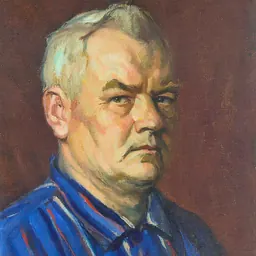
Boris Taslitzky, sometimes Boris Tazlitsky (September 30, 1911 – December 9, 2005), was a French painter with left-wing sympathies, best known for his figurative depictions of some difficult moments in the history of the twentieth century. His work is considered as representative of Socialist realism in art in France.
Biography
Boris Taslitzky was born in Paris to Jewish parents who had emigrated to France from Russia after the failure of the 1905 Russian Revolution. His father, an engineer, died during World War I and Boris became a ward of the nation. He began painting at the age of fifteen and attended the academies of Montparnasse, went to the Louvre museum and copied grand masters such as Rubens, Delacroix, Géricault and Courbet. In 1928, he entered the École des Beaux-Arts in Paris studying with Lucien Simon, Jacques Lipchitz and Jean Lurçat for tapestry.
In 1935 he joined the French Communist Party and also acted in artistic organizations.
In 1936 he supported the Popular Front and its cultural policies. Some of his paintings depicted the miners involved in the 1936 strikes.
Taslitzky traveled to Spain during the Spanish Civil War and, in 1937 at the International Exhibition of Art and Technology in Modern Life, exhibited his painting The Telegram, tribute to García Lorca alongside Pablo Picasso's Guernica.
With the advent of World War II, he was drafted into the army in August 1939. He was captured in June 1940, but managed to escape in August and became involved in the resistance movement with the National Front active during the Occupation of France by Germany.
Arrested by the special brigades On the last day of July 1944, he was deported in one of the last transports to Buchenwald where he managed to do some pencil drawings that bear witness to the life in the camps. His sketches were made on stolen German paper. He created portraits of fellow prisoners.
His mother was taken in the Vel' d'Hiv Roundup and died on the way to Auschwitz.
In 1946, after the war, Louis Aragon published a hundred of his drawings of Buchenwald. Taslitzky started lecturing at the École Nationale Supérieure des Arts Décoratifs, became Secretary General of "the Union des arts plastiques" and, the same year, was awarded the Blumenthal Prize for painting.
In 1945, after his release, to commemorate the death at Auschwitz of the wife of Laurent Casanova, a French Communist party official, he painted The Death of Danielle Casanova, in the form of a secular Pietà rendering.
At the 1951 Salon d'Automne, Riposte, a depiction of striking dockers in Marseille refusing to load weapons destined for the war in Indochina, was removed by the police. In 1952 he traveled to Algeria, then still a French colony, to make paintings exposing the poor conditions under which people lived and to denounce colonialism.
His art included works on the First Indochina War, the Vietnam War, the coup d'état that took Augusto Pinochet to power in Chile in 1973, Apartheid in South Africa and the Zaire events.
Already decorated with the 1939–1945 war cross and the military medal, he was awarded Knighthood in the Legion of Honor in 1997 with the title of "Resistance and Deportation".
His work, often labeled as representative of Socialist realism in art, is a free interpretation of the genre. His life was marked by the great upheavals of the twentieth century and his artistic and political commitments denote his awareness and sense of responsibility as an artist.
Death
Taslitzky died on December 9, 2005, in Paris.
Collections Musée National d'Art Moderne, Paris Pushkin Museum, Moscow Cité nationale de l'histoire de l'immigration Tate gallery, London : Les Grèves de juin 1936 (1936), La mort de Danielle Casanova (study) (1949), Riposte (1951).
Don’t just read it —
keep it.
Full-length biographies made to live with: read them, listen on the way to work, watch them tonight.
- E-book
- Audio
- Video
Instant download · yours to keep · every purchase keeps this site free
Important facts
People in Boris Taslitzky's life
Named in this biography and alive at the same time

Related people
Same field, nearest in time



Contemporaries
People whose lives overlapped Boris Taslitzky's






Frequently asked questions
Who was Boris Taslitzky?
French painter (1911-2005)
When was Boris Taslitzky born?
Boris Taslitzky was born on 30 September 1911 in 6th arrondissement of Paris.
When did Boris Taslitzky die?
Boris Taslitzky died on 9 December 2005 in 14th arrondissement of Paris.
What was Boris Taslitzky's occupation?
Boris Taslitzky was a painter and university teacher.
What nationality was Boris Taslitzky?
Boris Taslitzky was French.
Sources & further reading
Cite this page
APA: Biography.guide. (2026). Boris Taslitzky. https://biography.guide/boris-taslitzky/
MLA: "Boris Taslitzky." Biography.guide, https://biography.guide/boris-taslitzky/.
Chicago: "Boris Taslitzky." Biography.guide. https://biography.guide/boris-taslitzky/.
Data last updated: 2026-09-20 · Spot an error? Report a correction.
Page generated 2026-09-27 05:32 UTC