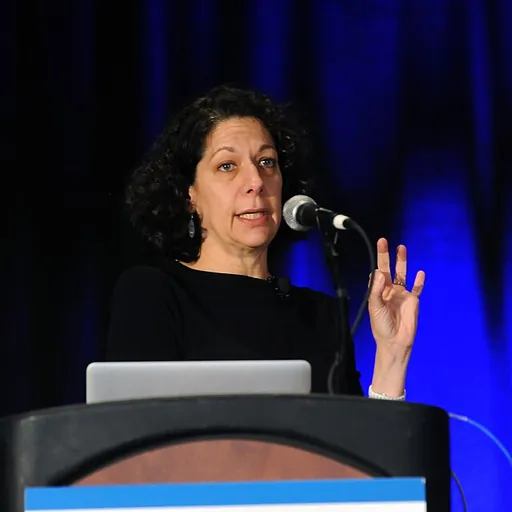
Bonnie L. Bassler
American molecular biologist
About Bonnie L. Bassler
Born 1962. Bonnie L. Bassler is an American molecular biologist, university teacher, biochemist and microbiologist, known for Quorum sensing.
Bonnie Lynn Bassler (born 1962)
Bassler has received numerous awards for her research, including the Princess of Asturias Award (2023), Paul Ehrlich and Ludwig Darmstaedter Prize (2021), a Foreign Member of the Royal Society (as of 2012), a former president of the American Society for Microbiology (2011) She was an editor of the Annual Review of Genetics from 2012 to 2017.
Early life and education Bassler was born in Chicago and raised in Danville, California.
Bassler entered the University of California, Davis as a major in veterinary sciences, but focused on genetics and biochemistry and received a Bachelor of Science in biochemistry. Bassler worked for UC Davis biochemistry and molecular medicine professor Frederic Troy, who assigned her to a bacteria research project. Within this project, Bassler characterized an enzyme in E. coli which cleaved sugars from various membrane glycoproteins. Bassler has stated that prokaryotes are "the perfect creatures to work on."
Her postdoctoral research was conducted at the Agouron Institute in La Jolla, California where she worked with Michael R. Silverman from 1990 to 1994. Silverman was the first to discover quorum sensing, by studying the marine bacterium Vibrio fischeri. The glow-in-the-dark bacteria communicate chemically about their numbers and only give off light when a cohort is large enough to create an effective light source. Bassler determined further that bacteria are "multilingual" and use multiple chemical signal molecules to communicate with each other.
In 1994, Bassler joined the Princeton faculty. She is currently the chair of the department of molecular biology and the Squibb Professor in molecular biology. Her lab at Princeton University researches quorum sensing, the process of cell-cell communication in bacteria.
Bassler's exploration of the ways in which bacteria communicate and behave collectively can be seen as contributing to a paradigm shift in how scientists view the microbial world. Bassler's discoveries are said to "open new vistas in basic science, but are also of practical significance." Bassler's research has contributed new and exciting strategies for treating bacterial disease. In 2002, the MacArthur Foundation awarded Bassler a fellowship in recognition of her contributions to the bacterial lexicon.
Research
During her postdoctoral research, Bassler experimented with genetic manipulation of bioluminescent genes in V. harveyi bacteria and discovered that this bacteria had multiple molecules for quorum sensing. She found that these bacteria use quorum sensing to turn on and off a large number of genes in response to communications from other bacteria. These communications and responses allow bacteria of the same species and of different species to cooperate in a similar manner to multi-cellular organisms. She extended this research in a series of experiments leading to the discovery that boron binding is used as a co-factor in communication. Boron is found in abundance in the oceans where V. harveyi is found. 2006 National Academy of Sciences 2008 Special Recognition from the World Cultural Council 2009 Wiley Prize in Biomedical Sciences 2010 USA Science and Engineering Festival's Nifty Fifty Speakers, nominated by American Society for Microbiology 2010–2016 National Science Board, nominated by President Barack Obama 2011 Richard Lounsbery Award 2011 L'Oréal-UNESCO For Women in Science Awards Laureate for North America 2010–2011 President of the American Society for Microbiology 2012 Member in the American Philosophical Society 2014 American Society for Microbiology EMD Millipore Alice C. Evans Award 2015 Shaw Prize in Life Science and Medicine 2016 The FASEB Excellence in Science Award 2016 Pearl Meister Greengard Prize 2016 Max Planck Research Award 2016 Elected member of the National Academy of Medicine 2018 Dickson Prize 2018 Ernst Schering Prize 2020 Genetics Society of America Medal 2020 Gruber Prize in Genetics 2022 Wolf Prize in Chemistry. 2022 Honorary Doctor of Humane Letters from Johns Hopkins University 2023 Canada Gairdner International Award 2023 Princess of Asturias Awards 2023 Albany Medical Center Prize 2025 National Medal of Science 2026 Copley Medal of the Royal Society
Selected works
Don’t just read it —
keep it.
Full-length biographies made to live with: read them, listen on the way to work, watch them tonight.
- E-book
- Audio
- Video
Instant download · yours to keep · every purchase keeps this site free
Important facts
more
Bonnie L BasslerPeople in Bonnie L. Bassler's life
Named in this biography and alive at the same time


Related people
Same field, nearest in time



Contemporaries
People whose lives overlapped Bonnie L. Bassler's



Frequently asked questions
Who is Bonnie L. Bassler?
American molecular biologist
When was Bonnie L. Bassler born?
Bonnie L. Bassler was born in 1962 in Chicago.
What is Bonnie L. Bassler's occupation?
Bonnie L. Bassler is a molecular biologist, university teacher, biochemist and microbiologist.
What is Bonnie L. Bassler known for?
Bonnie L. Bassler is known for Quorum sensing.
What nationality is Bonnie L. Bassler?
Bonnie L. Bassler is American.
Sources & further reading
· Wikipedia: Bonnie L. Bassler
Cite this page
APA: Biography.guide. (2026). Bonnie L. Bassler. https://biography.guide/bonnie-l-bassler/
MLA: "Bonnie L. Bassler." Biography.guide, https://biography.guide/bonnie-l-bassler/.
Chicago: "Bonnie L. Bassler." Biography.guide. https://biography.guide/bonnie-l-bassler/.
Data last updated: 2026-09-20 · Spot an error? Report a correction.
Page generated 2026-09-27 05:09 UTC