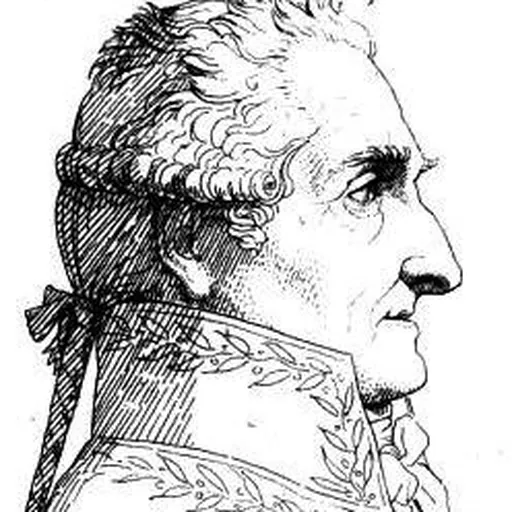
Bon-Joseph Dacier
French historian, philologist and translator from ancient Greek
About Bon-Joseph Dacier
Lived 1742 – 1833 (aged 90). Bon-Joseph Dacier was a French linguist, politician, librarian, historian, classical scholar and translator.
Bon Joseph Dacier (Valognes, 1 April 1742 – Paris, 4 February 1833) was a French historian, philologist and translator of ancient Greek. He became a Chevalier de l'Empire (16 December 1813), then Baron de l'Empire (29 May 1830 ). He also served as curator of the Bibliothèque nationale.
Biography After studying at the collège d'Harcourt, he became the student and assistant of Étienne Lauréault de Foncemagne. Dacier came to public notice in 1772 via his translation of the Histories of Claudius Aelianus and the same year became an associate member of the Académie des inscriptions, becoming its president and permanent secretary in 1782. In that position, he wrote the organisation's history from 1784 to 1830. He translated the Cyropaedia by Xenophon (1777). He became a member of Paris's corps municipal in 1790 and led the imposition of the new system of contributions directes, but refused Louis XVI's offer of the post of finance minister. After retiring to Seine-et-Oise during the French Revolution, he became a member of the Tribunat in 1799. In 1800 he was made curator of manuscripts at the Bibliothèque nationale and elected to the Académie des Sciences morales et politiques.
It was to Dacier that Champollion sent his famous 1822 letter, known widely as Lettre à M. Dacier, revealing his discovery of how to decipher Egyptian hieroglyphs. At age 80, Dacier was elected to the Académie française in 1822; at the time he was the oldest member of the society. He was made a baron on 26 May 1830. Pierre-François Tissot, his successor in the Académie, said of him that "he had the sanest ideas on scholarship, and he unceasingly tended to give it a useful and philosophical direction. "Don't look for gold mines" he said to his brother-academicians and especially to their young emulators. [ ... ] Nothing could be more dangerous than his elogies; they were believed like an epigram by Lebrun. On the other hand, he liked to support the development of talent; after having the good luck of having found something, his greatest pleasure was to bring it to public light." Biographic notice n° 124, devoted to him on page 118 of Le premier siècle de l'Institut de France (1895), gives his name as "DACIER (Le Baron Bon, Joseph)". He is buried in the cimetière du Père-Lachaise (29th Division, 4th line, S, 33).
Main works Journals edited by Bon Joseph Dacier included the Journal des sçavans, and he also wrote on the history of the Order of Saint Lazarus (of which he was a member). He also wrote several historical articles.
Translations Histoires diverses d'Élien le Sophiste (1772). La Cyropédie, ou Histoire de Cyrus (by Xenophon, 2 volumes, 1777)
Other Les chroniques de Jehan Froissart (1788). Left incomplete due to the 1793 troubles Rapport historique sur les progrès de l'histoire et de la littérature ancienne depuis 1789 et sur leur état actuel (1810). Reissued : Belin, Paris, 1989. – commissioned by Napoleon I of France and published in 1810, remains a reference work for historians of the French Revolution. Histoire et mémoires de l'Institut royal de France. Académie des inscriptions et belles-lettres (10 volumes, 1821–33)
Don’t just read it —
keep it.
Full-length biographies made to live with: read them, listen on the way to work, watch them tonight.
- E-book
- Audio
- Video
Instant download · yours to keep · every purchase keeps this site free
Important facts
People in Bon-Joseph Dacier's life
Named in this biography and alive at the same time

Related people
Same field, nearest in time




Contemporaries
People whose lives overlapped Bon-Joseph Dacier's




Frequently asked questions
Who was Bon-Joseph Dacier?
French historian, philologist and translator from ancient Greek (1742-1833)
When was Bon-Joseph Dacier born?
Bon-Joseph Dacier was born on 1 April 1742 in Valognes.
When did Bon-Joseph Dacier die?
Bon-Joseph Dacier died on 4 February 1833 in Paris.
What was Bon-Joseph Dacier's occupation?
Bon-Joseph Dacier was a linguist, politician, librarian, historian, classical scholar and translator.
What nationality was Bon-Joseph Dacier?
Bon-Joseph Dacier was French.
Sources & further reading
· Wikipedia: Bon-Joseph Dacier
Cite this page
APA: Biography.guide. (2026). Bon-Joseph Dacier. https://biography.guide/bon-joseph-dacier/
MLA: "Bon-Joseph Dacier." Biography.guide, https://biography.guide/bon-joseph-dacier/.
Chicago: "Bon-Joseph Dacier." Biography.guide. https://biography.guide/bon-joseph-dacier/.
Data last updated: 2026-09-21 · Spot an error? Report a correction.
Portrait: Wikimedia Commons · author & licence
Page generated 2026-09-27 04:59 UTC