About Bobby Chalmers
Lived 1941 – 2022 (aged 80–81). Bobby Chalmers was a Zimbabwean association football player.
Early life and amateur football
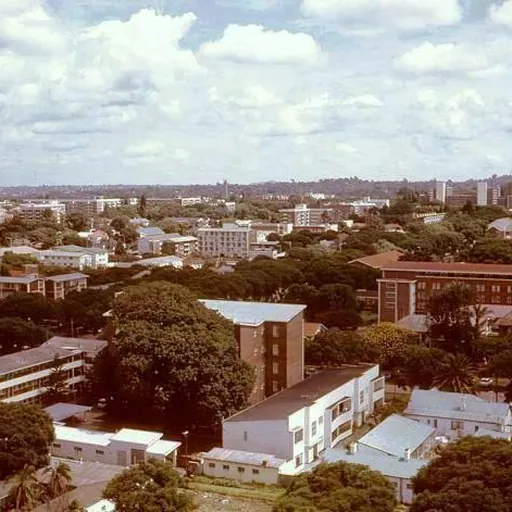
Bobby Chalmers was born on 19 February 1941 in Southern Rhodesia's second city of Bulawayo, where he attended Raylton Junior School, Milton Junior School and Milton High School. However, he proved a more keen football player, and honed his skills as an amateur in the youth teams at Queens Sports Club, usually playing as a winger. just 18 days after the tourists had lost that year's FA Cup Final 2–0 to English League champions Tottenham Hotspur. Leicester beat Rhodesia 4–3. Based at their New Kingsmead ground, Durban City had been formed in May 1959, by 1962, they were one of the country's top teams, having won two of the first three national titles. A key player for the club during its early days was Les Salton, a South African forward who was the SANFL's top goalscorer in each of its first three seasons, netting 117 goals in all competitions, including eight in one game against Johannesburg City in 1961. Chalmers joined just after Salton's sale to local rivals Durban United. He started the following season on the wing, but was fielded as a centre forward for the first time in June 1963, when his club took on Kimberley United in a Castle Cup first-round tie.
During early 1964, Chalmers prepared thoroughly for the new season, seeking to broaden his style of play and remove some of the perceived technical weaknesses which observers thought had previously let him down; for example, before this time his heading skill had been seen as sub-par, and his passing skill had been little more than ordinary. When the season started, however, it quickly became evident to reporters that his hard work had paid off. In what is generally considered one of his strongest years as a professional, Chalmers progressed significantly during 1964, showing marked improvement in his heading, passing and shooting in particular. According to Byrom, Chalmers was during this period the best player in South Africa, "by far". the Football Association of South Africa's FIFA membership was suspended in October 1964 because apartheid required sports matches in South Africa to be racially homogeneous, clashing with FIFA regulations regarding team selection. This proved to part of a wider-scale sporting boycott of South Africa. FIFA's ruling proscribed further tours there, but some individual football players, mostly British, continued to tour South Africa during their off-season as "all-star" or "invitational" XIs. |group="n"|name="last tours"
Chalmers became one of the league's top forwards, in one match scoring three goals in four minutes against Arcadia Shepherds. In the Castle Cup, his goalscoring exploits consistently helped Durban City to progress. In the quarter-final, he scored what Byrom considers one of the best goals of his career, in a home match against rivals Durban United. United, with Salton leading their front line, scored twice in the first 13 minutes before City closed the gap to 2–1 a minute before the break. Early in the second half, Chalmers collected the ball near the edge of the penalty area and sprinted with it along the 18-yard line, prevented from moving forward by three pursuant United defenders. Chalmers then stopped abruptly and, as his opponents were caught off balance, fired a low shot past them into the net. the two teams were level at 1–1 before Chalmers scored a hat-trick during the second half to give his side a 4–1 victory. It was the Rhodesian's second cup medal, and the only time a hat-trick was scored in a Castle Cup final. ), with 39 of them coming in the league's 32 games. At the end of the season, Chalmers was named South African Footballer of the Year. Chalmers scored 38 goals for Durban City during the 1965 season, including 22 in the league, In the Life Bowl, City reached the final, which was played against Cape Town City at Cape Town's Hartleyvale Stadium. Chalmers scored two of his team's goals as Durban City finished 3–1 victors to win the cup for the second time.
Durban United
Chalmers continued to perform strongly in the colours of Durban United, scoring a further 36 goals (25 in the league) before the year was out, giving him a total of 42 for the 1966 season. In the Life Bowl, United reached the final, where Chalmers scored his team's goal in their 3–1 defeat to Johannesburg Rangers at Rand Stadium. In one game during this year, against East London City, he scored eight in his team's 13–0 victory. Chalmers' contribution to the team this year was vastly reduced by a long-term injury; he appeared only six times for United during 1968, and scored only once. He also played a key role for the club in both cup competitions that year, scoring a combined total of six goals, Participation in international competitions became very difficult as many governments used the international sanctions on Rhodesia as grounds to refuse visas to the country's athletes, As the Rhodesian Football Association had been expelled from the Confederation of African Football for political reasons, FIFA announced in December 1968 that Rhodesia would be placed in World Cup qualifying Group 15A, an Asian–Oceanian section which would see them play against Australia, Japan and South Korea, in an elimination mini-tournament held in the South Korean capital Seoul in October 1969.
A month before the tournament was due to start, the South Korean government abruptly refused to grant visas to the Rhodesian players, citing the country's political situation. This prompted a series of tortuous negotiations between the various football associations and FIFA, which was keen to ensure Rhodesia could still play. Under the compromise ultimately agreed upon, the mini-tournament would go ahead without Rhodesia, and the winner from Seoul would then play Rhodesia over two legs in an as yet undecided "neutral" country. Australia protested that Rhodesia received an unfair advantage in playing fewer matches, but grudgingly went along with this. Australia won the initial qualifying series, while in Group 15B Israel defeated New Zealand over two legs. The winner of the second round matches between Australia and Rhodesia, played in Mozambique, would therefore play Israel for a place in the World Cup finals.
Australia vs Rhodesia
The Rhodesian team, headed by Scottish manager Danny McLennan, was out of practice, having not played since 1967. A four-game friendly series against Malawi was organised for February 1969, with two games each at home and away. Rhodesia drew 2–2 and won 1–0 in Malawi on 1 and 2 February respectively, then won 4–0 and drew 1–1 at Gwanzura Stadium in Salisbury a week later. Chalmers scored once in the third match.
During late 1969, the Rhodesian team played seven practice matches against local clubs and provincial XIs, and finished the series unbeaten. Chalmers and Grainger joined the squad for the last two warm-up games.
Four uninvited Rhodesian officials surreptitiously observed the Australians' first practice session in Mozambique on 18 November. The teams were allowed two training sessions each at the match venue, the newly built 40,000-capacity Estádio Salazar, and during their exercises the Rhodesian squad were soon revealed to be well-drilled, with the Sydney Morning Herald reporter commenting on the high standard of their fitness, athleticism and ball skills, as well as the influence of Chalmers, who he wrote was ably fulfilling his duties as captain: "Chalmers ... their danger man, was all over the pitch cajoling his team to pull out that little bit extra." Observers still considered Australia to be favourites, but Rhodesia's strong form in training, combined with injury problems amongst the Australians, shortened the odds on a Rhodesian victory.
The first leg of the tie, played in torrential rain before about 6,500 spectators on 23 November 1969, was reportedly an uncultured affair, with the slippery playing conditions affecting both teams' passing and coordinated movement. The Australian team reportedly underperformed significantly, with their forward line struggling to work together against the Rhodesians, who were reported to be technically outclassed, but apparently far more motivated than the Australians, defending doggedly. Exceptional goalkeeping by the Rhodesian goalkeeper Jordan frustrated Australia for much of the game, and earned him glowing praise from reporters representing the Sydney and Melbourne presses. The score remained level until early in the second half, when Chalmers collected a loose ball and shot it past Ron Corry in the Australian goal to make the score 1–0 to Rhodesia. Tommy McColl scored Australia's only goal soon after, and the match ended in a 1–1 draw. Angry at their own poor performance, the Australian players declared Rhodesia to be the worst team they had ever played in a World Cup match, and promised the Australian press a 6–0 victory in the second leg.
Four days later, in the second leg, the Rhodesian underdogs once again frustrated Australia, holding them to a 0–0 draw. A play-off was therefore organised for 29 November; if this tie-breaker still failed to produce a winner, the match would be decided by ballot. The Sydney Morning Herald reporter expected the play-off, attended by less than 3,000, to head the same way as the sides' two previous meetings, but was surprised to see Australia finally find their groove, "spraying pin-point passes all over the field, making Rhodesia look flat-footed by comparison". Australia lost to Israel 2–1 on aggregate in the final round.
Style of play
Chalmers is widely held to be one of the best football players ever from Rhodesia or Zimbabwe, as well as one of the finest forwards to have played in South Africa. With his burly frame, sports historian Peter Raath postulates that Chalmers "could quite easily have been a Springbok rugby player". Byrom describes him as "soccer dynamite"; "a graceful stylist, with a supple swerve and cannon-ball shot". Playing as a forward, Chalmers was a strong all-round player, able to skilfully control the ball with both feet and with his head. While able to supply his team-mates with deft passes, he also boasted an exceptionally powerful shot, which while he was playing for Maritzburg was once put to the test with an electronic timer. Chalmers' shot, taken bare-footed, was timed at , just below the speed registered with boots on by Leeds United and Scotland winger Peter Lorimer in an English "hardest shot" competition.
As the captain of Rhodesia in 1969, Chalmers was greatly assisted in his leadership of the mostly black team by his fluent knowledge of both Sindebele and Shona. In his 1980 profile of Chalmers, Byrom described him as "always the perfect gentleman and sportsman", and attested that he "deserved the accolade as Southern Africa's Crown Prince of Soccer".
Honours and achievements Rhodesia national team Full internationals only 1969: 3 caps (all as captain), 2 goals Durban City South African National Football League: runner-up, 1964 Castle Cup: winner, 1962, 1964 Life Bowl: winner, 1965; runner-up, 1964 Durban United South African National Football League: runner-up, 1968 Life Bowl: runner-up, 1966 Maritzburg Castle Cup: winner, 1969 Life Bowl: runner-up, 1969 Individual South African Footballer of the Year: 1964 South African record transfer fee: R20,000, Durban City to Durban United, 1966 South African National Football League all-time top goalscorer: 303 goals (in all competitions), 1962–74 Durban City F.C. top goalscorer: 1963, 1964, 1965 Maritzburg F.C. top goalscorer: 1969, 1970, 1973
Notes and references Footnote
Don’t just read it —
keep it.
Full-length biographies made to live with: read them, listen on the way to work, watch them tonight.
- E-book
- Audio
- Video
Instant download · yours to keep · every purchase keeps this site free
Important facts
People in Bobby Chalmers's life
Named in this biography and alive at the same time





Related people
Same field, nearest in time





Contemporaries
People whose lives overlapped Bobby Chalmers's


Frequently asked questions
Who was Bobby Chalmers?
footballer
When was Bobby Chalmers born?
Bobby Chalmers was born on 19 February 1941 in Bulawayo.
When did Bobby Chalmers die?
Bobby Chalmers died in 2022.
What was Bobby Chalmers's occupation?
Bobby Chalmers was an association football player.
What nationality was Bobby Chalmers?
Bobby Chalmers was Zimbabwean.
Sources & further reading
Cite this page
APA: Biography.guide. (2026). Bobby Chalmers. https://biography.guide/bobby-chalmers/
MLA: "Bobby Chalmers." Biography.guide, https://biography.guide/bobby-chalmers/.
Chicago: "Bobby Chalmers." Biography.guide. https://biography.guide/bobby-chalmers/.
Data last updated: 2026-09-24 · Spot an error? Report a correction.
Portrait: Wikimedia Commons · author & licence
Page generated 2026-09-27 05:09 UTC