
Bob Paisley
English footballer and manager
About Bob Paisley
Lived 1919 – 1996 (aged 77). Bob Paisley was a British association football player and association football coach.
Early life Bob Paisley was born on Thursday 23 January 1919, in the small County Durham coal mining village of Hetton-le-Hole. Paisley described it as "a close-knit community where coal was king and football was religion". His father Sam was a miner and his mother Emily a housewife. They had four sons: Willie, Bob, Hugh and Alan in age order. On the day Paisley was born, 150,000 miners nationwide went on strike for a shorter working week. Paisley attended a local school until he was thirteen and, like his friends there, had to rely on soup kitchens to supplement a meagre diet. In 1926, during the General Strike when he was seven, he had to scramble over slag heaps to collect coal dust that his parents could mix with water to create a crude fuel. Life was difficult for working-class families and, as Paisley recalled: "We lived in a small terraced house, and although we never went short of life's essentials, there was never much money left over by the end of the week". Instead, he signed for Bishop Auckland before the 1937–38 season for three shillings and sixpence per match. He signed his contract and began an association that would last half a century. His signing on fee was £25 and his wages were £8 a week in the season and £6 a week during the summer. He recalled: "I was full of beans that day, but it was very quiet really. I was met at the station and after that long trek up Scotland Road in a tramcar, I found there were only one or two youngsters at the ground – Billy Liddell, Eddie Spicer and Ray Lambert. The rest had been recruited for the territorials". Paisley took part in 34 of these matches between 1939 and 1941, scoring ten goals.
Paisley was stationed at several camps throughout Great Britain including one at Rhyl. For a long time, he was stationed at a camp near Tarporley in Cheshire which was about thirty miles from Anfield. Stan Liversedge describes one occasion when Paisley was given clearance by the Army to play for Liverpool against Everton in the 1940 Liverpool Senior Cup final. To get there, he had to use his bicycle and cycle nearly the whole way. He left the bike in Birkenhead and hitched a lift through the Mersey Tunnel. After the match, he had to do the same journey in reverse to return to camp. Although it was a relatively unimportant match of local interest only, Paisley recalled that "an estimated 30,000 turned up". Everton, the reigning league champions, won the match 4–2. That was Paisley's first encounter with Everton. He got his revenge soon afterwards on 1 April 1940 when he played alongside Matt Busby and Billy Liddell in a depleted Liverpool team who "sprang a surprise" by defeating Everton 3–1 at Goodison Park.
John Keith recounts that Paisley's football skills saved him from a posting to the Far East which would inevitably have resulted in his becoming a prisoner of war of the Japanese. He was captain of the 73rd's team and, when his battery was due to be posted, his commanding officer transferred him to another battery so that he could remain in Britain and lead the regimental team. His old unit was subsequently overrun by the Japanese. While he was in Egypt, Paisley became interested in horse racing through friendship with jockey Reg Stretton and trainer Frank Carr. Paisley learned to ride himself and he retained this interest after the war, often studying form in his spare moments.
He was stationed south of Cairo and learned to drive a 15 cwt. truck. More importantly, he had a month's training on firing anti-tank guns, a skill he needed in the desert as a member of the Eighth Army in Operation Crusader which relieved the Siege of Tobruk. During periods of leave from the conflict, Paisley returned to Cairo where he was mostly involved in team sports, not only football but also cricket and hockey. He represented the Combined Services football team as well as playing for his regiment. Paisley was involved in the Second Battle of El Alamein and subsequently fought his way across North Africa until the final defeat of the Afrika Korps in 1943. He only suffered an injury once when he was temporarily blinded by sand sprayed into his face by explosive bullets fired from an aircraft during a Luftwaffe attack on his unit.
In 1943, Paisley went with the Eighth Army into Sicily and then into Italy. Whilst he was on active service in Italy he received the news that his younger brother Alan, aged fifteen, had died at home from scarlet fever and diphtheria. In June 1944, Paisley took part in the liberation of Rome and rode into the city on top of a tank, an event he recalled 33 years later when Liverpool won the 1977 European Cup final in Rome's Stadio Olimpico.
Paisley finally returned to England in 1945 and was stationed at Woolwich Arsenal until he was demobbed. Shortly before that, he met his future wife Jessie, a schoolteacher, on a train at Maghull. She recalled her father being unimpressed that she had met a soldier who was a professional footballer in civilian life so she added that Paisley had worked as a bricklayer too. Her father said: "Oh, that's a proper job so that's alright then". On 17 July 1946, Bob and Jessie were married in Liverpool at All Souls Church, Springwood. They raised a family of two sons and one daughter: Robert, Graham and Christine. The family always lived in Liverpool and Jessie outlived Bob by sixteen years until she died in the early hours of 8 February 2012 as the result of a heart infection, aged 96.
Liverpool playing career In the 1945–46 season, the Football League decided not to revive the championship programme as, with the war only recently concluded, many players were still in the forces and travel could still be difficult to arrange. Instead they organised North and South divisions on a geographical basis to keep travel to a minimum and enable clubs to re-establish themselves without the pressure of official competition. His first goal came on 1 May 1948 in a league game at Anfield, against Wolverhampton Wanderers. Paisley's 22nd-minute strike along with a late Jack Balmer goal were enough to help the Reds win 2–1.
In the first full season after the war, 1946–47, featuring in a Liverpool side that included the prolific Albert Stubbins and Balmer in attack with Billy Liddell on the wing, Paisley helped Liverpool to their first league title since 1923, making 34 appearances in the 42-match season. He remained a fixture in the side, appearing in over 30 matches in 1947–48 and 1948–49 and 28 in 1949–50, a season of both highs and lows for Paisley who scored the opening goal of a 2–0 FA Cup semi-final win over Merseyside rivals Everton, a result which saw Liverpool reach their first FA Cup final since 1914, only to sustain an injury and be unavailable for all the games leading up to the final against Arsenal, the club's first appearance at Wembley, for which he was not selected. Paisley later said that the experience stood him in good stead when it came to telling players they were not going to play in big games as he knew how they felt. Paisley became club captain the following season. He played his last match for the club in March 1954 before retiring. He later became the reserve team coach and then, in August 1959 when Albert Shelley retired, first team trainer. The arrival of Bill Shankly as manager in December 1959 transformed the fortunes of the club and Paisley recalled that "from the moment he arrived, we got on like a house on fire". Shankly pointed out that he would decide the training strategy and they must all work together with absolutely loyalty to each other and to the club. Under Phil Taylor, training had been the traditional slog of physical exercise and road running. Shankly insisted on training which was "based on speed and using the ball". Fagan is credited with converting a storage area at Anfield into a "common room" for the coaches and it became the now-legendary Boot Room. Shankly began a Liverpool tradition, later upheld by Paisley and Fagan, of holding daily meetings in there to discuss strategy, tactics, training and players.
Training strategy was key to Liverpool's success in the 1960s and afterwards. There was more to it than using the ball and playing five-a-side matches. Influenced by Paisley, Fagan and Bennett, Shankly cottoned on to the importance of allowing players to cool down after training before having a bath or shower. Paisley, as a trained physiotherapist, argued that a person needs to cool down for about forty minutes after heavy exercise because, if they go into a bath while still sweating, their pores remain open and they are more susceptible to chills and strains. Fagan had advocated getting changed at Anfield before going via team bus to the club's training complex at Melwood. They would return to bath, change and eat. This routine satisfied the need for a cooling down period and had the added advantages of encouraging team bonding during the two journeys and ensuring familiarity with Anfield, an important need for them as home team. Everton, by contrast, did everything at their Bellefield training complex and their players only went to Goodison Park for home matches every two weeks or so. Shankly claimed that the cooling down period resulted in "an astonishing lack of injuries over many seasons". For example, in 1965–66 when Liverpool won the league title and reached the European Cup Winners' Cup final, they only used fourteen players in the entire season.
Shankly's biographer Stephen F. Kelly describes Paisley as "the perfect number two: never a threat to Shankly but always offering wise counsel". Following victory in the 1974 FA Cup final, Shankly unexpectedly announced his retirement; the Liverpool directors appointed Paisley as his replacement in the hope of maintaining continuity. Though initially reluctant to take on the role, Paisley became a huge success and, apart from his first season, won at least one major trophy in each of his nine years as manager. Liverpool's dominance in England was primarily challenged by Nottingham Forest under Brian Clough, and Aston Villa under Ron Saunders and Tony Barton between 1977 and 1982. There were brief challenges from a number of other clubs, Ipswich Town under Bobby Robson in seasons 1980–81 and 1981–82, Manchester City under Tony Book in 1976–77, and Manchester United under Tommy Docherty in 1975–76 and 1976–77. Sharing Shankly's ability to see the potential in raw talent, Phil Neal, who Paisley signed from Northampton Town, praised Paisley's acquisitions from the lower leagues, among them "Ronnie Whelan from Irish League side Home Farm, striker Ian Rush from Chester". He won honours at a rate of 2.2 per season, an English record. In recognition of his managerial achievements with Liverpool, in 2002, Paisley was among the six managers who were inaugural inductees into the English Football Hall of Fame. Paisley worked informally as a consultant and advisor to Kenny Dalglish for two years after the latter's appointment as player-manager in 1985, before being appointed as a club director. According to John Keith:
quote|He did become a director at the club, but he didn't interfere with the playing side, although he did become an advisor to Kenny Dalglish when he was player-manager. Kenny later said that "the biggest debt I owe in football is to Bob Paisley" because of the vast knowledge he shared with him. Following his death in 1996, Paisley was honoured by the club with the opening of the Paisley Gateway at one of the entrances to Anfield, complementing the existing Shankly Gates. while a memorial plaque was unveiled on his former home in Woolton, South Liverpool, in August 2026.
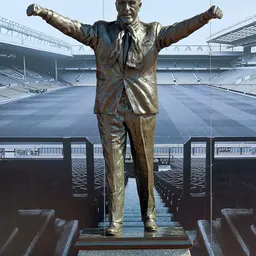
In January 2020, a statue which depicts a scene from 1968, when Paisley carried the injured future Liverpool captain Emlyn Hughes off the field, was unveiled outside Anfield. The plinth features a quote from Paisley: "This Club has been my life; I'd go out and sweep the street and be proud to do it for Liverpool FC if they asked me to." Paisley also features in the popular Liverpool chant "Allez, Allez, Allez", which is frequently sung by Liverpool supporters, especially during European matches.
Personal life Bob Paisley was married to his wife Jessie, a school teacher in Liverpool, from 1946 until his death 50 years later. Jessie Paisley died in February 2012 at the age of 96.
Honours Player Liverpool Football League First Division: 1946–47
Manager The 1981 European Cup, Paisley's third, in the Liverpool F.C. museum Liverpool Football League First Division: 1975–76, 1976–77, 1978–79, 1979–80, 1981–82, 1982–83 FA Cup runner-up: 1976–77 League Cup: 1980–81, 1981–82, 1982–83; runner-up: 1977–78 FA Charity Shield: 1974, 1976, 1977, 1979, 1980, 1982 European Cup: 1976–77, 1977–78, 1980–81 UEFA Cup: 1975–76 UEFA Super Cup: 1977; runner-up: 1978 Intercontinental Cup runner-up: 1981
Individual
Officer of the Order of the British Empire (OBE): 1983 PFA Merit Award: 1983 FWA Tribute Award: 1984 English Football Hall of Fame (Manager): 2002 World Soccer 8th Greatest Manager of All Time: 2013 France Football 26th Greatest Manager of All Time: 2019 Sports Illustrated 10th Greatest Manager of All Time: 2019 FourFourTwo 22th Greatest Manager of All Time: 2023
Managerial statistics TeamFromToRecordGWDLWin %Liverpool26 August 19741 July 1983
Don’t just read it —
keep it.
Full-length biographies made to live with: read them, listen on the way to work, watch them tonight.
- E-book
- Audio
- Video
Instant download · yours to keep · every purchase keeps this site free
Important facts
People in Bob Paisley's life
Named in this biography and alive at the same time






Related people
Same field, nearest in time


Contemporaries
People whose lives overlapped Bob Paisley's



Frequently asked questions
Who was Bob Paisley?
English footballer and manager (1919–1996)
When was Bob Paisley born?
Bob Paisley was born on 23 January 1919 in Hetton-le-Hole.
When did Bob Paisley die?
Bob Paisley died on 14 February 1996 in Liverpool.
What was Bob Paisley's occupation?
Bob Paisley was an association football player and association football coach.
What nationality was Bob Paisley?
Bob Paisley was British.
Sources & further reading
Cite this page
APA: Biography.guide. (2026). Bob Paisley. https://biography.guide/bob-paisley/
MLA: "Bob Paisley." Biography.guide, https://biography.guide/bob-paisley/.
Chicago: "Bob Paisley." Biography.guide. https://biography.guide/bob-paisley/.
Data last updated: 2026-09-20 · Spot an error? Report a correction.
Page generated 2026-09-27 05:21 UTC