
About Björn Gunnlaugsson
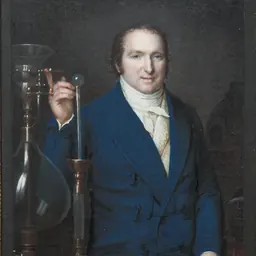
Lived 1788 – 1876 (aged 87). Björn Gunnlaugsson was an Icelandic cartographer and mathematician.
Björn Gunnlaugsson (25 September 1788 – 17 March 1876) was an Icelandic mathematician and cartographer. For the Icelandic Literary Society, he surveyed the country from 1831 to 1843. The results of his work were published in a topographic map of Iceland at a scale of 1:480,000 on four sheets. It was the first complete map of Iceland and, although generally dated to 1844, was not completed until 1848. It was published under the direction of Olaf Nikolas Olsen in Copenhagen. In 1849, a smaller edition on one sheet at a scale of 1:960,000 appeared. For his survey work, Björn received the Order of the Dannebrog in 1846 and the French Légion d'honneur in 1859.
Life
Björn was born at Tannstaðir, a remote farm on the Hrútafjörður in Húnavatnssýsla in north-western Iceland. Although the family was poor, they sent him to school to the local priests, who recognized his intellectual abilities. In 1808, Björn passed an exam in Reykjavík, obtaining a recommendation from the bishop for studying at the University of Copenhagen. But these plans were delayed by the Gunboat War between Denmark-Norway and the United Kingdom. Only after the end of the Napoleonic Wars could Björn travel to Denmark and enrolled in 1817 at the University of Copenhagen, where he studied theology and mathematics.
In 1822, a new post for a school teacher in Danish, mathematics, and history opened at the school of Bessastaðir in Iceland and was offered to Björn. He abandoned his theologic studies and accepted the post, returning to Iceland and taking up his duties as a school teacher on 14 May 1822. When the school was moved to Reykjavík in 1846, Björn followed. Five years later he was appointed chief assistant (Yfirkennari) to the rector. He retired in 1862. Guðlaug Aradóttir (died 1873). Yet the simple folk also felt a certain kind of respectful awe towards this scholar.
Björn knew the inclination towards the practical of his fellow countrymen well. When he returned to Iceland as a school teacher for mathematics, the curriculum at the grammar school at Bessastaðir covered barely more than the four basic operations addition, subtraction, multiplication and division. In his inauguration speech at the school, he emphasized the practical applications of mathematics. He tried to take mathematics education to a higher level, but failed ultimately as his treatment of the subject was often too abstract for his pupils and he was, according to Benedikz, "not capable of handling a class of mathematical ignoramuses".
The only studied mathematician in Iceland in the 19th century, Björn was isolated from the academic community in Europe, and the intellectual environment made him turn to didactics and the applications of mathematics, and also to philosophy. In August 1829, Björn, who had done in the early 1820s cartographic work under the direction of Heinrich Christian Schumacher at Altona, extending the triangulation inland. The Literary Society supported him with a yearly grant, and so did the Danish government from 1836 to 1846.
Björn's hand-drawn maps were sent to Copenhagen for preparing the publication. Olaf Nikolas Olsen had been appointed as the director of publication; he proposed to publish the map on four sheets, and he probably also defined the scale of 1:480,000 and the conical projection used. The map was published under Olsen's name, with the Literary Society of Iceland as the publisher, and paid by the Danish treasury. The title page was in Danish and French. Although dated 1844, it was probably not completed until 1848. In 1849, a smaller version of the map on one sheet at a scale of 1:960,000 was published. The central highlands were sketchy on his map; they were mapped properly for the first time by Þorvaldur Thoroddsen, whose map was printed in 1901. Still, Björn's survey is considered a great advancement, especially given the limited resources he had at his disposition. The map was also exhibited at the World's fair at Paris in 1878, where it was awarded a prize.
Njóla – "Night"
Njóla is a long didactic theological-philosophical poem Björn wrote mostly during his survey travels when the weather did not permit him to work or in the evenings. It was published originally in the annual report of 1842 of the Bessastaðir school, and then in 1853 with some minor revisions and again in 1884 in Reykjavík. In later stanzas, he describes the birth of the universe, covers Newton's laws and explains gravity. He interweaves such physics and mathematics framed as poetry with theological and philosophical musings about the purpose of the universe, the nature of good and evil, and God's intent.
Tölvísi: A mathematical textbook
Towards the end of his teaching career, Björn wrote down the mathematics he would have liked to teach in the Tölvísi, a mathematical textbook unprecedented in Iceland, both in its breadth and depth, but also in the rigour of its proofs. Moreover, it was written in Icelandic; in an attempt to make mathematics more accessible to his fellow countrymen, Björn even tried to find Icelandic names for mathematical concepts that hitherto had only been named using Danish or Latin words. But the work was largely ignored, and Björn's Icelandic terms never caught on. Begun in 1856, volume 1 was published in Reykjavík in 1865 by E. Þórðarson, but its second part was still unpublished in 2003 and existed only as an unpublished manuscript at the National and University Library of Iceland. Gunnlaugsson's first biographers, Melsteð and Jensson, wrote that it was "a book praised by all but read by extremely few".
Don’t just read it —
keep it.
Full-length biographies made to live with: read them, listen on the way to work, watch them tonight.
- E-book
- Audio
- Video
Instant download · yours to keep · every purchase keeps this site free
Important facts
People in Björn Gunnlaugsson's life
Named in this biography and alive at the same time


Related people
Same field, nearest in time


Contemporaries
People whose lives overlapped Björn Gunnlaugsson's


Frequently asked questions
Who was Björn Gunnlaugsson?
cartographer
When was Björn Gunnlaugsson born?
Björn Gunnlaugsson was born on 25 September 1788 in Iceland.
When did Björn Gunnlaugsson die?
Björn Gunnlaugsson died on 17 March 1876 in Reykjavík.
What was Björn Gunnlaugsson's occupation?
Björn Gunnlaugsson was a cartographer and mathematician.
What nationality was Björn Gunnlaugsson?
Björn Gunnlaugsson was Icelandic.
Sources & further reading
· Wikipedia: Björn Gunnlaugsson
Cite this page
APA: Biography.guide. (2026). Björn Gunnlaugsson. https://biography.guide/bjorn-gunnlaugsson/
MLA: "Björn Gunnlaugsson." Biography.guide, https://biography.guide/bjorn-gunnlaugsson/.
Chicago: "Björn Gunnlaugsson." Biography.guide. https://biography.guide/bjorn-gunnlaugsson/.
Data last updated: 2026-09-22 · Spot an error? Report a correction.
Page generated 2026-09-27 05:24 UTC