
About Bjarne Keyser Barth
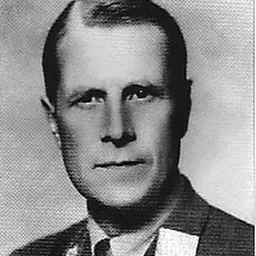
Lived 1892 – 1972 (aged 80). Bjarne Keyser Barth was a Norwegian editor and journalist.
Bjarne Keyser Barth (14 April 1892 – 23 April 1972) was a Norwegian fortress artillery officer. A military officer from 1914, Barth took part in Norwegian neutrality protection duties during the First World War, mostly at Oscarsborg Fortress. Remaining in military service after the end of the First World War, he served at several different Norwegian fortresses, finally at Fossumstrøket Fortress in south-eastern Norway.
In the inter-war years, Barth continued his military career, as well as working as a journalist, schoolteacher and book editor, and ran a small business.
During the Second World War, Barth again took part in neutrality protection duties, until the German invasion of Norway in April 1940. Barth led the garrison of Høytorp Fort, which fought the German invasion forces before being encircled and surrendering. Close to two years later, in 1942, Barth was arrested by the German occupying authorities and sent as a prisoner of war to Germany.
In the post-war years, Barth was involved with officer associations, and edited several military professional magazines. In this role he was often critical of the political leadership of the Norwegian Armed Forces.
Early and personal life Barth was born in Kristiania on 14 April 1892 to bank manager Christian Andreas Barth and Marie Georgine Antoinette Keyser. Having attended Oslo Cathedral School, he achieved his Examen artium student qualifications in 1910. The couple had a son, He remarried to Solveig Elfrida Bjørnstad in Oslo, Norway, on 26 June 1926.
Barth was a freemason, having joined the Lodge St. Olaus to the white Leopard in January 1917.
Career He graduated as military officer from the Norwegian Military Academy in 1914, He then graduated from the Norwegian Military College in 1919. In 1924, 1927 and 1930 he again travelled in Europe for studies, visiting France, Italy and Germany.
In addition to his military service, Barth had several civilian occupations. From 1920 to 1921 he worked as a schoolteacher, at a primary school in Kristiania and at his old secondary school Oslo Cathedral School. He also worked as chief of advertising at the advertising agency Høydahl Ohme. Starting in 1924, he ran an agency business in Oslo.
When the Germans invaded Norway on 9 April 1940, Barth was in command of Fossumstrøket Fortress' signals unit. Fossumstrøket Fortress' two forts immediately began mobilizing, although at Høytorp Fort this was hampered by ill-maintained and outdated fortifications and the poor quality of the other facilities. During the decade before 1940 the role of Høytorp Fort had been changed to one as a mobilization area for field artillery rather than a defensible fortification. At Trøgstad Fort artillery ammunition was in very short supply. Captain Barth was placed in charge of Høytorp Fort, and took direct command of the fort's two 12 cm turreted artillery pieces. After their initial landings along the coast, the Germans began their inland advance. The 196th Infantry Division was tasked with seizing the far south-east corner of Norway, including the Fossum area. The unit began its advance from Oslo on 12 April 1940. When one of the advance columns of the 196th Infantry Division reached the Askim area on 13 April, the cannon at Høytorp Fort opened fire to cover the retreat of the Norwegian 1st Division. In the course of two hours a total of 100 high-explosive shells were fired from the fort in an indirect area bombardment without the aid of observers. The artillery fire was estimated by the Norwegians as having been reasonably effective. Having expended their stocks of artillery ammunition, the fort's crew redeployed for defence of the interior of the fort. In a post-action report, Barth praised the crew of Høytorp Fort for their "fire discipline and good attitude in action". On 14 April 1940 Fossumstrøket Fortress surrendered after a meeting of the fortress commander and six of the other officers, including Captain Barth. The officers held a vote and unanimously agreed that the fortress could not continue fighting. At the time the fortress was encircled and under machine gun and artillery fire, while the Norwegian 1st Division had retreated from the area and no longer needed the fortress' support. Barth stated in connection with his vote that the fortress was in an impossible tactical situation, and was manned by poorly trained and demoralized crews. Barth and another officer were appointed to approach the German forces and begin surrender negotiations on behalf of the fortress commander. The fortress guns were rendered inoperable by the destruction of vital parts at 14:05, and a flag of truce was raised over the fortress at 14:16. In a report written in 1941, Lieutenant Colonel Rodtwitt praised Barth's efforts during the fighting, describing him as "loyal, devoted to duty, able and brave", pointing especially to his leadership of Høytorp Fort during the fighting and to his "rescue of important documents" after the surrender of the fortress. |group=Note He was released from captivity on 28 September 1942, due to having fallen severely ill during his captivity. For his wartime service, Barth was decorated with the Defence Medal 1940–1945.
Post-war years In the post-war years, Barth edited the periodical Vår Hær from 1946 to 1964, and Norges Forsvar from 1964 to 1966. while Norges Forsvar was and still is the magazine of the Norges Forsvarsforening (Norwegian Defence Association). In a 1946 leader, Vår Hær criticized the Norwegian Minister of Defence, Jens Christian Hauge and demanded his resignation. The resignation demand, which included claims that Hauge had ignored the advice of military professionals and involved himself too much in the details of military matters in the post-war reconstruction of the Norwegian Armed Forces, led to a debate in the national newspapers. Barth stated in the debate that "most army officers" would agree with the criticism of Hauge. In the debate Barth was himself criticised by the Norwegian Army Officers' Association which said it was too soon to judge minister Hauge's efforts, and that Barth's statements were too broad in nature.
Barth was given an honourable discharge from the Norwegian Armed Forces on 15 April 1952. His last military position was at Fossumstrøket Fortress. Barth had applied unsuccessfully for several positions during his last seven years in the Norwegian Armed Forces, the first of his post-war applications being to the position of general inspector and commander of the Norwegian coastal artillery service in 1945. In 1946, the officer appointed to the position for which Barth had applied the previous year, Colonel Gunnar Isaachsen Willoch, recommended that Barth should be promoted to the rank of colonel and given command of the coastal artillery in Western Norway. However, due to a bureaucratic mistake Barth was considered by the Commanding Admiral of the Royal Norwegian Navy, Admiral Elias Corneliussen, to be disqualified due to his age and another officer given the position. Admiral Corneliussen and army general Halvor Hansson had interpreted the age regulations for promotion to the rank of colonel without taking into account Barth's war service, which would have enabled him to be qualified for a promotion despite his age. Barth sent a written complaint after being disqualified. A parliamentary investigative commission concluded months later that Barth had been qualified for the position, and should be considered for other similar positions. Wright brought up once more the cases of Barth and several other officers who claimed to have been unreasonably bypassed, in 1949. In 1948 Barth applied unsuccessfully for the position of commander of Coastal Artillery Brigade Eastern Norway. The next year he applied unsuccessfully for the position of director of the Norwegian Defence University College, and also for the position as military attaché at the Norwegian embassies in Copenhagen and Stockholm. He died on 23 April 1972 at the age of 80, having lived at Akersborg terrasse in Oslo.
Don’t just read it —
keep it.
Full-length biographies made to live with: read them, listen on the way to work, watch them tonight.
- E-book
- Audio
- Video
Instant download · yours to keep · every purchase keeps this site free
Important facts
People in Bjarne Keyser Barth's life
Named in this biography and alive at the same time



Related people
Same field, nearest in time


Contemporaries
People whose lives overlapped Bjarne Keyser Barth's






Frequently asked questions
Who was Bjarne Keyser Barth?
Norwegian officer (b. 1892)
When was Bjarne Keyser Barth born?
Bjarne Keyser Barth was born on 14 April 1892 in Oslo Municipality.
When did Bjarne Keyser Barth die?
Bjarne Keyser Barth died on 23 April 1972 in Oslo Municipality.
What was Bjarne Keyser Barth's occupation?
Bjarne Keyser Barth was an editor and journalist.
What nationality was Bjarne Keyser Barth?
Bjarne Keyser Barth was Norwegian.
Sources & further reading
· Wikipedia: Bjarne Keyser Barth
· DBpedia: Bjarne Keyser Barth
Cite this page
APA: Biography.guide. (2026). Bjarne Keyser Barth. https://biography.guide/bjarne-keyser-barth/
MLA: "Bjarne Keyser Barth." Biography.guide, https://biography.guide/bjarne-keyser-barth/.
Chicago: "Bjarne Keyser Barth." Biography.guide. https://biography.guide/bjarne-keyser-barth/.
Data last updated: 2026-09-20 · Spot an error? Report a correction.
Page generated 2026-09-27 05:26 UTC