
About Binod Kumar Roy
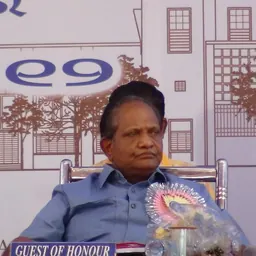
Lived 1944 – 2019 (aged 74–75). Binod Kumar Roy was an Indian judge.
Binod Kumar Roy (26 December 1944 – 20 June 2019) was an Indian Judge and former Chief Justice of three High Courts of India.
Career Roy was born in 1944. He studied in Patna College and passed LL.B from Magadh University. He started his career in the Patna High Court as an advocate. Roy was elevated as a Judge of the Patna High Court on 31 October 1988. In April 1994 he was transferred to the Allahabad High Court. Roy became the Chief Justice of Punjab and Haryana High Court on 14 October 2002. He was subsequently moved to the Gauhati High Court and served there as the Chief Justice. On 30 September 2005, Justice Roy became the Chief Justice of the Sikkim High Court after retirement of Justice Radha Krishna Patra. He retired as a judge on 27 December 2006. He died on 20 June 2019 after prolonged illness.
Controversy and transfer The unprecedented 2004 institutional crisis at the Punjab & Haryana High Court erupted on 19 April 2004, when 25 sitting judges went on an extraordinary mass casual leave to revolt against Chief Justice Roy, completely paralyzing the state's highest court. The standoff began when Chief Justice Roy, acting as a strict institutional disciplinarian, demanded formal written explanations from senior judges who had accepted free, honorary memberships from the elite Forest Hill Golf and Country Resort, a luxury estate that was actively facing major environmental litigation before that very court. The dissenting judges took severe offense, arguing that a Chief Justice is merely first among equals rather than a disciplinary authority, prompting a total breakdown of internal communication where judges began boycotting administrative duties. The crisis went public when Chief Justice Roy gave a televised interview accusing judges of bypassing decorum by calling the court registrar to pull specific, high-stakes cases into their courtrooms without his knowledge.
The public spectacle drew national alarm, prompting President A. P. J. Abdul Kalam to express deep distress over the erosion of public trust, while Chief Justice of India V. N. Khare summoned three senior most judges of Punjab & Haryana High Court G. S. Singhvi, V. K. Bali and H. S. Bedi and sharply reprimanded the striking judges in New Delhi for indefensible judicial impropriety. To restore administrative order and defuse the explosive tension, the Supreme Court Collegium executed a massive institutional reshuffle, transferring Chief Justice Roy to head the Gauhati High Court and Justice Singhvi to Gujarat High Court and systematically shifting the ringleaders of the protest to various other High Courts across India, leaving the incident as a permanent landmark case study on the fragile boundary between judicial ethics and internal hierarchy.
Roy's transfer spree was not ended here, in Gauhati High Court too 15 of the 17 of his colleagues on the bench as well as 151 lawyers has written formal complaint against roy's manner of conducting High Court proceedings and perceived high handedness. Supreme court collegium again transferred him out of Gauhati High Court and sent to Sikkim High Court, smallest high court in India with sanctioned strength of 3 including chief justice.
The transfer sparked an intense debate on judicial accountability within legal circles. While factions of the Bar in Chandigarh and Guwahati complained about his rigid and high-handed management style, many legal columnists and purists defended him. They argued that Justice Roy was an incorruptible judge paying a heavy career price precisely because he was unwilling to compromise on ethics, particularly regarding his initial crack-down on judges accepting corrupt golf resort memberships.
Ultimately, Justice Roy accepted the assignment quietly. He assumed charge as Chief Justice of the Sikkim High Court on 30 September 2005, and served out a peaceful, conflict-free final tenure in Gangtok until his standard constitutional retirement on 27 December 2006.
Don’t just read it —
keep it.
Full-length biographies made to live with: read them, listen on the way to work, watch them tonight.
- E-book
- Audio
- Video
Instant download · yours to keep · every purchase keeps this site free
Important facts
People in Binod Kumar Roy's life
Named in this biography and alive at the same time

Related people
Same field, nearest in time


Contemporaries
People whose lives overlapped Binod Kumar Roy's




Frequently asked questions
Who was Binod Kumar Roy?
Indian judge
When was Binod Kumar Roy born?
Binod Kumar Roy was born in 1944.
When did Binod Kumar Roy die?
Binod Kumar Roy died in 2019.
What was Binod Kumar Roy's occupation?
Binod Kumar Roy was a judge.
What nationality was Binod Kumar Roy?
Binod Kumar Roy was Indian.
Sources & further reading
Cite this page
APA: Biography.guide. (2026). Binod Kumar Roy. https://biography.guide/binod-kumar-roy/
MLA: "Binod Kumar Roy." Biography.guide, https://biography.guide/binod-kumar-roy/.
Chicago: "Binod Kumar Roy." Biography.guide. https://biography.guide/binod-kumar-roy/.
Data last updated: 2026-09-20 · Spot an error? Report a correction.
Page generated 2026-09-27 05:11 UTC