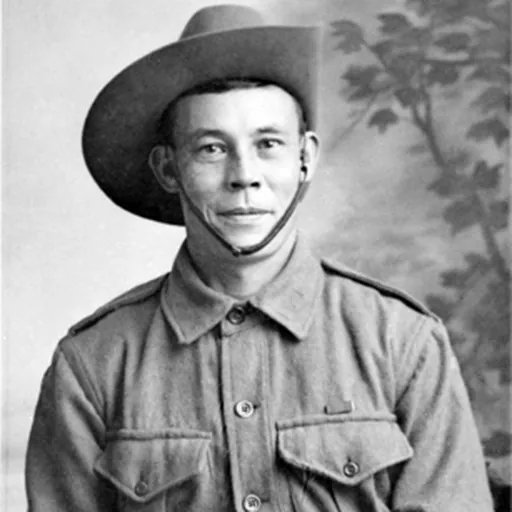
Billy Sing
Australian soldier in World War I
About Billy Sing
Lived 1886 – 1943 (aged 57). Billy Sing was an Australian military personnel, soldier and stockman (Australia).
William Edward Sing, DCM (3 March 1886 – 19 May 1943), known as Billy Sing, was an Australian soldier of Chinese and English descent who served in the Australian Imperial Force during World War I, best known as a sniper during the Gallipoli Campaign. He took at least 150 confirmed kills during that campaign, and may have had over 200 kills in total. Towards the end of the war, Sing married a Scottish woman, but the relationship did not last long.
Early life Sing was born on 3 March 1886 in Clermont, Queensland, Australia, the son of a Chinese father and an English mother. His parents were John Sing (c. 1842–1921), a drover from Shanghai, China, and Mary Ann Sing (née Pugh; c. 1857–unknown), a nurse from Kingswinford, Staffordshire, England. Sing's mother had given birth to a daughter named Mary Ann Elizabeth Pugh on 28 May 1883, less than two months before marrying Sing's father on 4 July 1883. It is unclear whether this child was John Sing's daughter as well. A daughter, Beatrice Sing, was later born into the family on 12 July 1893. The three children grew up together on the farm run by the Sings, and all three performed well academically.
There was considerable anti-Chinese sentiment in Australia at this time. As a boy, Sing was well known for his shooting skill, but was the subject of racial prejudice due to his ancestry. He began work hauling timber as a youth, He regularly won prizes for his shooting, and also played cricket with skill.
On 24 October 1914, two months after the outbreak of war, Sing enlisted as a trooper in the Australian 5th Light Horse Regiment of the Australian Imperial Force. His Certificate of Medical Examination at the time showed that he stood at and weighed . According to John Laws and Christopher Stewart, he was accepted into the army only after a recruitment officer chose to disregard the fact that Sing was part Chinese; at the time, only those of European ancestry were generally considered suitable for Australian military service.
Military service Gallipoli Campaign
Sing began his military career as part of the Australian and New Zealand Army Corps (ANZAC) forces in the Gallipoli Campaign in modern day Turkey. Biographer John Hamilton described the Turkish terrain thus: "It is a country made for snipers. The Anzac and Turkish positions often overlooked each other. Each side sent out marksmen to hunt and stalk and snipe, to wait and shoot and kill, creeping with stealth through the green and brown shrubbery ..." Sing partnered with spotters Ion 'Jack' Idriess and, later, Tom Sheehan. Idriess described Sing as "a little chap, very dark, with a jet black moustache and goatee beard. A picturesque looking mankiller. He is the crack shot of the Anzacs." An account by Private Frank Reed, a fellow Australian soldier, states that Sing was so close to the Turkish lines that enemy artillery rarely troubled him. That same month, an enemy sniper's bullet struck Sheehan's spotting telescope, injuring his hands and face, and then hit Sing's shoulder, but the latter was back in action after a week's recuperation. Sheehan was more severely wounded, and was shipped back to Australia. He reportedly acquired the latter nickname due to his callous attitude towards the enemy. By early September 1915, he had taken 119 kills, according to Brigadier-General Granville Ryrie, commanding officer of the 2nd Australian Light Horse Brigade. Regimental records list Sing as having taken 150 confirmed kills, but on 23 October 1915, General William Birdwood, commander of ANZAC forces, issued an order complimenting him on his 201 unconfirmed kills. This was the first official recognition of his service. with a related entry in military records reading: "For conspicuous gallantry from May to September, 1915, at Anzac, as a sniper. His courage and skill were most marked, and he was responsible for a very large number of casualties among the enemy, no risk being too great for him to take." Apart from the recognition he received from his superiors, Sing's exploits were also reported in British and American newspapers of the time.
Western Front At the end of November 1915, Sing suffered from myalgia and was confined to the hospital ship HMHS Gloucester Castle for almost two weeks. During this time, he was conveyed to Malta, then Ismaïlia, Egypt. While in Egypt, he was also hospitalised with parotitis and mumps, but rejoined his unit at the end of March 1916.
Sing transferred to the 31st Infantry Battalion on 27 July 1916 at Tel-el-Kibir and sailed to England the following month. Following a brief period of training in England, he sailed for France and entered action on the Western Front in January 1917. In May 1917, while recovering in Scotland, he met waitress Elizabeth A. Stewart (c. 1896–unknown), who was the daughter of Royal Navy cook George Stewart.
After a month with his new wife, Sing returned to the trenches in France in August 1917, but was in very poor health due to his battle wounds and the effects of gas poisoning. and was also recommended for the Military Medal—but never received it. Sing suffered lung disease from his exposure to gas, and it soon brought his military career to an end. An army medical report from 23 November 1918 noted that he had gunshot wounds in the left shoulder, back, and left leg, and had suffered gas poisoning. The report stated that his general health was 'good' but that he complained of coughing upon exertion. The State Repatriation Board approved the application but Elizabeth remained in Edinburgh where she had two children by a Queenslander residing in Britain. Elizabeth later settled in Wollongong with her de-facto husband and their two children. Sing and Elizabeth do not appear to have ever divorced.
Later life and death
In later life, Sing reported chest, back, and heart pain. His only significant possessions were a hut (worth around £20) on a mining claim and a mere 5 shillings found with him in his room. in Kedron, a northern suburb of Brisbane. His grave is now part of the lawn cemetery section of the Lutwyche Cemetery, and the inscription on his bronze plaque reads:
AT RESTWILLIAM EDWARD (BILLY) SING (DCM)Born Clermont Qld. 2–3–1886 — 19–5–1943Reg. No. 355 Australian Fifth Light Horse Regiment and later the 31st Infantry BattalionSon of JOHN SING (bn. SHANGHAI) and MARY ANN (nee PUGH bn. ENGLAND)AND MARRIED FOR A TIME TO ELIZABETH (STEWART) IN EDINBURGH 29–6–1917A man of all trades, Pte. Sing was awarded the Distinguished Conduct Medal for conspicuous gallantry, the Belgian Croux [sic] De Guerre and mentioned often in despatches. Serving at Gallipoli and in France from 1915–1918, he became known as Australia's most effective marksman/sniper accounting for more than 150 of the opposing forces.His incredible accuracy contributed greatly to the preservation of the lives of those with whom he served during a war always remembered for countless acts of valour and tragic carnage.
Legacy The Queensland Military Historical Society set up a bronze plaque at 304 Montague Road, South Brisbane, where Sing had died. Ren said, "Billy Sing is a symbol of the long history of Chinese in Australia, and the great role they have played in your nation's past ... It also reminds us that China and Australia were allies through both world wars, and that we have a long and proud shared past." and in greater depth by Hamilton in his book, Gallipoli Sniper: The life of Billy Sing (2008). Hamilton's book includes a detailed account of how snipers worked at Gallipoli and their contribution to the progress of the campaign. Reviewer John Wadsley wrote that "Hamilton is able to bring together a range of sources to create the story, and while at times, you get the feeling he is padding it out to make up for the lack of direct material about Billy Sing, the book works."
A television mini-series, The Legend of Billy Sing, was in post-production as of 2010. Despite some reports that it was based on Hamilton's book, the author maintained that he was never contacted by the film makers. Although Sing and his father were partly Chinese and fully Chinese, respectively, the mini-series portrayed them with actors of European ancestry. The director, Geoff Davis, was criticised for this decision. Politician Bill O'Chee, a member of the Billy Sing Commemorative Committee, said, "When a person dies, all that is left is their story, and you can’t take a person’s name and not tell the truth about their story." and Laws and Stewart described him simply as "one of many Australians of Chinese descent who served with distinction in the Australian forces during World War I."
Each year on the weekend immediately before Anzac Day (25 April), the William 'Billy' Sing Memorial Shooting Competition is held at the North Arm Rifle Range on the Sunshine Coast in Queensland using the Lee Enfield military service rifle. The competition is held over several hundred metres worth of stages with the highest scorer awarded the William 'Billy' Sing Memorial Trophy.
Don’t just read it —
keep it.
Full-length biographies made to live with: read them, listen on the way to work, watch them tonight.
- E-book
- Audio
- Video
Instant download · yours to keep · every purchase keeps this site free
Important facts
People in Billy Sing's life
Named in this biography and alive at the same time




Related people
Same field, nearest in time



Contemporaries
People whose lives overlapped Billy Sing's



Frequently asked questions
Who was Billy Sing?
Australian soldier in World War I
When was Billy Sing born?
Billy Sing was born on 2 March 1886 in Clermont.
When did Billy Sing die?
Billy Sing died on 19 May 1943 in Brisbane.
What was Billy Sing's occupation?
Billy Sing was a military personnel, soldier and stockman (Australia).
What nationality was Billy Sing?
Billy Sing was Australian.
Sources & further reading
Cite this page
APA: Biography.guide. (2026). Billy Sing. https://biography.guide/billy-sing/
MLA: "Billy Sing." Biography.guide, https://biography.guide/billy-sing/.
Chicago: "Billy Sing." Biography.guide. https://biography.guide/billy-sing/.
Data last updated: 2026-09-20 · Spot an error? Report a correction.
Portrait: Wikimedia Commons · author & licence
Page generated 2026-09-27 04:57 UTC