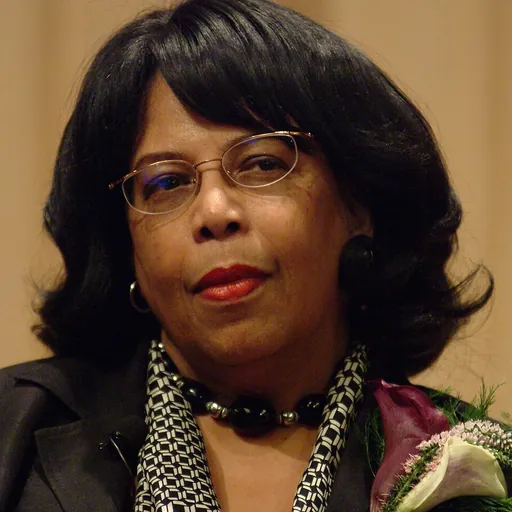
About Bettye Collier-Thomas
Born 1941. Bettye Collier-Thomas is an American historian.
Bettye Collier-Thomas (born Bettye Marie Collier, February 18, 1941) is a scholar of African-American women's history.
Early life and education Collier-Thomas was born the second of three children of Joseph Thomas Collier, a business executive and public school teacher, and Katherine (Bishop) Collier, a public school teacher. She attended elementary schools in New York, Georgia, and Florida, and high school in Jamaica, New York. Her family belonged to the black middle class, with professions such as nurse, building subcontractor, and barber represented among her near relatives as well as teacher and businessman. Her great-uncle Frank Richard Veal was an African Methodist Episcopal minister and president of the historically black Allen University (South Carolina) and Paul Quinn College (Texas). She thought that she would go into law, but an 11th grade teacher inspired her to become an historian instead. She hyphenated her name upon marriage to Charles J. Thomas, an educator (deceased) and writer.
Collier-Thomas was awarded bachelor's degree at Allen University, where she was inducted into the Alpha Kappa Mu National Honor Society (the black Phi Beta Kappa during segregation). She won a Presidential Scholarship to attend Atlanta University, where she received the master's degree. In 1974, supported by a Ford Foundation Fellowship, she became the first black woman to receive a Ph.D. in history from George Washington University.
In 1994, Collier-Thomas was awarded the Department of the Interior's Conservation Service Award in recognition of her leading role in creating and developing BMA. In giving the award, then–Interior Secretary Bruce Babbitt wrote: "Dr. Collier-Thomas has established the only repository in the country solely devoted to the collection and preservation of materials relating to African-American women in America. Other repositories may collect materials on black history or on women's history, but no other repository gives black women their principal attention." She is also a distinguished lecturer for the Organization of American Historians and a public policy Fellow at the Woodrow Wilson Center.
As a scholar, Collier-Thomas specializes in the social and political history of African-American women and has written on topics such as black theater, religion, and women's organizations. She argues that too many historians write as if race is the only locus of discrimination for African-Americans. In her view, African-American women suffer from being framed simultaneously by race, class, and gender—a kind of "oppression-in-triplicate". This experience, in turn, provides them with a strong ground from which to speak truth.
Collier-Thomas's book Jesus, Jobs and Justice (2010) examines the ways in which both black and white Protestant women dealt with racial issues in the first half of the 20th century, prefiguring the emergence of the Civil Rights Movement. Her Daughters of Thunder (1998) is an anthology of 19th and 20th century sermons by black women, selected from a collection amassed by Collier-Thomas over the course of two decades. Such sermons by women were rarely collected or recorded, making this anthology especially useful as source material for other scholars.
Selected publications
Author Jesus, Jobs and Justice: African American Women and Religion. Random House, 2010. "John Hope Franklin: Mentor and Confidante." Journal of African American History 94.3 (2009): 344–353. Daughters of Thunder: Black Women Preachers and Their Sermons, 1850-1979. Jossey-Bass, 1998. African American Women and the Vote, 1837-1965. Co-edited with Ann Dexter Gordon. Univ of Massachusetts Press, 1997. "Towards Black Feminism: The Creation of the Bethune Museum-Archives." Special Collections 3.3-4 (1985): 43–66. "The Impact of Black Women in Education: An Historical Overview," Journal of Negro Education 51 (Summer 1982)
Co-author and co-editor Franklin, V. P., and Bettye Collier-Thomas. "Biography, Race Vindication, and African American Intellectuals." The Journal of African American History (2002): 160–174. Collier-Thomas, Bettye, and Vincent P. Franklin, eds. Sisters in the Struggle: African American Women in the Civil Rights-Black Power Movement. New York University Press, 2001. Collier-Thomas, Bettye, and Vincent P. Franklin.My Soul is a Witness: A Chronology of the Civil Rights Era in the United States, 1954-1965. Henry Holt, 2000. Collier-Thomas, Bettye, and James Turner. "Race, Class and Color: The African American Discourse on Identity." Journal of American Ethnic History (1994): 5-31.
Don’t just read it —
keep it.
Full-length biographies made to live with: read them, listen on the way to work, watch them tonight.
- E-book
- Audio
- Video
Instant download · yours to keep · every purchase keeps this site free
Important facts
People in Bettye Collier-Thomas's life
Named in this biography and alive at the same time





Related people
Same field, nearest in time




Contemporaries
People whose lives overlapped Bettye Collier-Thomas's



Frequently asked questions
Who is Bettye Collier-Thomas?
African American academic
When was Bettye Collier-Thomas born?
Bettye Collier-Thomas was born on 18 February 1941.
What is Bettye Collier-Thomas's occupation?
Bettye Collier-Thomas is a historian.
What nationality is Bettye Collier-Thomas?
Bettye Collier-Thomas is American.
Sources & further reading
· Wikipedia: Bettye Collier-Thomas
· DBpedia: Bettye Collier-Thomas
Cite this page
APA: Biography.guide. (2026). Bettye Collier-Thomas. https://biography.guide/bettye-collier-thomas/
MLA: "Bettye Collier-Thomas." Biography.guide, https://biography.guide/bettye-collier-thomas/.
Chicago: "Bettye Collier-Thomas." Biography.guide. https://biography.guide/bettye-collier-thomas/.
Data last updated: 2026-09-20 · Spot an error? Report a correction.
Portrait: Wikimedia Commons · author & licence
Page generated 2026-09-27 04:58 UTC