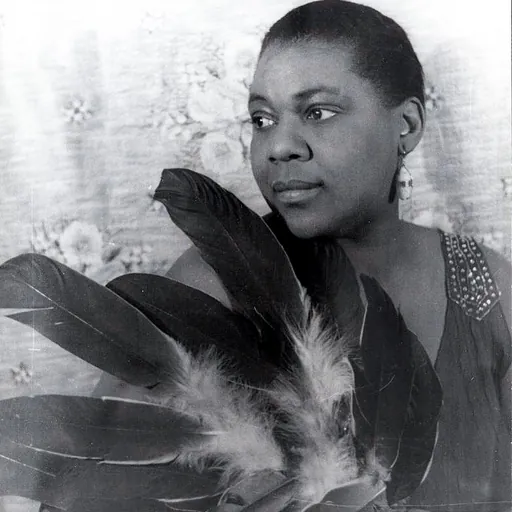
About Bessie Smith
Lived 1894 – 1937 (aged 43). Bessie Smith was an American street artist, musician, singer, dancer, mime artist and entertainer.
Bessie Smith (April 15, 1892 – September 26, 1937) was an African-American blues singer widely renowned during the Jazz Age. Nicknamed the "Empress of the Blues" and formerly Queen of the Blues, she was the most popular female blues singer of the 1930s. Inducted into the Rock and Roll Hall of Fame in 1989, she is often regarded as one of the greatest singers of her era and was a major influence on fellow blues singers, as well as jazz vocalists.
Born in Chattanooga, Tennessee, Smith was young when her parents died, and she and her six siblings survived by performing on street corners. She began touring and performed in a group that included Ma Rainey, and then went out on her own. Her successful recording career with Columbia Records began in 1923, but her performing career was cut short by a car crash that killed her at the age of 45.
Biography
Early life
The 1900 census indicates that her family reported that Bessie Smith was born in Chattanooga, Tennessee, in July 1892. The 1910 census gives her age as 16, and a birth date of April 15, 1894, which appears on subsequent documents and was observed as her birthday by the Smith family. The 1870 and 1880 censuses report several older siblings or half-siblings.
Smith was the daughter of Laura and William Smith, a laborer and part-time Baptist preacher (he was listed in the 1870 census as a "minister of the gospel", in Moulton, Lawrence County, Alabama). He died while his daughter was too young to remember him. By the time Bessie was nine, her mother and a brother had also died and her older sister Viola took charge of caring for her siblings. As a consequence, Bessie was unable to gain an education.
Due to her parents' death and her poverty, Bessie experienced a "wretched childhood."
In 1912, Clarence returned to Chattanooga with the Stokes troupe and arranged an audition for his sister with the troupe managers, Lonnie and Cora Fisher. Bessie was hired as a dancer rather than a vocalist since the company already included popular singer Ma Rainey. Smith eventually moved on to performing in chorus lines, making the "81" Theatre in Atlanta her home base. She also performed in shows on the black-owned Theater Owners Booking Association (T.O.B.A.) circuit and would become one of its major attractions.
Career
Bessie Smith began forming her own act around 1913, at Atlanta's "81" Theater. By 1920, she had established a reputation in the South and along the East Coast. At the time, sales of over 100,000 copies of "Crazy Blues", recorded for Okeh Records by the singer Mamie Smith (no relation), pointed to a new market. The recording industry had not directed its product to black people, but the success of the record led to a search for female blues singers.
Hoping to capitalize on this new market, Smith began her recording career in 1923. She was signed to Columbia Records in 1923 by Frank Walker, a talent agent who had seen her perform years earlier. Her first recording session for Columbia was on February 15, 1923; it was engineered by Dan Hornsby who was recording and discovering many southern music talents of that era. For most of 1923, her records were issued on Columbia's regular A-series. When the company established a "race records" series, Smith's "Cemetery Blues" (September 26, 1923) was the first issued. Both sides of her first record, "Downhearted Blues" backed with "Gulf Coast Blues", were hits (an earlier recording of "Downhearted Blues" by its co-writer Alberta Hunter had previously been released by Paramount Records).
As her popularity increased, Smith became a headliner on the Theatre Owners Booking Association (T.O.B.A.) circuit and rose to become its top attraction in the 1920s. Working a heavy theater schedule during the winter and performing in tent shows the rest of the year, Smith became the highest-paid black entertainer of her day and began traveling in her own 72-foot-long railroad car. Columbia's publicity department nicknamed her "Queen of the Blues", but the national press soon upgraded her title to "Empress of the Blues". Smith's music stressed independence, fearlessness, and sexual freedom, implicitly arguing that working-class women did not have to alter their behavior to be worthy of respect.
Despite her success, neither she nor her music was accepted in all circles. She once auditioned for Black Swan Records (W. E. B. Du Bois was on its board of directors) and was dismissed because she was considered too rough as she supposedly stopped singing to spit. Even her admirers—white and black—considered her a "rough" woman (i.e., working class or even "low class").
Smith had a strong contralto voice, which recorded well from her first session, which was conducted when recordings were made acoustically. The advent of electrical recording made the power of her voice even more evident. Her first electrical recording was "Cake Walking Babies [From Home]", recorded on May 5, 1925. Smith also benefited from the new technology of radio broadcasting, even on stations in the segregated South. For example, after giving a concert to a white-only audience at a theater in Memphis, Tennessee, in October 1923, she performed a late-night concert on a Memphis radio station, WMC, which was well received by the audience. Musicians and composers like Danny Barker and Tommy Dorsey compared her presence and delivery to a preacher because of her ability to enrapture and move her audience.
She made 160 recordings for Columbia, often accompanied by the finest musicians of the day, notably Louis Armstrong, Coleman Hawkins, Fletcher Henderson, James P. Johnson, Joe Smith, and Charlie Green. A number of Smith's recordings—such as "Alexander's Ragtime Band" in 1927—quickly became among the best-selling records of their release years.
Broadway
Smith's career was cut short by the Great Depression, which nearly put the recording industry out of business, and the advent of sound in film, which spelled the end of vaudeville. She never stopped performing, however. The days of elaborate vaudeville shows were over, but Smith continued touring and occasionally sang in clubs. In 1929, she appeared in a Broadway musical, Pansy. The musical was a flop; top critics said she was its only asset.
Film
In November 1929, Smith made her only film appearance, starring in a two-reeler, St. Louis Blues, based on composer W. C. Handy's song of the same name. In the film, directed by Dudley Murphy and shot in Astoria, Queens, she sings the title song accompanied by members of Fletcher Henderson's orchestra, the Hall Johnson Choir, the pianist James P. Johnson and a string section, a musical environment radically different from that of any of her recordings.
Swing era In 1933, John Henry Hammond, who also mentored Billie Holiday, asked Smith to record four sides for Okeh (which had been acquired by Columbia Records in 1925). He claimed to have found her in semi-obscurity, "working as a hostess in a speakeasy on Ridge Avenue in Philadelphia." Smith worked at Art's Cafe on Ridge Avenue, but not as a hostess and not until the summer of 1936. In 1933, when she made the Okeh sides, she was still touring. Hammond was known for his selective memory and gratuitous embellishments.
Smith was paid a non-royalty fee of $37.50 for each selection on these Okeh sides, which were her last recordings. Made on November 24, 1933, they serve as a hint of the transformation she made in her performances as she shifted her blues artistry into something that fit the swing era. The relatively modern accompaniment is notable. The band included such swing era musicians as the trombonist Jack Teagarden, the trumpeter Frankie Newton, the tenor saxophonist Chu Berry, the pianist Buck Washington, the guitarist Bobby Johnson, and the bassist Billy Taylor. Benny Goodman, who happened to be recording with Ethel Waters in the adjoining studio, dropped by and is barely audible on one selection. Hammond was not entirely pleased with the results, preferring to have Smith revisit her old blues sound. "Take Me for a Buggy Ride" and "Gimme a Pigfoot", both written by Wesley Wilson, were among her most popular recordings.
Dr. Smith stated that this injury alone did not cause her death. Though the light was poor, he observed only minor head injuries. He attributed her death to extensive and severe crush injuries to the entire right side of her body, consistent with a sideswipe collision. Henry Broughton, a fishing partner of Dr. Smith's, helped him move Smith to the shoulder of the road. Dr. Smith dressed her arm injury with a clean handkerchief and asked Broughton to go to a house about off the road to call an ambulance. By the time Broughton returned, about 25 minutes later, Smith was in shock.
Time passed with no sign of the ambulance, so Dr. Smith suggested that they take her into Clarksdale in his car. He and Broughton had almost finished clearing the back seat when they heard the sound of a car approaching at high speed. Dr. Smith flashed his lights in warning, but the oncoming car failed to slow and plowed into his car at full speed. It sent his car careening into Smith's overturned Packard, completely wrecking it. The oncoming car ricocheted off Hugh Smith's car into the ditch on the right, barely missing Broughton and Bessie Smith.
The young couple in the speeding car did not sustain life-threatening injuries. Two ambulances then arrived from Clarksdale—one from the black hospital, summoned by Broughton, the second from the white hospital, acting on a report from the truck driver, who had not seen the crash victims. Smith was taken to the G. T. Thomas Afro-American Hospital in Clarksdale, where her right arm was amputated. She died that morning without regaining consciousness.
After her death, an often repeated, but now discredited story emerged that she died because a whites-only hospital in Clarksdale refused to admit her. The jazz writer and producer John Hammond gave this account in an article in the November 1937 issue of DownBeat magazine. The circumstances of Smith's death and the rumor reported by Hammond formed the basis for Edward Albee's 1959 one-act play The Death of Bessie Smith. "The Bessie Smith ambulance would not have gone to a white hospital; you can forget that", Hugh Smith told Albertson. "Down in the Deep South Cotton Belt, no ambulance driver, or white driver, would even have thought of putting a colored person off in a hospital for white folks."
Smith's funeral was held in Philadelphia a little over a week later, on October 4, 1937. Initially, her body was laid out at Upshur's funeral home. As word of her death spread through Philadelphia's black community, her body had to be moved to the O. V. Catto Elks Lodge to accommodate the estimated 10,000 mourners who filed past her coffin on Sunday, October 3. Contemporary newspapers reported that her funeral was attended by about seven thousand people. Far fewer mourners attended the burial at Mount Lawn Cemetery, in nearby Sharon Hill. Jack Gee thwarted all efforts to purchase a stone for his estranged wife, once or twice pocketing money raised for that purpose.
Unmarked grave Smith's grave remained unmarked until a tombstone was erected on August 7, 1970, paid for by the singer Janis Joplin and Juanita Green, who as a child had done housework for Smith. Dory Previn wrote a song about Joplin and the tombstone, "Stone for Bessie Smith", for her album Mythical Kings and Iguanas. The Afro-American Hospital (now the Riverside Hotel) was the site of the dedication of the fourth historical marker on the Mississippi Blues Trail.
Personal life In 1923, Smith was living in Philadelphia when she met Jack Gee, Smith frequented Buffet Flats after concerts with friends, including drag queens and gay men who viewed it as a safe haven. Her friends reported that a lot of people would pay top dollar to see the sex shows at the buffet,
What becomes evident after listening to her music and studying her lyrics is that Smith emphasized and channeled a subculture within the African-American working class. Additionally, she incorporated commentary on social issues like poverty, intra-racial conflict, and female sexuality into her lyrics. Her lyrical sincerity and public behavior were not widely accepted as appropriate expressions for African-American women; therefore, her work was often written off as distasteful or unseemly, rather than as an accurate representation of the African-American experience.
Smith's work challenged elitist norms by encouraging working-class women to embrace their right to drink, party, and satisfy their sexual needs as a means of coping with stress and dissatisfaction in their daily lives. Smith advocated for a wider vision of African-American womanhood beyond domesticity, piety, and conformity; she sought empowerment and happiness through independence, sassiness, and sexual freedom.
Awards and honors Grammy Hall of Fame Three recordings by Smith were inducted into the Grammy Hall of Fame, an award established in 1973 to honor recordings that are at least 25 years old and that have "qualitative or historical significance".
Bessie Smith: Grammy Hall of Fame Award Year Recorded Title Genre Label Year Inducted 1923 "Downhearted Blues" Blues (single) Columbia 2006 1925 "St. Louis Blues" Jazz (single) Columbia 1993 1928 "Empty Bed Blues" Blues (single) Columbia 1983
National Recording Registry In 2002, Smith's recording of "Downhearted Blues" was included in the National Recording Registry by the National Recording Preservation Board of the Library of Congress. The board annually selects recordings that are "culturally, historically, or aesthetically significant".
"Downhearted Blues" was also included in the list of Songs of the Century by the Recording Industry of America and the National Endowment for the Arts in 2001, and in the Rock and Roll Hall of Fame's 500 songs that shaped rock 'n' roll.
Inductions Year Inducted Category Notes 2008 Nesuhi Ertegun Jazz Hall of Fame Jazz at Lincoln Center, New York 1989 Grammy Lifetime Achievement Award 1989 Rock and Roll Hall of Fame "Early influences" 1981 Big Band and Jazz Hall of Fame 1980 Blues Hall of Fame 1984 National Women's Hall of Fame
U.S. postage stamp The U.S. Postal Service issued a 29-cent commemorative postage stamp honoring Smith in 1994.
Other In 2019 Time created 89 new covers to celebrate women of the year starting from 1920; it chose Smith for 1923.
In 2023, Rolling Stone ranked Smith at No. 33 on their list of the 200 Greatest Singers of All Time.
In pop culture The 1948 short story "Blue Melody", by J. D. Salinger, and the 1959 play The Death of Bessie Smith, by Edward Albee, are based on Smith's life and death, but poetic license was taken by both authors; for instance, Albee's play distorts the circumstances of her medical treatment, or lack of it, before her death, attributing it to racist medical practitioners. The circumstances related by both Salinger and Albee were widely circulated until being debunked at a later date by Smith's biographer.
Dinah Washington and LaVern Baker released tribute albums to Smith in 1958. Released on Exodus Records in 1965, Hoyt Axton Sings Bessie Smith is another collection of Smith's songs performed by folk singer Hoyt Axton.
The song "Bessie Smith" by The Band first appeared on The Basement Tapes in 1975, but probably dates from 1970 to 1971, although musician Artie Traum recalls bumping into Rick Danko, the co-writer of the song, at Woodstock in 1969, who sang a verse of "Going Down The Road to See Bessie" on the spot.
Her song "See If I'll Care" was sampled by Indian Summer throughout their self-titled EP, released in 1993. The release was received well by critics, noting how the sample helped contrast the post-hardcore and emo styles of the rest of the release. When their discography was reissued in 2019 to acclaim, Smith and the song also saw a boost in popularity.
She was the subject of a 1997 biography by Jackie Kay, reissued in February 2021 and featuring as Book of the Week on BBC Radio 4, read in an abridged version by the author.
In the 2015 HBO film Bessie, Queen Latifah portrays Smith, focusing on the struggle and transition of Smith's life and sexuality. The film was well received critically and garnered four Primetime Emmy Awards, winning Outstanding Television Movie.
In the medical show New Amsterdam, season 2 episode 16, the character Reynolds says Bessie Smith's accident, and the myth she was first taken to a white hospital and denied care, was what inspired him and his treatment plans. The show did get the fact that she had an unmarked grave corrected and mentioned her legacy in the world of blues.
Each June, the Bessie Smith Cultural Center in Chattanooga sponsors the Bessie Smith Strut as part of the city's Riverbend Festival.
Digital remastering Technical faults in the majority of her original gramophone recordings (especially variations in recording speed, which raised or lowered the apparent pitch of her voice) misrepresented the "light and shade" of her phrasing, interpretation and delivery. They altered the apparent key of her performances (sometimes raised or lowered by as much as a semitone). The "center hole" in some of the master recordings had not been in the true middle of the master disc, so that there were wide variations in tone, pitch, key and phrasing, as commercially released records revolved around the spindle.
Given those historic limitations, the 70 LP complete recordings and even more the digitally remastered versions of her work deliver noticeable improvements in the sound quality. Some critics believe that the American Columbia Records compact disc releases are somewhat inferior to subsequent transfers made by the late John R. T. Davies for Frog Records.
Discography Throughout her entire music career (1923-1933), Bessie Smith recorded 156 tracks for Columbia Records and 4 for the subsidiary OKeh. This makes it quite easy to acquire her complete musical works, which were first released in the 1970s across the following five double albums: The World's Greatest Blues Singer (1970), Any Woman's Blues (1970), Empty Bed Blues (1971), The Empress (1971), Nobody's Blues But Mine (1972). Those recordings were later reissued on LPs and CDs in the 1990s under The Complete Recordings (Vol. 1-5).
1923-24 – The Complete Recordings Vol. 1 (2XLp or CD) (Columbia/Legacy, 1991) 1925-25 – The Complete Recordings Vol. 2 (2XLp or CD) (Columbia/Legacy, 1991) 1925-28 – The Complete Recordings Vol. 3 (2XLp or CD) (Columbia/Legacy, 1992) 1928-31 – The Complete Recordings Vol. 4 (2XLp or CD) (Columbia/Legacy, 1993) 1932-33 – The Complete Recordings Vol. 5 (2XLp or CD) (Columbia/Legacy, 1996) 1923-33 – The Complete Recordings Vols. 1-8 (8xCD) (Frog, 2001)
First editions in 10 and 12" LPs
Bessie Smith Album (Columbia, 1938) 6 shellac 10" Lp 78 rpm albums Empress of the Blues (Columbia, 1940) shellac 10" Lp 78 rpm album Empress of the Blues, Vol. II (Columbia, 1947) shellac 10" Lp 78 rpm album The Bessie Smith Story, in 4 Volumes (Columbia, 1951) 12" Lp 33 rpm albums
Antologies
1923-33 - The Essential Bessie Smith (2xCD) (Columbia/Legacy, 1997) 1923-33 - Empress of the Blues (Giants Of Jazz, 1985) 1923-33 - The Collection (Columbia, 1989) 1928-33 - Blue Spirit Blues (Drive, 1989)
78 RPM singles — Columbia Records
78 RPM Singles — Okeh Records 8945"I'm Down in the Dumps"1933-11-248945"Do Your Duty"1933-11-248949"Take Me for a Buggy Ride"1933-11-248949"Gimme a Pigfoot (and a Bottle of Beer)"1933-11-24
Hit records There was no official national record chart in the US until 1936. National positions have been formulated post facto by music historian Joel Whitburn.
YearSingleUSPop 1923"Downhearted Blues"1"Gulf Coast Blues"5"Aggravatin' Papa"12"Baby Won't You Please Come Home"6"T'ain't Nobody's Biz-Ness if I Do"91925"The St. Louis Blues"3"Careless Love Blues"5"I Ain't Gonna Play No Second Fiddle"81926"I Ain't Got Nobody"8"Lost Your Head Blues"51927"After You've Gone"7"Alexander's Ragtime Band"171928"A Good Man Is Hard to Find"13"Empty Bed Blues"201929"Nobody Knows You When You're Down and Out"15
Don’t just read it —
keep it.
Full-length biographies made to live with: read them, listen on the way to work, watch them tonight.
- E-book
- Audio
- Video
Instant download · yours to keep · every purchase keeps this site free
Important facts
People in Bessie Smith's life
Named in this biography and alive at the same time





Related people
Same field, nearest in time



Contemporaries
People whose lives overlapped Bessie Smith's

Frequently asked questions
Who was Bessie Smith?
American blues singer (1892–1937)
When was Bessie Smith born?
Bessie Smith was born on 15 April 1894 in Chattanooga.
When did Bessie Smith die?
Bessie Smith died on 26 September 1937 in Clarksdale.
What was Bessie Smith's occupation?
Bessie Smith was a street artist, musician, singer, dancer, mime artist and entertainer.
What nationality was Bessie Smith?
Bessie Smith was American.
Sources & further reading
Cite this page
APA: Biography.guide. (2026). Bessie Smith. https://biography.guide/bessie-smith/
MLA: "Bessie Smith." Biography.guide, https://biography.guide/bessie-smith/.
Chicago: "Bessie Smith." Biography.guide. https://biography.guide/bessie-smith/.
Data last updated: 2026-09-22 · Spot an error? Report a correction.
Portrait: Wikimedia Commons · author & licence
Page generated 2026-09-27 05:04 UTC